
The Personality Hidden in a Custom Sticker's Thickness
Custom sticker thickness quietly shapes a brand's personality, shifting from confident and thin to playful and puffy long before anyone reads the label on it.
Manufacturer · Prepress & production
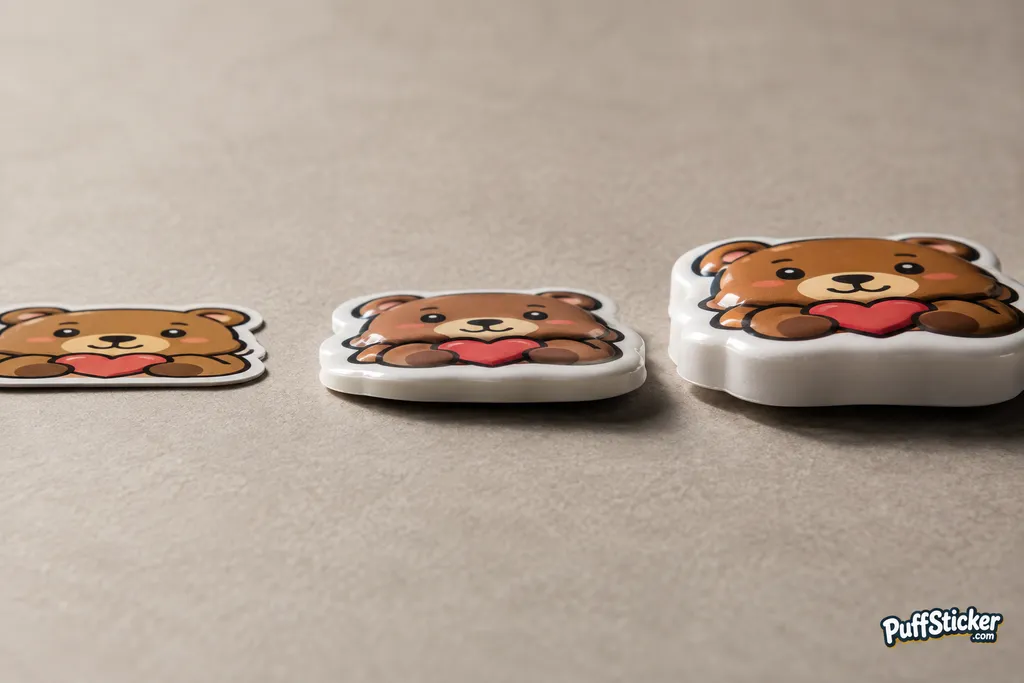
Hold two stickers side by side. One is a thin, flat square that barely lifts off your fingertip. The other has a little give to it, a soft dome you can feel before you look down at it. You haven't read either design yet. You already like one better, and you probably can't say why.
That reaction isn't about the artwork. It's about thickness, and thickness turns out to be doing more talking than most people realize.
Weight Has Always Meant Something
Long before anyone put a sticker on a laptop, people were reading weight as a stand-in for importance. A heavier book feels more serious than a thin pamphlet, even if the pamphlet says something smarter. A thick wool coat feels like it was made to last, while a flimsy one feels like it was made to sell. Researchers who study embodied cognition, the idea that we think partly through our bodies and not just our heads, have shown this isn't just a figure of speech. In a well known study led by psychologist Nils Jostmann, people holding a heavier clipboard judged unrelated questions, like the importance of a country's currency policy, as more serious than people holding a lighter one. The weight in their hands leaked into the weight they gave the idea.
A sticker is a much smaller object than a clipboard, but the same wiring is still switched on. A thicker sticker, one with real dimension to it, borrows a little of that same authority. It doesn't need to say "premium" anywhere on it. The thickness says it first.
Thin and Thick Are Saying Different Things
Here's where it gets interesting. Thickness isn't just a dial between "cheap" and "expensive." It has a personality of its own, and different amounts of it say different things.
A very thin, flat sticker can read as confident rather than cheap, if the rest of the design earns it. Think of a minimalist logo on a laptop, printed flush and quiet. The thinness says: I don't need to raise my voice. That's a real personality, understated and sure of itself.
Move up slightly, to a sticker with the faintest lift, barely enough to notice under a finger, and the tone shifts. Now it feels considered rather than plain, like something someone chose rather than defaulted to.
Go further, into genuinely puffy territory, where the surface rises enough to invite a thumb to press down on it, and the personality changes again. Now it feels playful, warm, a little indulgent. This is the register where puffy stickers live, with their soft, raised foam center built specifically to create that squishy texture, a sensory experience that all but asks to be touched. Nobody has to write "fun" on a sticker like that. The foam already said it.
None of these three versions is more correct than the others. They're simply speaking in different registers, the way a font can whisper or shout depending on its weight, or a voice can be hushed or booming depending on how much air is behind it. Thickness is a kind of vocabulary, and a designer choosing it is making a tonal decision whether or not they think of it that way.
Consider a small candle company deciding how to label its jars. A completely flat sticker would feel almost clinical next to the warmth the candle is supposed to sell. A fully puffy one might feel too playful for a product people buy to relax with, not to bounce around with. The middle ground, a gentle lift that's noticeable but not bold, ends up matching the mood better than either extreme. That's not a coincidence. It's the same instinct that makes someone choose a mid-weight cardigan over a parka or a t-shirt for a dinner that's casual but not sloppy. The body already knows how to read degrees, even when the mind hasn't caught up.
Why This Feels Like Something New, Even Though It Isn't
People have always dressed for the message they wanted their clothes to send, choosing a heavy wool suit for one meeting and a light linen shirt for another. What's changed is that this instinct now shows up on objects as small as a sticker. A water bottle covered in thin, flat decals reads differently than the same bottle covered in puffy ones, even if the artwork is identical. One feels tidy and low key. The other feels loud and a little joyful. People are choosing between those two moods more deliberately than they'd ever admit out loud, the same way someone picks a font weight for a wedding invitation without being able to explain the difference between medium and bold.
This is also why the same brand might reach for different thicknesses in different places. A tech company might keep its laptop stickers flat and understated, matching the confident-minimalist register, while going puffy and tactile on stickers meant for a kids' product line or a playful side project. The thickness isn't an afterthought tacked onto a finished design. It's doing part of the communicating.
 Same laptop, two registers: the flat decal reads tidy and low-key, the puffy one loud and a little joyful.
Reading the Room With Your Fingers
What makes this stranger, and more interesting, is that people register thickness before they consciously notice it. Your hand knows a sticker is puffy a fraction of a second before your brain files a verdict about the brand behind it. That's part of what makes thickness such an honest signal. It's harder to fake enthusiasm with a physical dimension than with a slogan. A company can write "we love keeping things fun" on their packaging, but if every sticker they ship is flat and clinical, the two messages contradict each other, and the fingers will believe the sticker over the copy every time.
This is close to what happens with a raised logo turning into what Why Some Custom Stickers Feel Like Objects called a small object rather than an image, and it echoes the involuntary pull toward touch described in The Reflex to Touch a Raised Surface. But neither of those pieces asked what the amount of thickness itself was communicating, only that thickness existed at all. Once a surface crosses into raised territory, the question stops being flat versus dimensional, the line When Does a Custom Sticker Stop Feeling Flat? drew so carefully, and starts being a much finer one: dimensional in which direction, and how much of it.
This is also why mismatched thickness can quietly undercut a brand without anyone being able to point at what went wrong. Picture a wellness label promising softness and calm, printed on a sticker so thin it might as well be paper. The words say one thing. The fingers say another. Most people won't consciously notice the contradiction, but they'll feel a faint dissonance they can't name, the same way a limp handshake undercuts an otherwise confident introduction. Thickness doesn't have to match the message perfectly, but when it actively contradicts it, the sticker is quietly working against its own copy.
Choosing a Thickness on Purpose
For anyone actually deciding how thick to make a sticker, the useful question isn't "does thicker look better." It's "what personality am I trying to hand someone before they've read a word." A brand built on restraint and precision probably wants to stay closer to the thin end, where the confidence lives. A brand built on comfort, nostalgia, or play has good reason to lean into real puffiness, where the softness itself becomes part of the pitch. Somewhere between the two sits a whole range of options for anyone who wants a middle register, warm but not childish, tactile but not loud.
None of this needs to be treated like a science, and it shouldn't be reduced to a formula. But it's worth remembering that a customer's thumb will form an opinion before their eyes finish reading the label, and that opinion is being shaped by a decision someone made about height, measured in fractions of a millimeter, long before the design ever got approved.
It also helps to think about where the sticker will actually live. A sticker meant for a laptop gets touched constantly, brushed by a palm dozens of times a day, so its thickness is doing ongoing work every time someone reaches for their keyboard. A sticker sealing a shipped box might only be touched once, at the moment of opening, which means that single touch has to carry the entire impression. The stakes of the decision change depending on how many chances the thickness gets to make its case.
 The whole argument happens in fractions of a millimeter, height the thumb reads long before the eye does.
 One vocabulary, three volumes: quiet, considered, and playful are heights, not just adjectives.
The Business Case Nobody Puts on a Spec Sheet
There's a quiet advantage in all this for anyone ordering stickers for a product or a campaign. Thickness is one of the cheapest ways to change how something feels without changing what it says. The words on the sticker can stay exactly the same. The image can stay exactly the same. Adjust only the height of the surface, and the emotional temperature of the whole object shifts with it. That's a lever most people never think to pull, mostly because it hides in a spec they treat as an afterthought rather than a decision.
 Change only the height of the surface and the emotional temperature of the whole object moves with it.
A Small Object, Doing a Lot of Work
Pick up that first pair of stickers again, the thin one and the puffy one. Neither is lying to you. Each is simply telling you something true about the personality behind it, in a language older than words, one your hand learned before your eyes did. The next time a sticker feels like more than a picture, it's worth asking not just whether it's raised, but by how much, and what that particular amount was trying to say all along.
 A quiet before-and-after: the flat paper sticker and the raised dome that learned to say more with height.