
When Does a Custom Sticker Stop Feeling Flat?
A raised sticker crosses from flat to dimensional at one precise point, not a gradual slide. Here's the perception science behind dimensional custom stickers.
Manufacturer · Prepress & production
When Does a Custom Sticker Stop Feeling Flat?
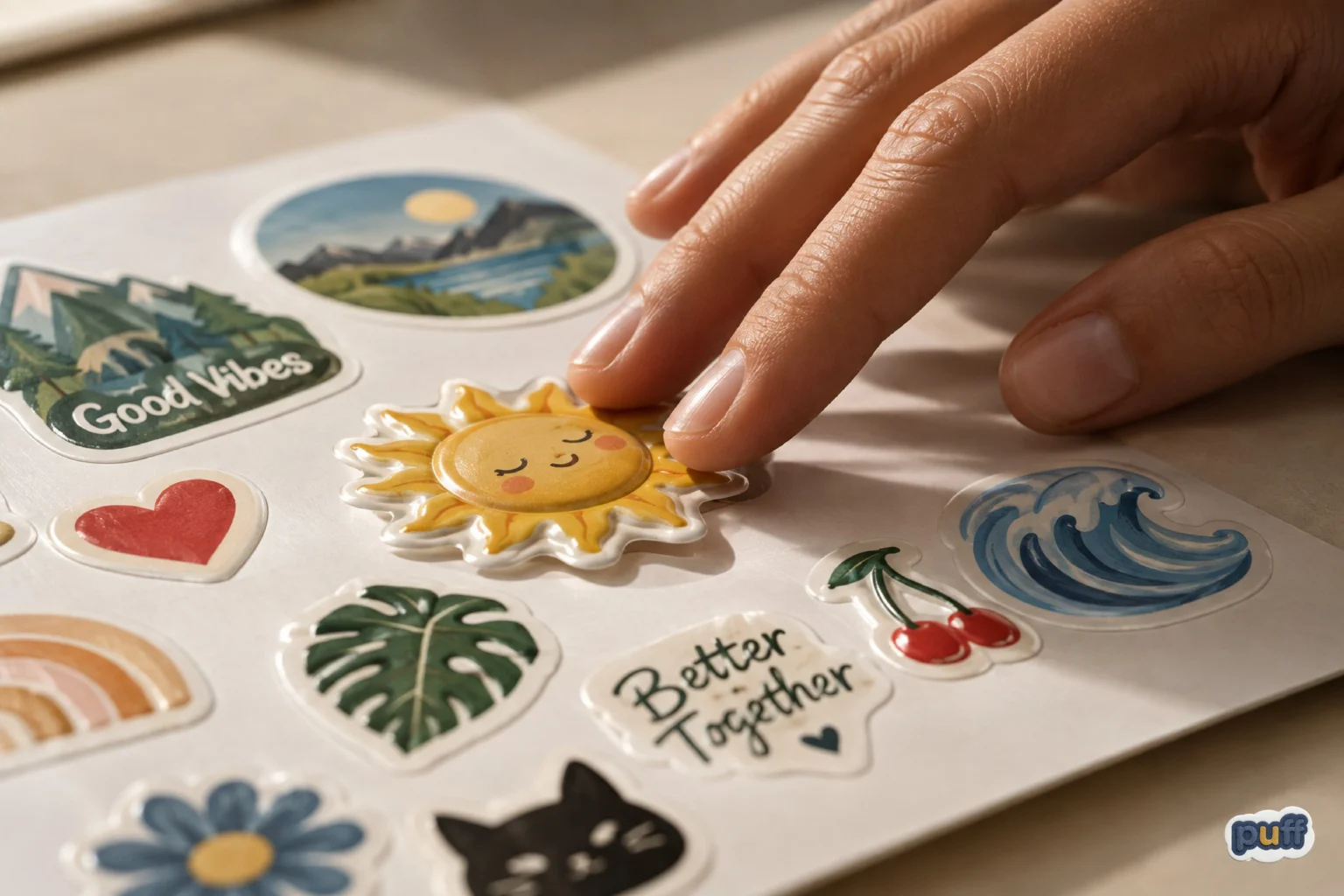
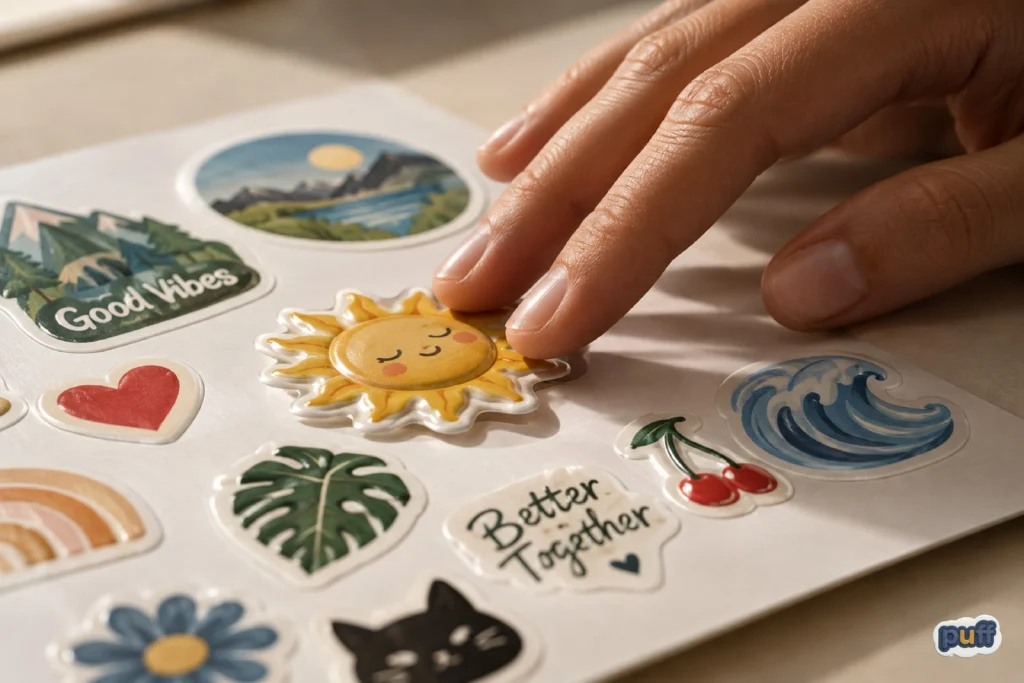
Run your thumb across a sheet of stickers with your eyes closed. Most of them do nothing under your skin, a thin layer of vinyl on paper, giving nothing away. Then one stops you. A shallow rise, not even a full millimeter, and something in your hand has already decided this one is different before your mind gets a vote.
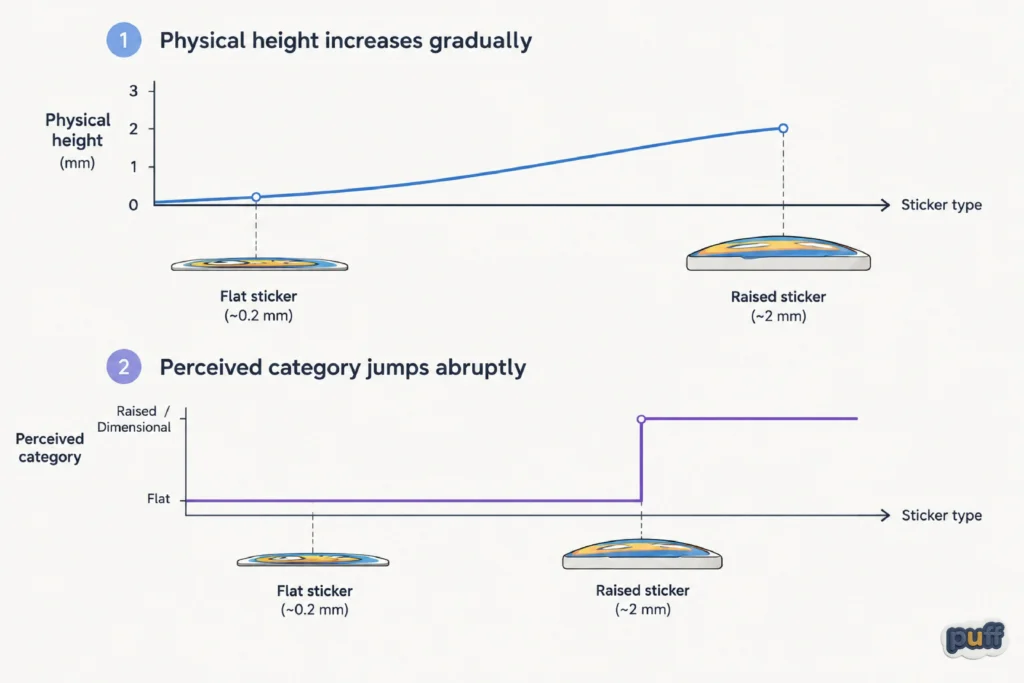
That decision happens fast, and it happens all at once. There is no in-between moment where a surface feels a little more raised than the last one. One second it feels flat. The next second it doesn’t. Nothing gradual sits between those two states, even though the physical change that caused them can be smaller than the width of a human hair.
This is strange once you sit with it. Height is continuous. A manufacturer can raise a surface by a tenth of a millimeter or a hundredth, any amount in between. But the feeling of flat versus raised isn’t continuous at all. It snaps, the same way a light switch snaps rather than dims.
A Line, Not a Slope
Psychologists have studied this kind of snap for well over a century, though their tools were tones and weights, not stickers. Push a sound louder in small steps and a listener won’t hear it climb in a smooth line. They’ll hear silence, then at some point, sound.
Add grains of sand to one side of a scale and the person holding it won’t feel the balance tip by degrees. They’ll feel level, then unlevel. The smallest change a person can detect has a name, the just-noticeable difference, first measured by researchers trying to work out how sensation and physical stimulus relate to each other at all.
A custom sticker follows the same rule. Why Some Custom Stickers Feel Like Objects already made the case that a raised surface stops behaving like a picture and starts behaving like a small object in its own right. What that piece didn’t get into is where the line sits.
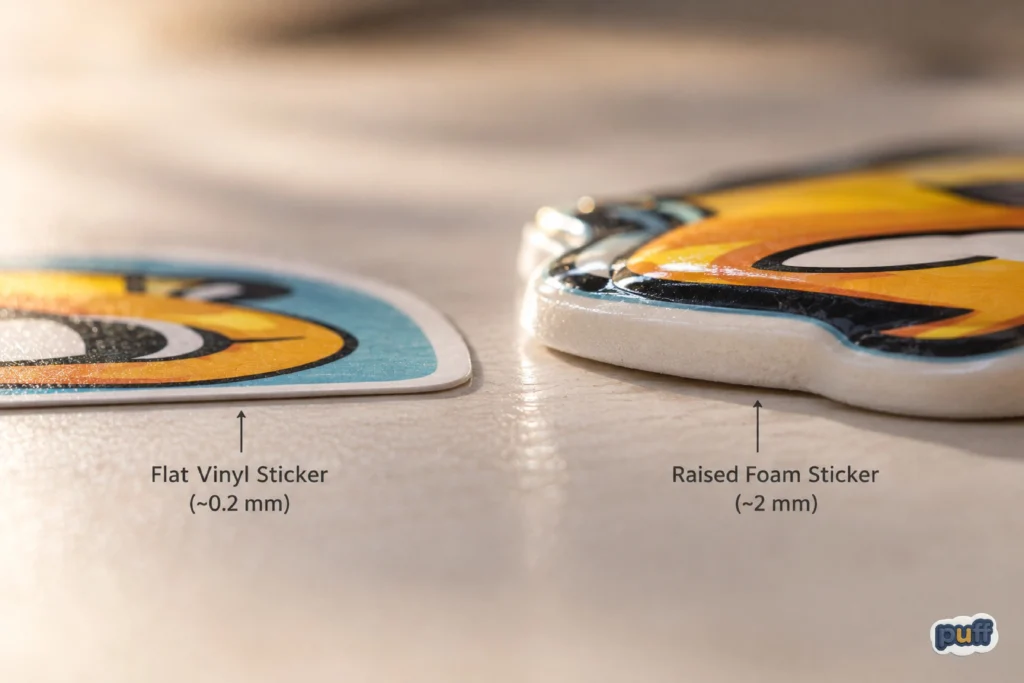
Somewhere between a sheet of custom vinyl and a domed epoxy label is a point where a raise stops registering as texture and starts registering as shape. Below that point, a finger notices roughness, print quality, maybe a coating. Above it, the finger notices an object sitting on top of another object. The manufacturer sees a gradient of possible heights. The hand sees two categories and nothing in between.
Anyone who has dug through a childhood drawer of stickers has felt this without naming it. Kids sort sticker sheets by feel as much as by picture, running a nail over the good ones before deciding they’re the good ones. The sorting isn’t random. It’s a small, unconscious vote for whichever side of the line a sticker landed on.
What the Body Decides Before the Mind Does
None of this requires conscious thought, which is part of what makes it worth noticing. A person doesn’t run a calculation to decide a surface has crossed into raised territory. The decision arrives finished, the way color arrives finished. You don’t work out that grass is green. You just see green.
The Reflex to Touch a Raised Surface looked at why a raised sticker pulls a hand toward it before a person decides to reach. This is the other half of that reflex: once the hand arrives, it doesn’t measure the surface so much as sort it.
Researchers who study touch have spent decades mapping this kind of boundary for raised patterns and textures, tracing back to work by Mark Hollins and colleagues on how the fingertip separates surfaces into categories well before the brain’s slower, more deliberate systems weigh in. The fingertip is doing classification work, not measurement work. It isn’t asking how many microns something rises. It’s asking which pile this goes in.
That distinction matters for anyone designing a physical product, because it means small increases in height don’t buy small increases in perceived quality. A sticker sitting just under the threshold might as well be flat, no matter how much material and cost went into that extra fraction of a millimeter. A sticker sitting just over it gets treated like a different object, not a better version of the same one. A brand can spend real money closing a gap that a customer’s hand will never register, or spend a little more and land somewhere the hand notices right away.
Why Some Raises Barely Register
This explains something that puzzles a lot of first-time buyers of custom stickers: two products with similar specs can feel worlds apart. A PU embossed sticker, built around a structured, leather-like surface, sits well past the threshold most people can detect by touch alone. The convex elevation isn’t subtle once a finger finds it, and that’s by design. It was built to clear the line with room to spare, not to tiptoe up to it.
The same principle shows up in different materials for different reasons. A foam sticker clears the threshold through softness, a plush-like give under the finger that a hard surface could never fake. A dome decal clears it through smoothness instead, a crystal-clear resin surface that rounds off into a shape the hand can trace with one motion. Neither one is trying to be the loudest version of raised. Each is aiming at a specific, deliberate distance past the line, calibrated to a particular kind of premium feeling rather than a maximum one.

Compare that to a printed texture meant to simulate depth without any real raise at all. No matter how convincing the shading looks from a foot away, a finger will find nothing there, and the illusion falls apart the moment it’s touched. The eye can be talked into a false sense of depth with contrast and shadow. The hand can’t be talked into anything. It only responds to what’s there, which is part of why Soft Depth vs Smooth Depth found puffy and epoxy stickers landing as more premium, more convincing, than anything relying on print alone.
Context shifts the line as well, and this is the part that trips people up. A raise that feels dramatic against a smooth matte background can feel almost ordinary next to a domed surface, because the hand isn’t measuring absolute height. It’s comparing whatever it just touched to whatever it touches next. Someone who has spent an afternoon handling epoxy stickers needs a taller raise to feel surprised than someone who has spent the afternoon handling plain paper labels. A packaging designer who tests a new label against last year’s flat version is testing against a moving target, not a fixed one.
Designing for the Line
None of this is a reason to chase height for its own sake. Plenty of the most satisfying custom stickers, including the flat ones people assume are the boring option, work because they commit to one side of the line instead of hovering near it. The goal was never to get as close to raised as possible while spending the least money. The goal is knowing which category you’re aiming for and landing inside it, not near it.
That’s a design decision as much as a manufacturing one. A brand chasing genuinely dimensional custom stickers needs enough raise to clear the threshold with margin, not just enough to argue about on a spec sheet. A brand that wants something clean and understated can lean into custom vinyl and skip the ambiguity altogether, since a confident flat surface holds up better over time than a raise too small to convince anyone it was intentional. Sitting near the line is the one option that satisfies nobody, because it looks like an attempt that didn’t quite land, rather than a choice.
There’s a practical lesson in this for anyone ordering a first production run. Creeping a design upward in tiny increments, testing a fraction more height with each sample, treats the problem as if it were a slope you climb one careful step at a time. It isn’t. A handful of samples spread further apart, some well under the line and some well over it, will tell you more in one round than a dozen samples clustered around a guess. Once you know which side of the threshold you want, you can spend the budget putting real distance between the sticker and the border, instead of hugging a line only a lab instrument could measure.
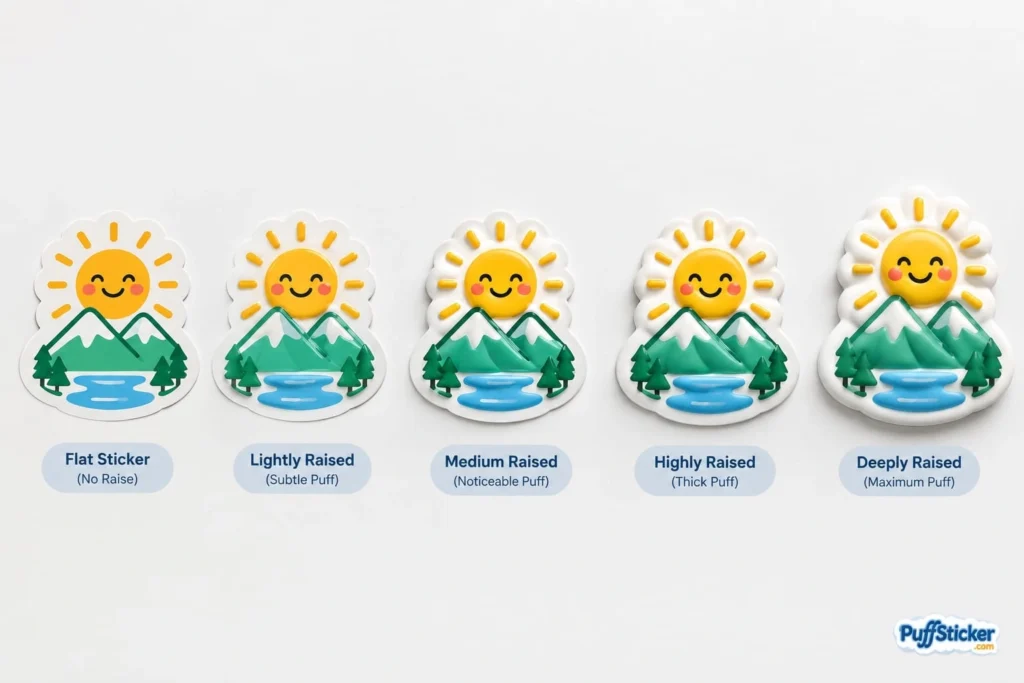
What’s easy to miss is that the line itself isn’t fixed. It moves with what a hand touched a moment ago, with expectation, with whatever else sits nearby on a shelf or inside a package. Two people running the same thumb over the same sticker at different points in their day could land on opposite sides of flat and not flat, and neither would be wrong. The threshold is real, but it isn’t a property of the sticker alone. It belongs to the moment the finger arrives.
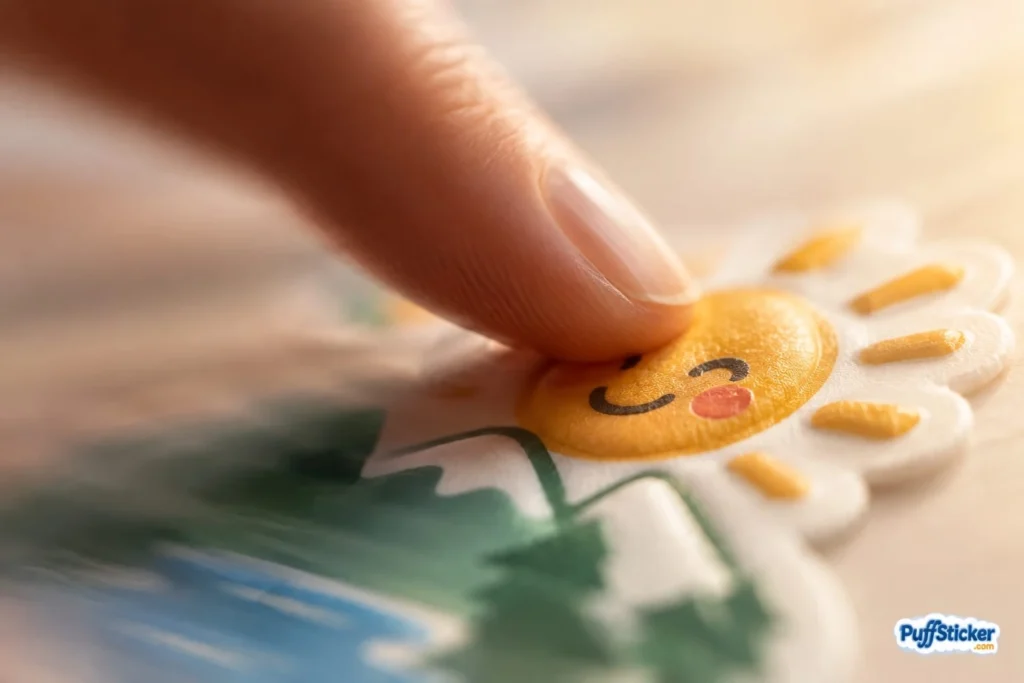
That’s worth remembering the next time something in your hand surprises you before you’ve even looked at it. The surprise isn’t a lapse in your attention. It’s your nervous system doing what it was built to do, sorting the world into categories fast enough that you never notice the sorting happen at all.