
The Quiet Bag: Why Not Every Package Needs to Shine
At a Saturday market, there is always someone carrying a bag that has been everywhere. Nobody stops to look at it, and yet it is one of the most successful pieces of packaging in the whole market.

At a Saturday market, there is always someone carrying a bag that has been everywhere. The jute has gone soft at the corners. The handles have taken on the shape of one particular shoulder. A printed logo, once crisp, has faded to the color of weak tea. Nobody stops to look at it, and yet it is one of the most successful pieces of packaging in the whole market.
Compare it with the glossy gift bag folded in the back of your closet. It was beautiful for about an afternoon. It caught the light, it rustled when you lifted it, and it made the thing inside feel like an event. Then the event ended, and the bag went into a drawer with the others, still perfect, never used again.
These two bags are doing very different jobs, and the difference has less to do with material than with time. A shiny package speaks at full volume and spends its whole voice in the first few seconds. A quiet bag speaks softly, but it keeps talking for years. This is the idea at the heart of quiet packaging: some bags are built to win a moment, and some are built to stay.
The Volume of a Package
Walk down any shop aisle and you can almost hear the shelves. Bright foil, saturated color, high gloss, bold type. Every package is trying to be the one your eye lands on first, and the competition pushes everything a little louder each year. In that setting, shine works. It catches movement, it signals newness, and it tells you that someone spent money on the box.
But volume has a cost. A loud package says everything it has to say at once. Once you have noticed it, picked it up and carried it home, it has nothing left to tell you. Its job ends at the moment of choice, and what remains is something to open, empty and throw away.
Some packaging even speaks in a literal voice. A metallized pouch has a crisp, bright crinkle, the kind of sound that makes a mylar bag recognizable with your eyes closed. That sound is part of its charm and part of its message: fresh, sealed, protected. Fabric and fiber bags work in a different register. Jute barely whispers when you lift it. Canvas folds without a sound. A paper bag gives a soft, dry rustle and then goes quiet.
It helps to think of a package as having a volume knob rather than a quality score. Turning the volume up does not make a bag better, and turning it down does not make it worse. It changes when and how the bag gets heard. Loud bags are heard all at once, in a crowded room. Quiet bags are heard in installments, one ordinary afternoon at a time.
Quiet bags are also much older than loud ones. Long before printed laminates, people went to market with string bags, woven baskets and cloth sacks that lasted for years and were mended when they tore. Many of us still remember a grandmother's shopping bag, the same one every week, hanging by the kitchen door between trips. It was never thought of as packaging. It was simply the bag, as much a part of the house as the kettle. The single-use, high-shine bag is the newcomer in this story, and in many places people are now drifting back toward the older habit, not out of nostalgia alone, but because a bag you keep makes a kind of sense that a bag you throw away never quite does.
That shift is easy to miss. When we judge packaging only by how well it competes on a shelf, we miss the bags whose real work begins after the shop door closes behind you.
A Family of Quiet Materials
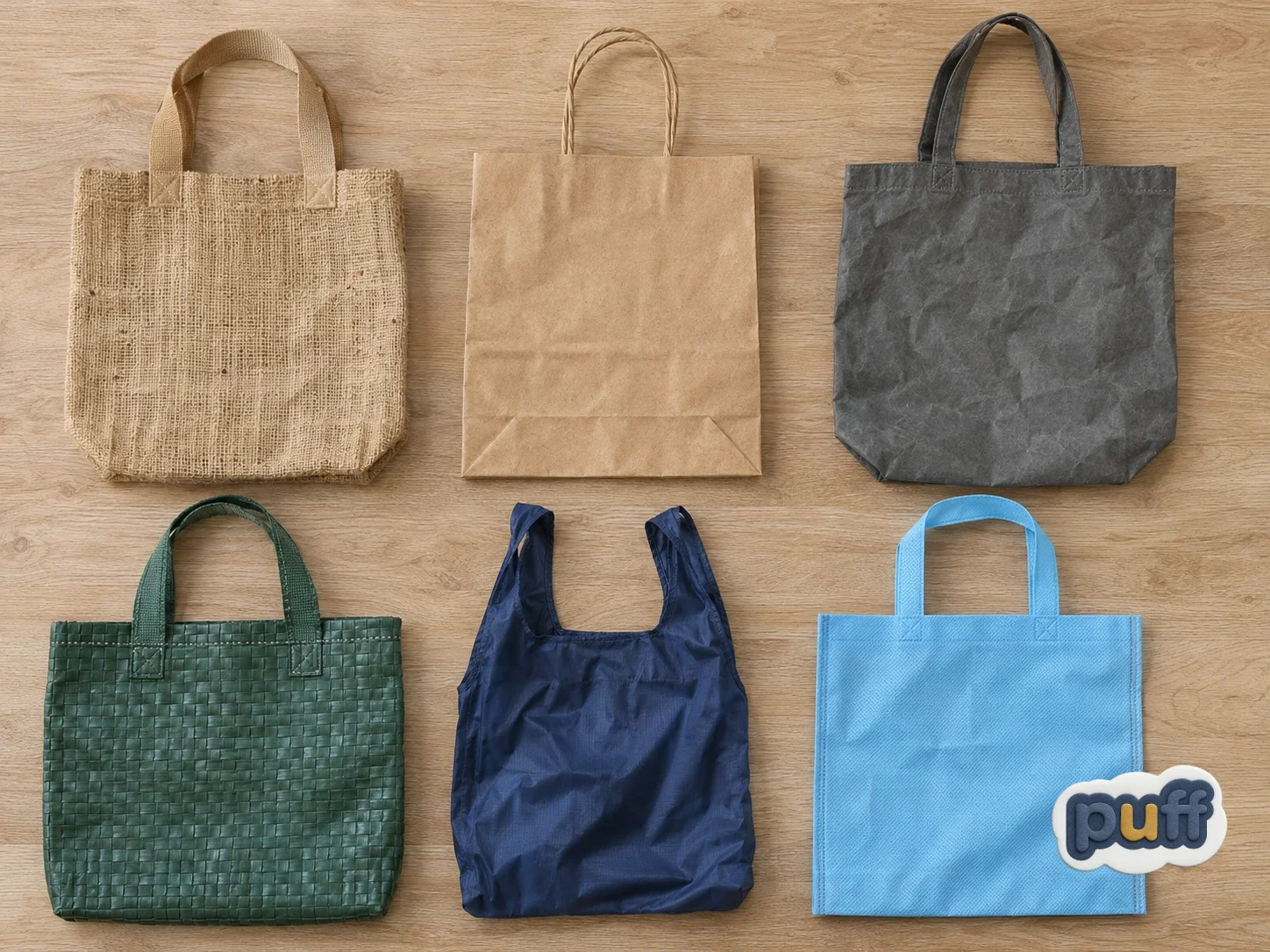
Lay a handful of everyday bags out on a wooden table and they start to look like a family. None of them shine, yet each one has its own way of being quiet.
Jute is the warm one. Its fibers are coarse and uneven, with small flecks and knots that remind you a plant grew here once. When you choose a jute bag woven with golden thread, you get something that feels rustic yet fashionable, rough enough to feel honest and neat enough to carry into a shop or an office. It is the bag that looks at home next to bread, flowers and a pair of worn boots.
Paper is the familiar one. A plain paper bag carries a long memory of bakeries, bookshops and corner stores, which is part of why it feels kind and unfussy. Kraft brown, in particular, has become a visual shorthand for "natural", though as we looked at in What a Kraft Look Actually Tells Us About a Package, that color now gets printed onto all sorts of materials that share none of paper's properties. A real paper bag is strong, recyclable and easy to print on, and its quiet comes from simplicity. It does not pretend to be anything else.
Washable paper is the surprising one. It looks like paper and handles a little like soft leather, with a gentle crumple that deepens each time you use it. It brings a kind of leather elegance without any animal hide, and it ages in a way that most people do not expect from something called paper.
Woven bags are the sturdy ones. Their tight criss-cross weave says "I can take it" before you put anything inside. They are tough and weather-resistant, the bag you trust with a heavy load of groceries in the rain.
Nylon is the smooth one. It has a soft sheen without real shine, a fabric that sheds water and folds down into a pocket. Its quiet is practical, almost invisible, the bag you forget you are carrying until you need it.
Non-woven bags are the light ones. Made from pressed fibers rather than woven threads, they are durable and lightweight, often the bag handed out at an event or a trade fair, and often the one that ends up as somebody's gym bag for the next three years.
Put them side by side and a pattern appears. None of these bags is trying to stop you in your tracks. Each one is offering a kind of company. They are less like a billboard and more like a good coat, something you reach for without thinking because it has never let you down.
Where the Eye Can Rest
There is a reason a room full of glossy surfaces can feel tiring. Shine is made of small, moving highlights. Every time you shift your head, the light slides across the surface, and your eye follows it, because the brain treats movement and change as things worth checking. That is useful on a crowded shelf. It is less pleasant on something you look at every day.
Matte fibers behave differently. They scatter light evenly, so the surface stays calm as you move around it. Your eye lands, takes in the texture, and is free to move on. We looked at the matte side of this story for stickers in The Psychology of Quiet Surfaces, but with bags the effect plays out over a much longer stretch of time. You are not looking at a bag for a few seconds. You are living with it.
Psychologists call the way our attention fades on repeated exposure habituation. The first time you see something bright, it grabs you. The tenth time, it grabs you a little less. By the hundredth time, the shine that once impressed you has become background noise, and sometimes a mild irritation. Quiet materials skip that curve. They never asked for your full attention in the first place, so there is nothing to wear out. What they offer instead is closer to comfort: the steady, low feeling of an object that fits into your day without demanding anything from it.
Think of the hook by your front door where the everyday bags hang. Most people do not choose what goes there by asking which bag is the most beautiful. They keep the ones that are easy to look at every morning, the ones that do not clash with the coat beside them or demand a second glance on the way out. Over time, that hook becomes a small collection of the quietest things you own. It is a gentle kind of editing that happens without a plan, and it says a lot about what we really want from the objects that share our space.
This is something older design traditions understood well. The Japanese idea of wabi-sabi finds beauty in things that are simple, a little imperfect and quietly marked by time, the cracked glaze on a tea bowl, the uneven edge of handmade paper. A jute tote with a slightly crooked weave fits that way of seeing far better than a flawless foil bag ever could. Its small irregularities are not mistakes to hide. They are part of why it feels human.
There is also a gentler kind of trust at work. When a surface does not shout, we tend to assume it has nothing to hide. That assumption can be wrong, and we will come back to that, but it explains why quiet bags so often feel more sincere than shiny ones, even before we know anything about what they are made of.
Calm You Can Hold
Close your eyes and pick up a jute bag, and then a glossy laminated one. Before you think about either, your hand has already formed an opinion.
The laminated bag feels cool and slick. Your fingers slide a little on its surface, and the stiff sheet pushes back when you fold it, holding a crease like a sharp elbow. It is pleasant enough, but it feels like a product, something made to be looked at more than handled.
The jute bag feels warm almost at once. Natural fibers do not pull heat from your skin the way a smooth coated surface does, so the bag seems to meet you at your own temperature. Its texture gives your fingertips something to read, small ridges and knots that slow your touch down. When you fold it, it gives way instead of fighting back. When you set it down, it slumps a little, like a coat dropped over a chair.
Those small sensations matter more than we tend to admit. An object that feels warm and yielding in the hand reads, at some deep level, as safe to keep close. It is the same reason we choose wool blankets and wooden spoons for the most personal corners of our homes. A quiet bag earns a place on your shoulder in part because it feels like it belongs there.
Weight plays a role too. A good woven or jute bag has a little heft even when empty, enough to feel sturdy but not enough to feel like a burden. A paper bag has almost none, which is part of its gentle, temporary charm. Nylon disappears into your hand. Each one tells your body what kind of relationship to expect: a long one, a brief one, or one that stays in the background until you need it.
Wear as Addition, Wear as Subtraction
Pick up two bags that have each been used for a year. One is a glossy laminated shopping bag. The other is a cotton or jute tote. Look closely, and you can read their histories in very different ways.
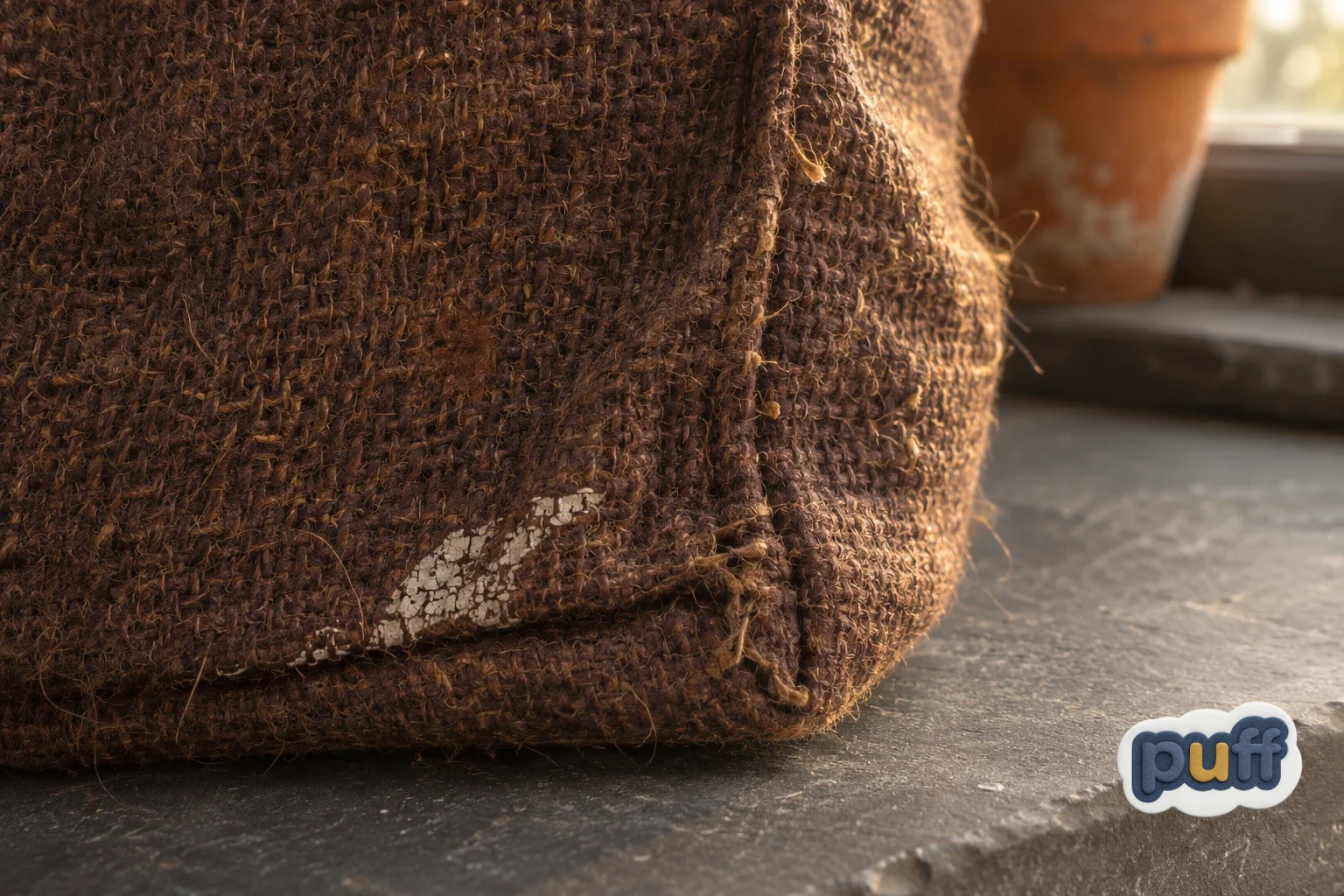
The glossy bag shows its year as damage. White stress lines run along every fold. The corners are scuffed down to a dull gray. A scratch catches the light in exactly the place where the logo used to gleam. Every mark is a small loss, a step away from the perfect object it was on the first day.
The jute bag shows its year as character. The fibers have softened. The handles have relaxed into a curve. The color has mellowed, and a small stain from a spilled coffee has turned into something you barely notice, the way you stop noticing a scar on a favorite table. Nothing about it looks worse. It looks used, and used in a way that suggests it was loved.
This gives us a simple test for any bag: does wear add to it, or subtract from it? Some materials, like high gloss, metallic finishes and bright printed laminates, are at their best on day one and lose value from there. Others, like jute, canvas, washable paper and many woven fabrics, start out a little plain and grow into themselves. The first kind of bag is a peak. The second kind is a slope that keeps climbing.
Designers have a name for the second kind of object. The design researcher Jonathan Chapman has written for years about emotionally durable design, the idea that the things we keep longest are the ones that build a relationship with us over time rather than the ones that impress us at first sight. A bag that ages well fits his thinking well. Each trip to the market, each rainy commute, each forgotten receipt in the side pocket becomes part of a shared story between the bag and its owner.
That story is the hidden value of quiet packaging. A shiny bag can only stay the same or get worse. A quiet bag has room to get better, and people sense that, even when they would never put it into words.
The Bag That Goes Home With You
A box usually ends its life in the kitchen. A quiet bag starts its real life there.
Once it leaves the shop, a reusable bag becomes part of somebody's routine. It goes to work, to the library, to the beach, to a friend's house with a bottle of wine inside. Along the way it gets seen by hundreds of people who never set foot in the shop where it came from. That is why jute bags and non-woven bags are so often described as a walking or mobile advertisement. The phrase sounds like marketing, but it describes something real about how these bags travel.
The interesting part is the kind of attention they get. Nobody on a train stares at a canvas tote. They glance, register the name or the little printed mark, and look away. It is a soft, repeated contact rather than one big impression. Over months, those small glances add up into a kind of familiarity that a loud shelf display struggles to buy. You start to recognize the bag before you can say where you have seen it.
If you are choosing a quiet bag, for yourself or for a small business, it helps to match the material to the life it will lead. Jute suits market runs and weekend errands, because it handles the lumpy shapes of market shopping and looks better the more it is used. Woven bags suit big grocery trips in all weathers, since they shrug off rain and rough handling without complaint.
Washable paper fits small boutiques and gift shops, where you want a calm, polished feel without reaching for gloss. Plain paper bags make sense for takeaway and everyday retail, where a bag needs to be simple, printable and easy to recycle once it has done its one trip. Nylon earns its place in a handbag or a coat pocket, folded small for the day you buy more than you planned. Non-woven bags work well at events and fairs, light and sturdy and affordable enough to hand out by the box.
A useful habit is to picture the bag six months from now. Where is it? On a hook by the door, under a car seat, in a drawer of bags nobody touches? The answer tells you more about the right material than any swatch book will.
None of these choices is about finding the most impressive bag. Each one is about finding the bag that will still be in use a year from now, because that is when a quiet bag does most of its work.
Quiet Is Not the Same as Honest
A row of jute totes in a shop window can look like a promise, all warm browns and soft weave, as if the bags themselves were telling you they are the good choice. It would be easy to believe them and call quiet bags the good ones and shiny bags the bad ones. That would be too simple, and a little unfair.
A matte, earthy surface tends to feel sustainable, but the feeling is not proof. We explored this trap in Why "Paper Is Better" Isn't a Complete Packaging Argument: the materials that look most natural are not always the ones that do the least harm. A reusable bag only earns its footprint by being reused, often many times over. A jute tote that sits unused in a cupboard has done less good than a humble paper bag that went home once and into the recycling bin.
So the quiet look is a starting point, not a verdict. The honest version of a quiet bag is one that matches its gentle appearance with a long, useful life. The dishonest version borrows the color and texture of calm without the durability that makes calm worth anything.
There is a second reason not to dismiss shine. Some products need protection that fiber and fabric cannot give. Coffee, tea, snacks and dried herbs need a sealed barrier against air, moisture and light, which is exactly what a metallized or laminated pouch provides. A beautiful jute tote cannot keep coffee fresh. In those cases, the loud package and the quiet bag are not rivals. They are partners. The sealed pouch protects the product on the inside, and the quiet bag carries it home and keeps living after the pouch is empty.
Shine also has a rightful place in celebration. A wedding favor, a birthday gift, a holiday launch: these are moments that are meant to feel bright and brief. Nobody needs a gift bag to age well. They need it to make one evening feel special. The mistake is not using shine. The mistake is using shine for things that are supposed to last.
A Brand That Speaks Softly
Picture two bags on a shop counter, one with a logo the size of a dinner plate, the other with a mark no bigger than a postage stamp. For a small brand, that picture changes the question you ask about packaging. Instead of asking "How do we stand out on the shelf?", you can also ask "What will people be happy to carry for the next two years?"
Those two questions lead to different designs. A shelf-first bag wants a big logo, bright colors and as much contrast as the printer can manage. A life-first bag often wants the opposite: a smaller mark, a calmer palette, and a design the owner can wear without feeling like a billboard. People will gladly carry a bag that looks good with their coat. They are far less keen to carry one that shouts a company name at everyone on the bus.
This is where a soft-spoken bag becomes a form of confidence. A brand that prints a small, well-placed mark on a sturdy jute or woven bag is saying, in effect, "We trust you to remember us." It is a polite way to be present. It does not grab your sleeve. It walks beside you.
The details of a quiet design are small, but they add up. A single print color often looks calmer than four. A mark placed low on the side of a tote feels more like a signature than a sign. Matching the ink to the natural tone of the fiber, a deep brown on jute or a soft cream on green weave, lets the logo sit inside the material instead of on top of it. Even the handles speak. Wide, soft straps say "carry me all day," while thin cords say "this is a short trip." None of these choices shout, yet each one shapes how the bag feels to the person carrying it, and how long they choose to keep it.
And because the bag improves with wear, the brand's mark ages along with it. The logo that fades a little on a well-loved tote is not a sign of failure. It is a sign the bag was chosen again and again, which is the strongest kind of endorsement any piece of packaging can earn.

The Long Voice
Go back to that Saturday market and the bag with the soft corners and the tea-colored logo. It never won a design award. It never caught anyone's eye across a crowded room. And yet it has been seen more times, carried further and trusted more than almost any glossy bag ever made.
That is the quiet bag's secret. It does not compete for the moment. It wins by staying. Every package has a voice, and some voices are meant to be loud and brief, like a cheer at the end of a race. Others are meant to be low and steady, like someone humming in the next room while you work. You do not stop to listen to that humming. You only notice how much you miss it when it goes away.
There is a gentleness in that sort of design. A quiet bag asks very little of the person who owns it. It does not need to be kept clean to stay beautiful, or tucked away to stay perfect. It can be dropped on a kitchen floor, stuffed with wet towels after a swim, or lent to a neighbor and returned a week later with a few new creases. All of that only makes it more itself.
The best packaging, in the end, may be the kind we stop seeing as packaging at all. Not because it disappeared, but because it became part of our lives.