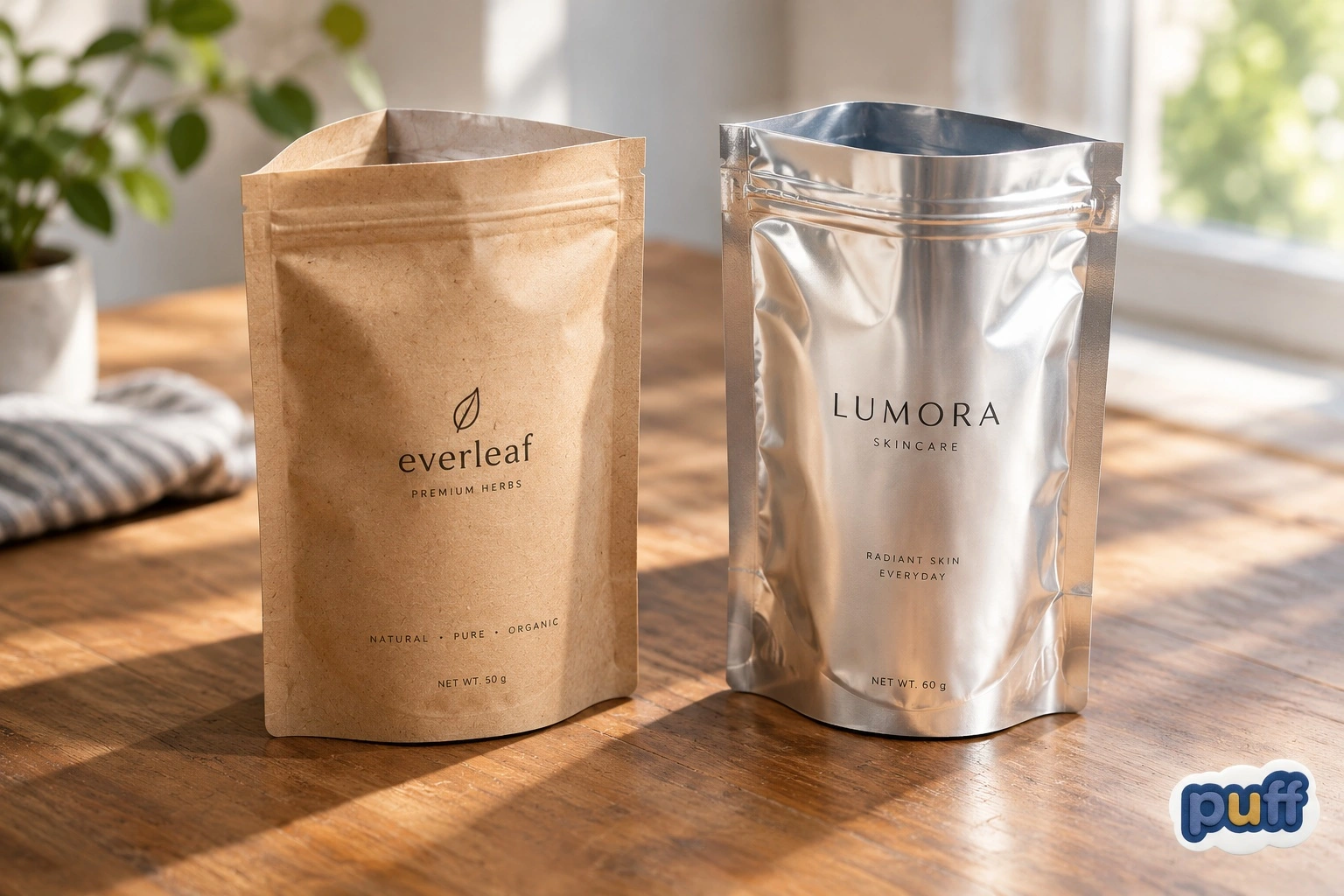
You are standing in front of a shelf with coffee in one hand and tea in the other. One bag is brown and matte, the paper rough under your thumb. The other is silver, cool, faintly reflective. Before you read a single word on either label, you have already decided which one is better for the planet. It is the brown one. It almost always is.
That instinct is fast, confident, and wrong more often than anyone likes to admit. It also isn’t really about the planet at all, not at first. It’s about what the bag in your hand says about you, standing there, choosing. The brown bag says you thought about it. The silver one, however good the product inside actually is, doesn’t get to say anything until you already own it.
The Bag as a Kind of Speech
Packaging has become one of the few places left where a brand gets to speak before anyone has used the product. It shows up in unboxing videos, in gift exchanges, in the split second a customer decides whether to keep a tote bag or fold it into the recycling. A kraft pouch says something specific in that moment: restraint, care, a brand that thought about more than the sale. That message travels fast, faster than any ingredient list or supply chain page ever will, because it doesn’t ask anyone to read anything. It just has to be held.
None of that is a bad instinct on a brand’s part. Packaging has always carried meaning beyond its function, since long before sustainability entered the conversation. The shift worth noticing is what that meaning has come to stand in for. A generation ago, a nice box signaled quality. Now, increasingly, a certain kind of material signals conscience. The two aren’t the same claim, and a package can make one convincingly while quietly failing the other.
The Speed of a Good Material Story
We judge packaging the way we judge a stranger in the first three seconds of meeting them: on surface signals, not on evidence. Paper reads as honest because you can see what it is made of. The fiber shows. It tears the way wood pulp is supposed to tear. A metallized pouch gives you none of that. It looks manufactured, a little synthetic, even when the film underneath is doing real environmental work. So the two bags get sorted into categories before any real information arrives: natural versus artificial, humble versus slick, good versus bad.
There is nothing wrong with this shortcut in general. Fast judgment is how you get through a day without stopping to analyze everything you touch. The trouble starts when that shortcut gets pointed at a question that actually has math behind it, and packaging is one of those questions.

Four layers, one job. Keeping air, moisture, and light out.
What the Fiber Isn’t Telling You
Here is what a plain kraft paper bag is generally not built to do on its own: block oxygen, hold back moisture, or keep light from reaching what’s inside. Those three things are the reason coffee goes stale, chips go soft, and spices lose their smell long before the date on the label. A barrier film, the kind used in a well-made mylar bag, exists specifically to slow all three of those processes down. It isn’t decoration sitting on top of the product. It is the actual job the package is there to do.
So when a product spoils faster inside the bag that looked like the responsible choice, something gets thrown away that took real land, water, and labor to grow, harvest, roast, and ship in the first place. All of that effort becomes trash, and none of it shows up in the moment you picked one bag over the other at the shelf. The paper bag looked lighter on the planet. Once the wasted product gets counted, the math can say the opposite.
The layers doing that quiet protective work are worth understanding on their own terms, not just trusting. The Complete Guide to Custom Mylar Bags walks through how a barrier film is actually built, layer by layer, for anyone who wants the mechanics behind the claim.
The Waste Nobody Sees at Checkout
This is the part of the sustainability conversation that rarely gets the attention it deserves, because it happens later, quietly, in someone’s kitchen, long after the purchase decision is over. Packaging researchers who study this gap, including Rafael Auras, who holds the Amcor Endowed Chair in Packaging Sustainability at Michigan State University, have spent years making the same point: a package’s environmental footprint can’t be judged by its material alone. It has to be judged by what that material protects, and for how long. A package that is slightly heavier or less obviously natural, but keeps food edible for six extra weeks, can beat a lighter, more compostable one that lets the product spoil early, once everything spent making that product gets counted too.
That logic sits at the center of life-cycle assessment, the practice of tracing a product’s full environmental cost from raw material to disposal instead of judging any single stage on its own. It is a slower, less satisfying way to think about packaging than “paper good, plastic bad.” It is also the more honest one.

One bag stays sealed. The other has been open for days.
One Word, Four Different Tests
Part of why this gets confusing is that “sustainable packaging” is really shorthand for four separate questions, and most conversations answer only one before declaring a winner. Can the bag be recycled where the customer actually lives? Will it break down naturally if it ends up in soil or water? How well does it protect what’s inside, and for how long? And where does the raw material come from in the first place?
A bag can score well on one of these and poorly on the rest. Kraft paper often wins on the first question and the last. A well-engineered barrier film can win on the third by a wide margin. Neither material sweeps every category, no matter how confidently either side of the packaging aisle wants to frame it.
Compostable pouches make the gap especially clear. A bag labeled compostable is telling the truth, but usually only under industrial composting conditions that most cities and most households don’t have access to. Dropped in a home bin or an ordinary recycling stream, that same bag may behave more like ordinary trash than its label implies. Being technically compostable and being practically compostable, for the person actually holding the empty bag, are two different promises wearing the same word.
How a Look Became a Shortcut
Part of the reason paper’s reputation runs ahead of the data is cultural, not scientific. Kraft brown, visible fiber, and a hand-torn edge became the visual language of conscious brands over the last decade, the same way minimalist white space became shorthand for premium design. Once a look gets adopted widely enough, it stops being read as a design choice and starts being read as a fact about the product. A bag doesn’t have to prove it’s better for the earth if it already looks like it grew there.
That aesthetic isn’t dishonest. Paper genuinely does come from a renewable source and genuinely does biodegrade under the right conditions. The problem is narrower than that: the look has started doing work that only an actual comparison of materials should be doing, and a brand’s packaging choice ends up shaped more by what customers will recognize as responsible than by what the product inside actually needs to survive the trip to their door.

Torn paper, backlit gold. The texture behind kraft’s earthy character.
Matching the Bag to the Job
None of this makes paper the wrong choice. For a low-moisture, quick-turnover product like a bakery item or a small gift, a paper bag’s strengths line up well with what the product actually needs, and its warmth in the hand is a real asset, not just a feeling. A candle, a scarf, a card, a small batch of cookies sold the same week they’re baked: none of these are fighting oxygen or humidity on a long journey, so paper’s honesty is also its accuracy.
But for something that has to survive weeks on a shelf and months in transit, like roasted coffee, jerky, loose tea, or anything sensitive to air and moisture, the protection question deserves more weight than the surface question. A bag of coffee in plain paper starts losing its aroma within days of roasting, oxidizing quietly whether or not anyone opens it. The same beans in a proper barrier pouch can hold their character for weeks. The difference isn’t cosmetic. It’s the entire reason the customer bought whole beans instead of a can of instant in the first place.
This is the reasoning behind PuffSticker’s eco-friendly kraft mylar bags: the kraft look and feel customers already trust, built over a barrier layer that does the protective work paper alone can’t. It isn’t a compromise dressed up as the best of both worlds. It’s a response to the fact that looking sustainable and performing sustainably are two different tests, and a package that only passes one of them is only half finished.
If you’re the one deciding what your product ships in, the honest starting point isn’t which material feels more responsible. It’s what this specific product needs to survive intact until someone opens it. A candle doesn’t need a barrier film. Ground coffee does. Getting that match right protects the product, protects the resources spent making it, and gives you a real answer the next time a customer asks why you packaged it the way you did, instead of a line about how it feels in the hand.

A quiet shelf moment. Coffee packaging built for the counter, not just the truck.
A Bag That Tells the Truth
The bag that looks most like nature is not always the one that costs nature the least. That’s an uncomfortable thing to sit with, because it takes away the easy version of the decision, the one where you could tell good packaging from bad packaging just by touching it. But the discomfort is useful. It’s a reminder that responsibility, in packaging as in most things, rarely announces itself in a single texture or color. It has to be worked out product by product, purpose by purpose, and the right answer isn’t always the one that feels the most familiar in your hand.

Before barrier film, packaging relied on tin, wax paper, and cardboard.