
Puffy Sticker Sheets for Resale: Planning a Retail-Ready Pack
A sticker sheet is the product, the display and the first impression all at once. Here is how to plan a puffy sticker sheet for resale, from the hero sticker and spacing to foam height, artwork rules, retail packing and order timelines.
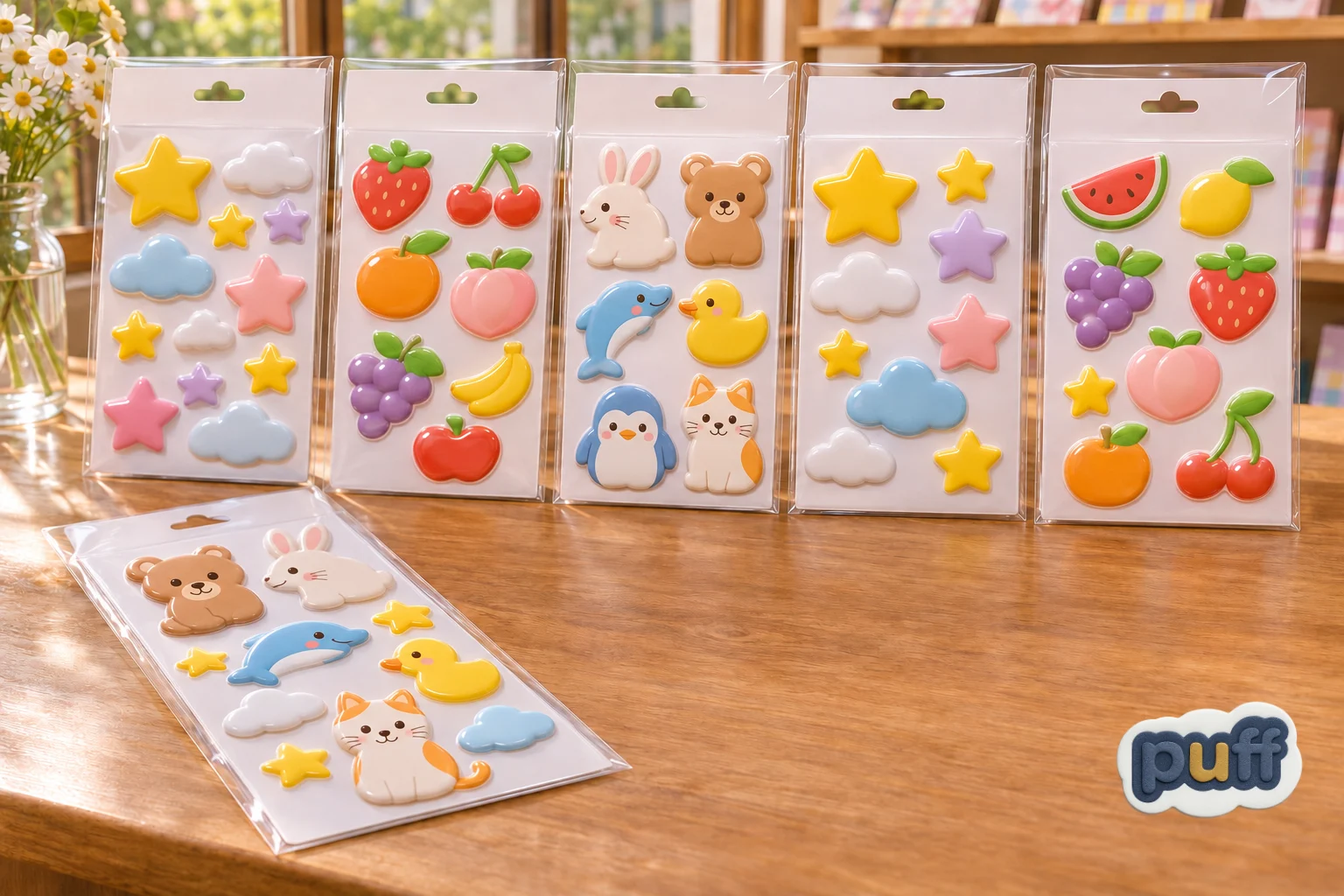
Stand by the counter of any stationery shop for ten minutes and watch the sticker rack. A hand reaches for a pack, tilts it toward the light, and runs a thumb across the raised shapes through the bag. Then the hand does something telling. It looks at the whole sheet, not at any single sticker, and decides in a second or two whether the set is worth taking home.
That moment is the one to design for. If you are planning sticker sheets for resale, whether for a shop, a brand, a publisher, a toy or stationery line or a subscription box, the sheet is not just a carrier for stickers. It is the product, the display and the first impression all at once.
This guide walks through how to plan that sheet: the set, the sizes and spacing, the foam, the artwork rules, the retail packing and the order itself.
Why a Sheet Sells as a Set
Lay a single puffy sticker on a table and it looks like a sample. Lay twenty of them together on one backing, arranged with care, and they start to look like a world.
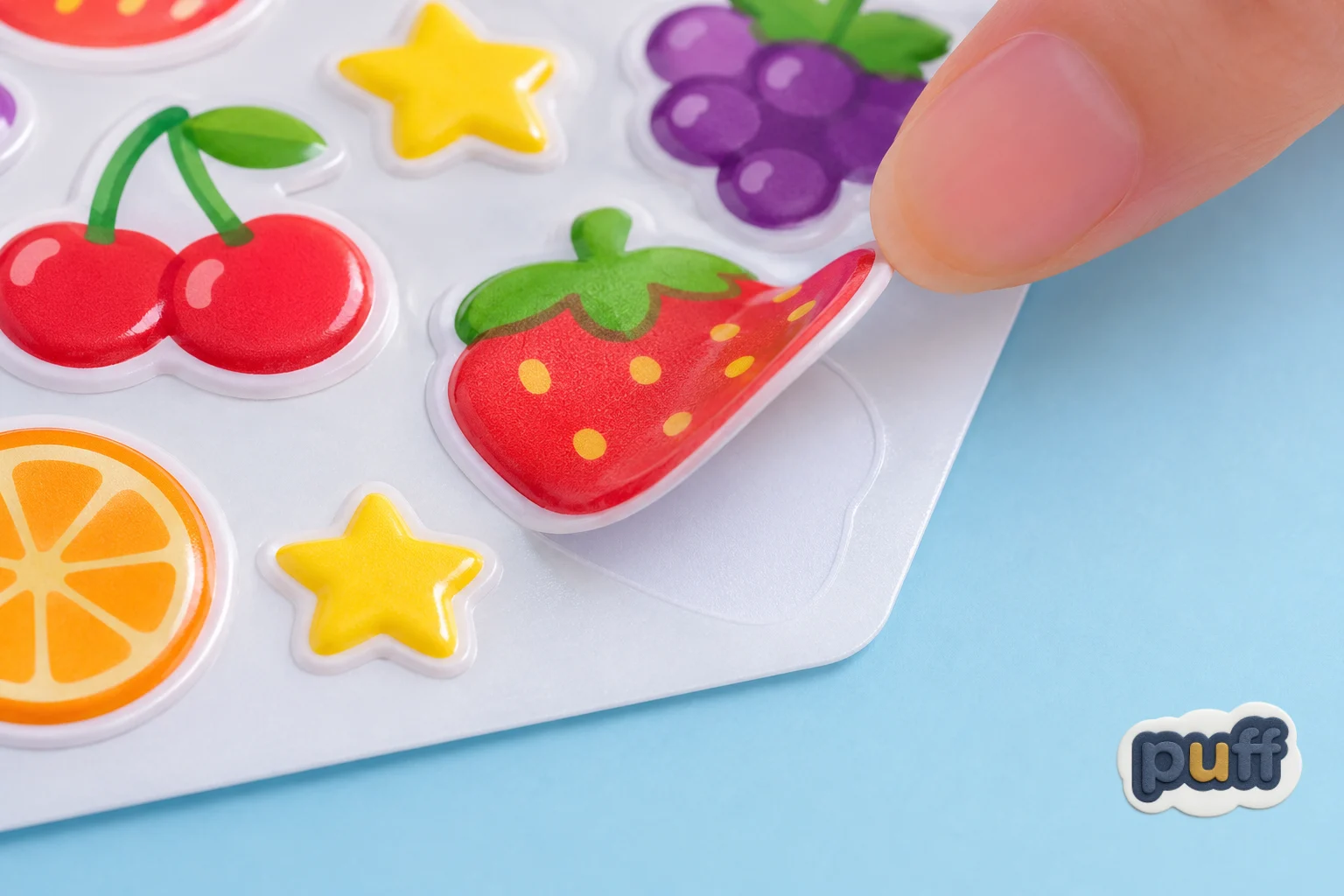
A puffy sticker sheet holds several puffy stickers kiss-cut on one backing, so they peel off one at a time. That last detail matters more than it seems. Because kiss-cut sticker sheets give up their stickers one by one, a sheet gets used over days or weeks, and each peel leaves a gap that shows what has already gone. The buyer is not paying for one sticker. They are paying for the whole set, and for the pleasure of working through it.
This is why sheets do well as add-on purchases, party bag fillers, reward charts, journal kits and subscription box extras. The value sits in the variety and in the story the sheet tells as a whole. Sticker books have lasted for generations for the same reason, as we explored in Why Sticker Books Never Really Disappeared. A collection held on one page feels complete in a way a loose sticker never does.
Planning the Set: Stars, Supporting Cast and Small Fillers
Think of a sheet the way a stage director thinks of a cast. There is one star, a group of supporting players, and a handful of small parts that fill the corners.
The star is your hero sticker. It is the biggest shape on the sheet, the one that carries the theme and the one a shopper sees first. Place it where the eye lands, often at the top or just off centre. The supporting cast are mid-sized stickers that develop the theme: the other characters, the matching objects, the second and third favourites. The small fillers are the stars, hearts, dots and tiny icons that use up the leftover space and make the sheet feel generous.
This structure helps with more than looks. It gives your shopper a reason to choose your sheet, a clear focal point, and enough small extras to feel like good value. It also gives you a simple way to build a range: keep the cast structure the same and change the theme from sheet to sheet, so a whole series reads as one family on the shelf. A clear series also gives buyers a reason to come back for the next theme, the same pull we looked at in When 3D Stickers Become Collectibles.
A sheet can hold up to 40 stickers, depending on their size. More is not always better. A crowded sheet with no star loses the moment of choice at the counter, while a sheet with ten well-sized stickers and clear breathing room can feel more special. Your free digital proof shows the final sticker sheet layout before anything goes to print, so you can judge the balance with your own eyes and ask for changes.

Sheet Size, Spacing and Foam Height
Hold a 3 x 5 in sheet and it fits in one palm, about the size of an index card. That is the standard size for custom puffy sticker sheets, made with 1 mm foam and ordered online in 250, 500 or 1,000 sheets. It suits checkout racks, party bags, mailers and subscription boxes, because it slips into almost any pack without folding.
Larger sheets, up to 8.5 x 11 in, are quoted, along with a 2 mm or 3 mm foam height and runs of 2,500 sheets or more. A larger sheet suits activity books, kits and premium sets where the sheet becomes a page in its own right.
Each sticker on the sheet shares the same build. EVA foam sits between a printed PET film on top and a PVC film underneath that carries the adhesive. Every sheet is waterproof, and you can choose a matte or gloss finish. Matte reads soft and crafted, and gloss gives each shape a little shine as it turns under shop lights.
Foam height changes the character of the set. A 1 mm foam keeps small, detailed designs crisp, which makes it the right choice for sheets with lots of tiny fillers or fine linework. A taller foam gives bolder, chunkier shapes a more playful, squeezable lift, and works best when every sticker on the sheet is large enough to carry it.
The Artwork Rules That Keep a Sheet Clean
Lay a ruler across a draft sheet before you send it. A few millimetres decide whether the finished stickers peel off whole or tear at the edges, and the rules below come from the sticker sheet artwork guidelines (PDF) on the product page.
Each sticker should be at least 5 mm across. Leave at least 4.5 mm (0.18 in) between cut lines, so the blade has room and each sticker lifts on its own. Add 2.5 mm (0.10 in) of bleed around every design, and keep any text 3 mm inside the edge so nothing important sits near the cut.
Set your files up in CMYK, the four-ink colour model used for print, rather than the RGB colours of a screen. Raster images should be 300 DPI. Convert all fonts to outlines and embed any linked images, so the file opens the same way on every machine. For sheets, send Adobe Illustrator (.AI) files only.
These rules can feel fussy at the planning stage. They are also what lets a 40-sticker sheet come off the press with every shape intact, so it is worth building them into your template from the first draft.
Packing Sticker Sheets for Resale
Picture a peg hook at the end of a shop aisle. Sticker packs for retail need to stay flat, look tidy and scan at the till.
For resale, sheets can be packed on backing cards or in poly bags, with your barcode printed. A backing card gives the sheet a firm frame, a place for your brand, and a clean edge on a hook or in a display box. A poly bag keeps the sheet protected and lets the raised texture show through, which suits subscription boxes, multipacks and online orders where the sheet travels before anyone sees it.
The barcode is the detail that turns a sticker sheet into a stock item. Most shops expect a Universal Product Code or similar retail barcode on anything they sell, so have your codes ready before you approve the proof, and leave a clear space for them in the pack design.
Think about how the sheet looks in the pack, too. The hero sticker should sit where it shows through the bag or above the fold of the card. If the best shape hides behind a header or a crease, the sheet loses its strongest argument at the moment of choice.

Ordering in Volume and Planning the Timeline
A sticker sheet range often starts small and grows. One design goes into a single shop, sells through, and then a buyer asks for six themes in ten times the quantity.
The minimum is 250 sheets per design. You receive a free digital proof first, with unlimited revisions until you sign off. Production takes 18 to 20 business days after proof approval, and 30 to 35 business days for 50,000 sheets or more per design. Since the clock starts at approval, count back from your launch, trade show or box ship date and leave room for a round or two of changes.
Orders for puffy sticker sheets in bulk are quoted, including runs of 50,000, 100,000 and 250,000 sheets per design. Wholesale and reseller pricing is available, along with bulk discounts, and you can set out your volumes on the bulk and wholesale stickers page. If you are launching a range of wholesale sticker sheets, remember that each design counts toward the minimum on its own.
Before committing to a large run, you can order a hardcopy sample of your own sheet. Holding the real thing in the pack you plan to sell it in is the surest way to check the foam height, the finish and how the hero sticker shows through.
A good sheet earns its place in two seconds at the counter and then keeps giving for weeks at home, one peel at a time. Plan the cast, respect the artwork rules, pack it so the star shows, and the sheet does the selling for you. When your layout is ready, send your artwork for a free digital proof or ask for a quote on the size, foam and quantity your range needs.