
Why We Save Stickers We Never Use
Why do people buy stickers and never use them? Explore the psychology behind sticker collecting, nostalgia, scarcity, emotional attachment, and why some stickers feel too valuable to stick.
Artwork, proofing & production
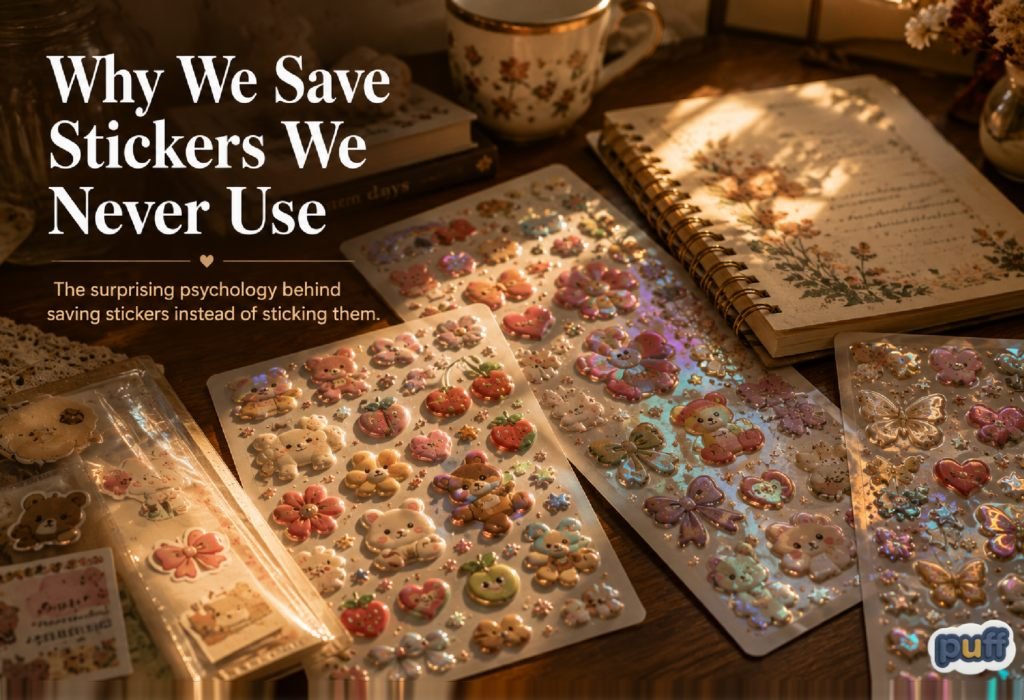
Why We Save Stickers We Never Use: The Psychology Behind Unused Stickers
"The surprising psychology behind saving stickers instead of sticking them"
Most stickers are created with a simple purpose.
They are meant to be placed on notebooks, water bottles, laptops, journals, phone cases, packaging, lockers, scrapbooks, and countless other surfaces. Yet if you look inside drawers, storage boxes, and stationery collections around the world, you will find something curious.
Thousands of perfectly good stickers that have never been used.
Some remain attached to their original backing sheets for years. Others are carefully stored inside envelopes, journals, or collectible binders. Some are moved from one home to another without ever being peeled.
People intend to use them.
Why Do We Hoard Stickers?
If you have a drawer full of unused stickers, you aren’t alone. Consumer psychology reveals four core reasons we save them:
Decision Paralysis: The fear of choosing the wrong spot and wasting a permanent choice.
Scarcity Mindset: Treating limited-edition or beautifully crafted designs as assets rather than disposable items.
The Endowment Effect: The instant psychological value and emotional attachment we form with physical, tactile objects.
Nostalgia Preserves: Using the sticker as a physical container for a memory or an era of our lives
At first glance, this seems irrational. Why purchase something designed for use only to preserve it indefinitely?
The answer has surprisingly little to do with stickers themselves and a great deal to do with human psychology.
The Moment a Sticker Becomes More Than a Sticker
Most people do not save every sticker.
They save certain stickers.
A sticker may remind someone of a special trip. It may have been given by a friend. It may come from a favourite brand, artist, museum, or event. Sometimes the design simply feels too beautiful to waste.
The moment emotional value enters the equation, the sticker stops being just an object.
And people treat memories differently than they treat products.
A person might happily use ten ordinary stickers in a week but hesitate endlessly over one particular sticker because using it feels permanent.
Once it is placed somewhere, the possibility of using it somewhere else disappears forever.
That small decision suddenly feels much larger than it should.
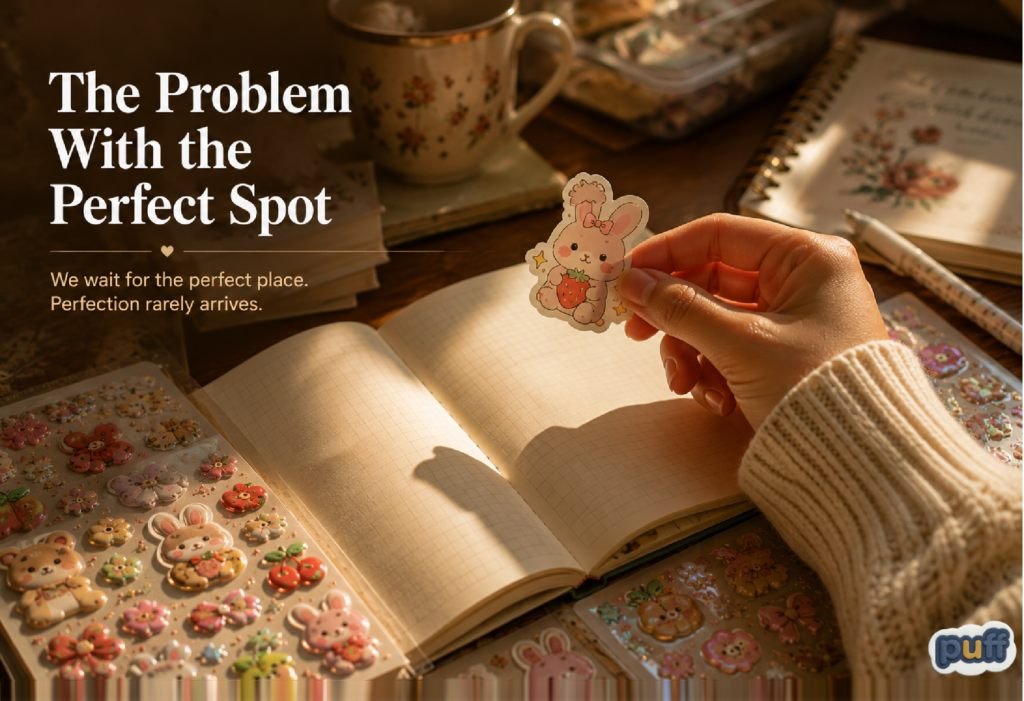
The Problem with the Perfect Spot
One of the biggest reasons stickers remain unused is surprisingly simple.
People are waiting for the perfect place.
The perfect journal page.
The problem is that perfection rarely arrives.
Psychologists sometimes refer to this as decision paralysis. When people believe a decision is important, they often delay making it altogether.
A sticker seems small, but emotionally it can represent a permanent choice.
Once it is applied, it cannot return to its original state.
As a result, many stickers become trapped in a strange limbo between ownership and use.
People are not refusing to use them.
They are postponing the decision indefinitely.
Why Ownership Feels Good Enough
An interesting thing happens when people collect objects.
Sometimes ownership itself becomes satisfying.
The brain receives a small reward simply from possessing something desirable.
The object does not necessarily need to be used.
Collectors understand this instinct well.
People collect trading cards, stamps, coins, comic books, sneakers, and vinyl records.
In many cases, the joy comes from having the item rather than consuming it.
Stickers often behave the same way.
A sticker sheet sitting safely inside a collection can feel complete exactly as it is.
Using the sticker would transform it from a collectible object into a decorative object.
And for some people, that feels like a loss.
Scarcity Changes Everything
People behave differently when something feels replaceable.
A common sticker purchased from a stationery store may be used without much thought.
A limited-edition sticker is different.
A discontinued design is different.
A sticker from a special event is different.
When people believe something is rare, its emotional value often increases dramatically.
This happens even when the actual monetary value remains low.
Scarcity creates caution.
The sticker suddenly feels less like decoration and more like an asset.
People begin asking questions:
What if I can’t get another one?
What if I regret using it?
What if it becomes more meaningful later?
The result is often predictable.
The sticker remains exactly where it is.
Nostalgia Is Stronger Than We Realize
Many adults still own stickers from childhood.
Not because they forgot about them.
Because they intentionally kept them.
Stickers are uniquely connected to memory.
Unlike many products, they often become associated with specific periods of life.
A sticker from primary school.
A sticker from a holiday.
A sticker from a favourite cartoon.
A sticker collected from a museum, theme park, or special event.
These small objects quietly absorb emotional significance over time.
This helps explain why sticker collections often survive for decades.
People are not preserving adhesive paper.
They are preserving experiences.
In many ways, stickers function like tiny memory containers. This same instinct, building small, personal archives out of what we keep, is explored further in Why Sticker Books Never Really Disappeared.
Why Children Save Stickers Too
This behaviour is not limited to adults.
Many parents have watched children refuse to use a favourite sticker despite owning it specifically for that purpose.
Children instinctively understand scarcity.
They understand favourites.
They understand special things.
In fact, many children become surprisingly selective when deciding where a sticker belongs.
The better the sticker feels, the harder the decision becomes.
This is especially true when the sticker feels unique, collectible, or difficult to replace.
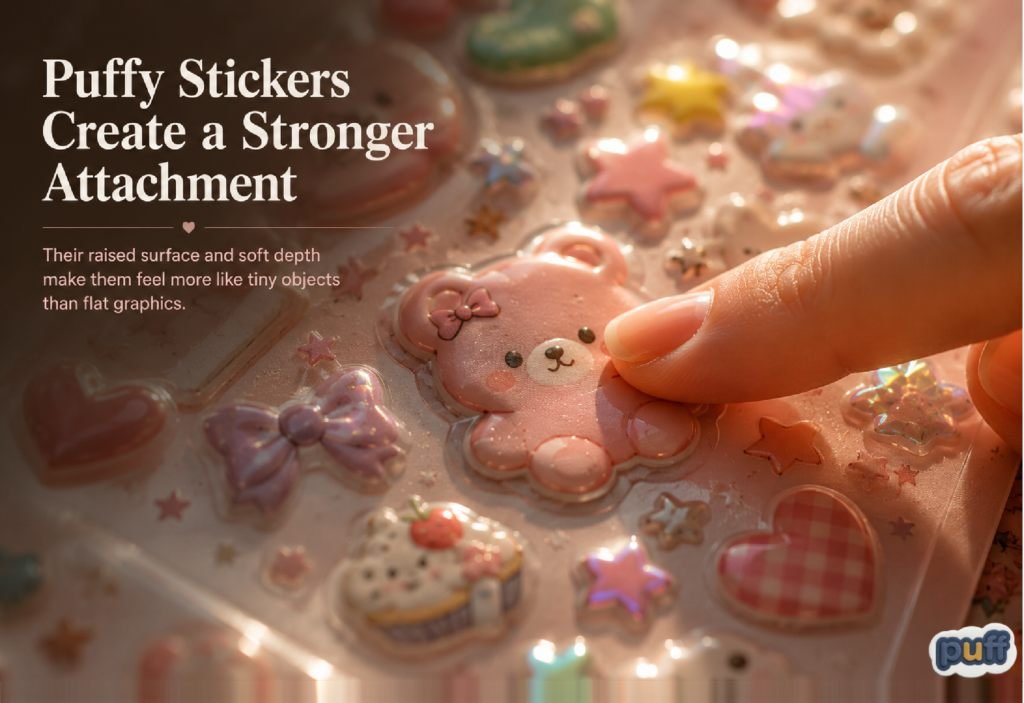
Puffy Stickers Create an Even Stronger Attachment
Interestingly, not all stickers trigger the same response.
Some stickers feel more valuable immediately.
This is one reason puffy stickers often remain unused longer than ordinary flat stickers. Their raised surface creates a stronger physical presence. They feel less like printed graphics and more like tiny objects.
As discussed in our material analysis of Soft Depth vs Smooth Depth, dimensional materials often create stronger emotional reactions because they engage touch as well as sight. People do not simply see depth; they physically anticipate interacting with it.
A puffy sticker does not simply look different.
That added depth often makes people more reluctant to part with it.
Many people instinctively treat dimensional stickers as miniature collectibles even when they were never intended to be collectible. In fact, some stickers begin behaving more like keepsakes than decorative products, a branding phenomenon we will explore deeply further in When 3D Stickers Become Collectibles.
The Fear of Regret
Another powerful psychological force is regret avoidance.
People naturally try to avoid future disappointment.
Using a sticker creates a possibility that regret may follow.
Perhaps the notebook gets lost.
Perhaps the laptop gets replaced.
Perhaps the chosen location no longer feels right.
The sticker itself becomes associated with uncertainty.
Keeping the sticker unused avoids that risk completely.
As strange as it sounds, preserving the possibility of future use can sometimes feel better than actually using the sticker.
The sticker remains perfect.
When Stickers Become Personal Symbols
Some stickers represent identity.
People use them to express interests, values, hobbies, or memories.
The more personally meaningful a sticker becomes, the harder it can be to use.
Applying the sticker feels like making a statement.
People begin wondering:
Will I still feel the same way later?
The sticker gains symbolic weight.
And symbolic objects are rarely treated casually.
Collecting Without Calling It Collecting
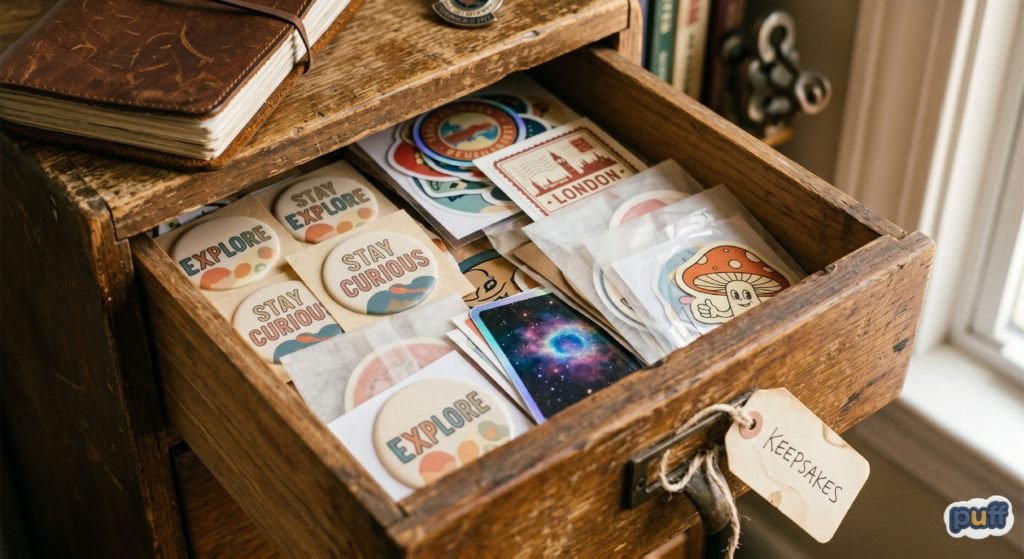
Many people insist they are not collectors.
Yet they own folders, drawers, or boxes full of unused stickers.
What they are describing is often a form of informal collecting.
Collecting does not always involve rarity or monetary value.
Sometimes collecting simply means preserving objects that create emotional satisfaction.
Stickers happen to excel at this.
They are affordable, visually appealing, easy to store, and emotionally meaningful.
This combination makes them unusually collectible even among people who never consider themselves collectors.
The Brand Strategy Takeaway
For businesses and packaging designers, an unused sticker isn’t a failed marketing asset, it’s a permanent piece of high-value real estate in a customer’s personal collection. When you design promotional items that tap into this deep emotional attachment, your brand’s shelf-life extends indefinitely.
Why Digital Life Makes Physical Objects More Valuable
Modern life is increasingly digital.
Memories live in cloud storage.
As we broke down in The Psychology of Quiet Surfaces, people are increasingly drawn toward physical experiences that feel tangible and real. In a world dominated by screens and digital interactions, physical objects often feel more emotionally grounding.
Stickers offer exactly that.
Their physical presence creates emotional value in ways digital assets often cannot replicate.
This may partly explain why sticker collecting remains surprisingly resilient despite the rise of digital culture.
Sometimes the Sticker Is Already Doing Its Job
Perhaps the most surprising explanation is also the simplest.
Sometimes the sticker does not need to be used to be meaningful.
People often assume an unused sticker has failed its purpose.
But that may not be true.
If a sticker brings back a memory, creates happiness, feels special, inspires creativity, or encourages collecting, then it may already be fulfilling an emotional purpose.
The sticker is providing value before it is ever peeled.
In some cases, preserving it becomes part of the experience itself.
This emotional attachment helps explain why stickers are often valued for more than decoration. In many cases, the experience of owning them becomes meaningful in itself, similar to the emotional comfort explored in How Custom Puffy Stickers Became the New Therapy.
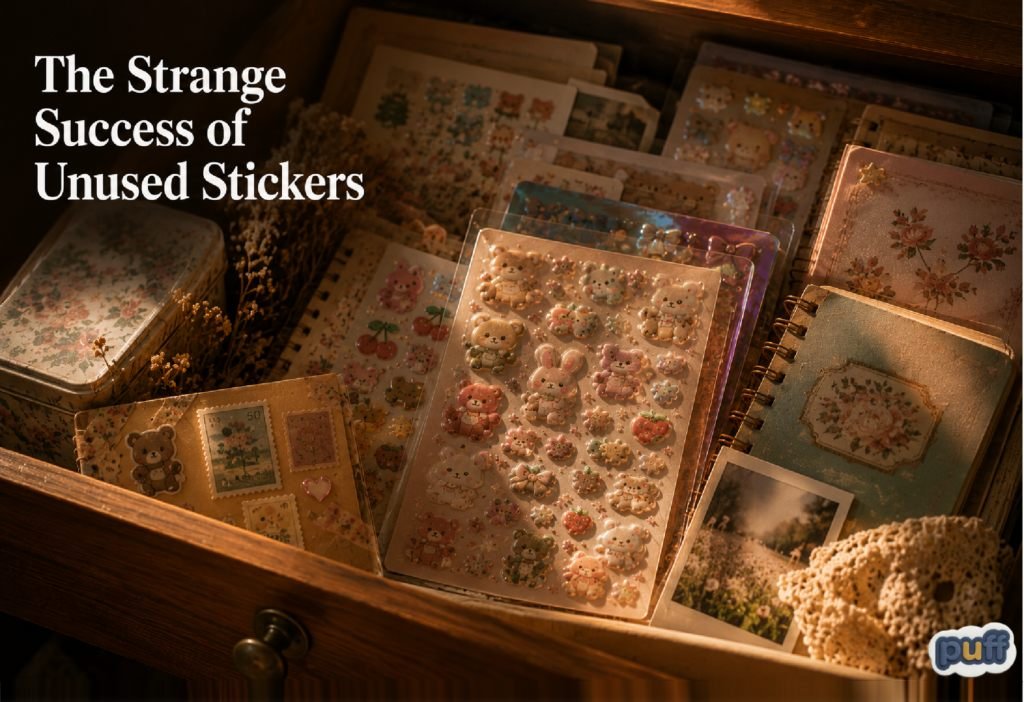
The Strange Success of Unused Stickers
From a practical perspective, an unused sticker appears incomplete.
Its intended function remains unrealised.
Yet emotionally, the opposite may be true.
The unused sticker continues holding possibility.
It continues carrying memories, anticipation, and meaning.
This is why so many sticker collections survive untouched for years.
People are not forgetting to use them.
They are choosing to preserve what the sticker represents.
And perhaps that is the real reason we save stickers we never use.
They stop being stickers.
They become something people simply do not want to lose.