Why Sticker Books Never Really Disappeared
From childhood sticker books to stickered laptops and suitcases - explore why humans never stopped building small personal archives.
Artwork, proofing & production
Why Sticker Books Never Really Disappeared
Before There Were Sticker Books
Before there were sticker books, there were smaller places. Not shelves in museums. Not carefully cataloged collections. Just ordinary corners of ordinary lives.
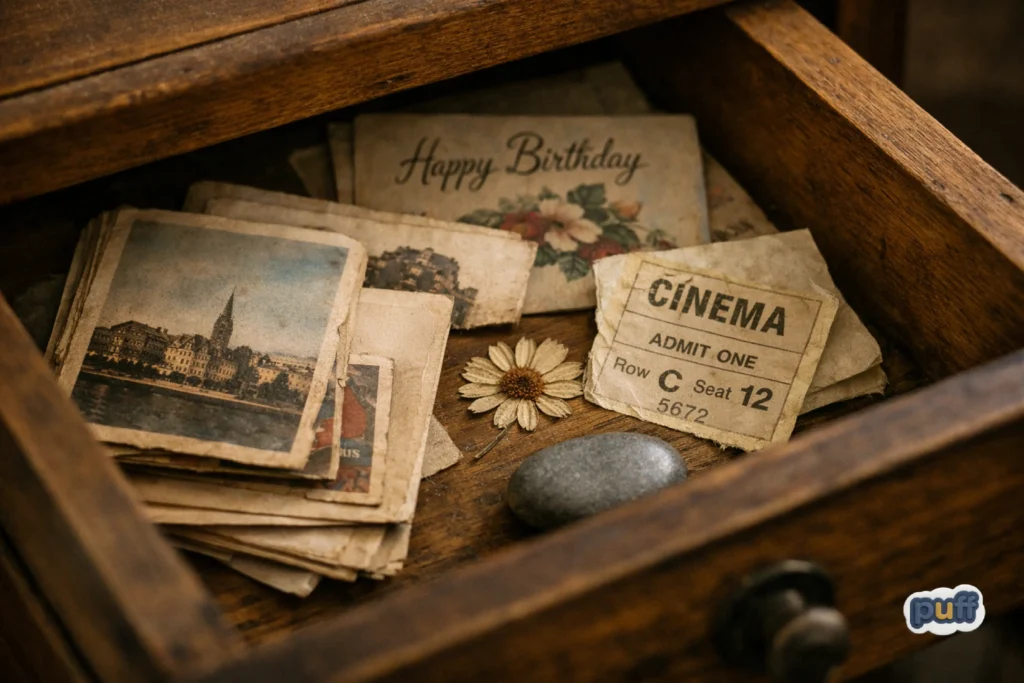
A shoebox beneath the bed filled with postcards from holidays no one remembered clearly anymore. A drawer where cinema tickets, birthday cards, and faded photographs slowly gathered without anyone deciding they belonged together. A pressed flower hidden inside a novel. A smooth pebble carried home from a beach because throwing it away somehow felt impossible.
None of these objects were particularly valuable. Most had no practical use once the moment had passed. Yet they stayed, not because they were needed, but because they had quietly become part of someone’s story.
Long before people filled sticker books, they were already creating places where memories could remain visible. The sticker book simply gave that instinct a page.
We tend to think of sticker books as childhood objects: bright collections of animals, cartoons, glittering letters, and favorite characters, eventually packed away into a cupboard as children grow older. That ending is what makes them look like they disappeared.
But perhaps they never disappeared at all. Perhaps they simply changed shape.
The Human Archive: Why We Keep What We Keep
Every person builds something we might call a human archive, not in the historical sense, but a personal one, small enough to fit inside everyday life. It might live in a notebook, a travel journal, a memory box, a shelf of souvenirs, a camera roll, or a drawer no one else is allowed to organize. These archives rarely begin with intention. One object survives because throwing it away feels wrong. Then another joins it. Years later, an entire collection exists without anyone remembering exactly when it started.
Every collection quietly asks the same question: will this still matter to me later? Most objects fail that test, receipts disappear, packaging gets thrown away, tickets fade inside pockets. But certain things resist being discarded, almost instinctively.
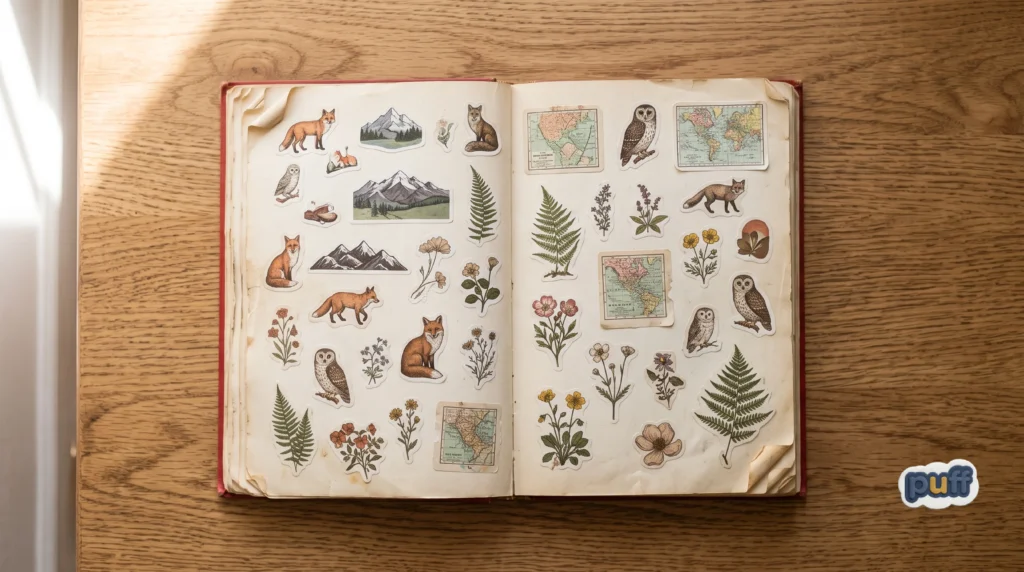
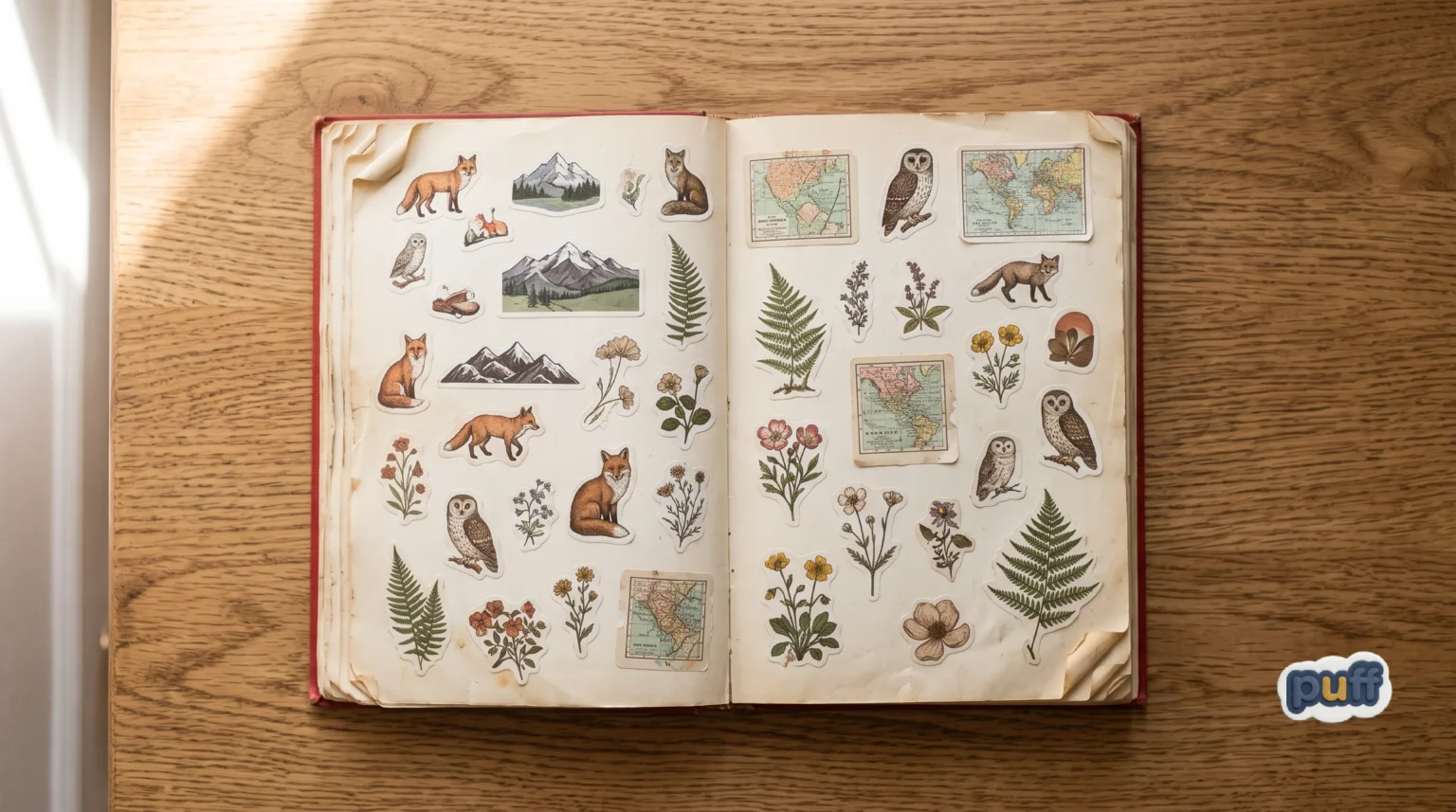
Sticker books reveal this process unusually well. Unlike photographs, which record what happened, stickers often record what mattered: a favorite animal, a school reward, a holiday attraction, a concert, a café discovered. Each page is also a series of small refusals, deciding that one sticker deserves the center while another belongs quietly in the corner, and that some space is better left empty.
No two completed sticker books are ever quite alike. Not because the stickers are different, but because the person arranging them is. They don’t simply preserve objects. They preserve judgment, taste, attention, memory, portraits written without words.
Empty Spaces Invite Stories
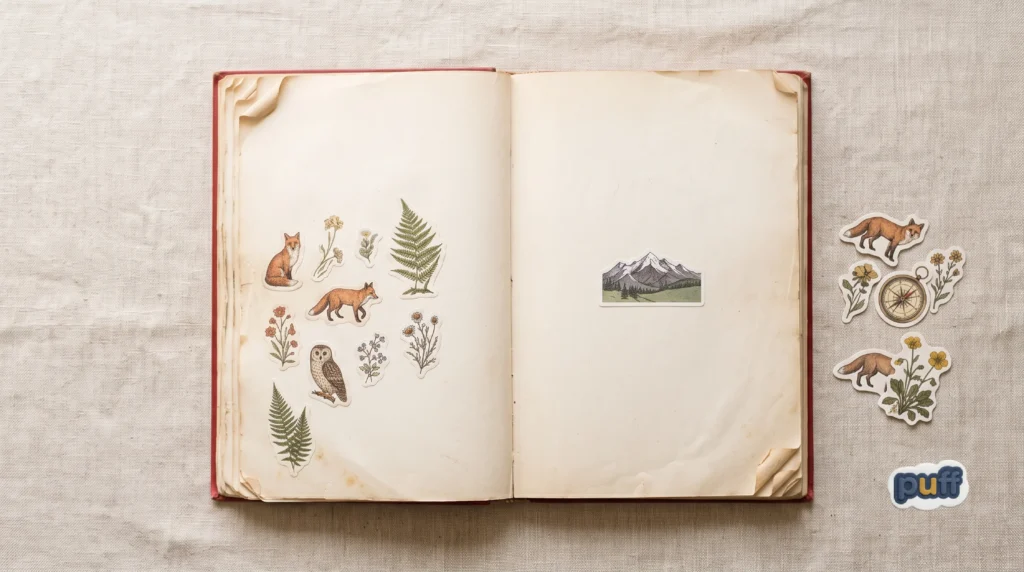
A blank page is rarely just a blank page. Before anything is placed on it, it already carries a quiet invitation, not to decorate, but to decide. Every empty space asks the same silent question: what belongs here?
Sticker books understand this instinct well. Each untouched page offers possibility without instruction. There is no correct sequence, no single arrangement every owner must follow. The page waits, and in waiting, it hands a small piece of authorship to whoever opens it.
That may be why sticker books feel personal even when two people start with the exact same set of stickers. One child groups animals together, imagining an entire forest across two pages. Another arranges by color, because balance feels satisfying. A third leaves large spaces untouched, convinced something better will eventually deserve that place. Years later, those decisions often reveal more about the collector than the stickers ever could.
Some sticker books end up preserving holidays. Some preserve childhood itself, or an interest that lasted only a few weeks before vanishing. Without ever intending to, the owner starts writing something close to autobiography, using placement instead of language, answering questions they never consciously asked: What delighted me? What felt worth keeping?
Why Arrangement Changes Meaning
Imagine emptying an entire sticker book onto a table. Nothing has been lost, every sticker, every color, every illustration survives. And yet something important disappears the moment the pages do: the relationship between the stickers. Arrangement creates meaning.
A single butterfly sticker says very little on its own. Placed beside pressed flowers from the same summer, it tells one story. Beside travel stickers from a family holiday, it becomes part of another. Surrounded by handwritten notes years later, it transforms again. The sticker doesn’t change. Only its context does.
This is true well beyond sticker books. A photo on a phone is information. The same photo framed beside childhood drawings becomes memory. Objects rarely speak for themselves, they borrow meaning from whatever surrounds them. Museums work on the same principle: curators rarely place objects at random, and meaning emerges through proximity, one object explaining another. A sticker book does this on a smaller, deeply personal scale. It is less a storage system than an exhibition assembled for an audience of one.
Collections Slow Time: Memory and the Sticker Book
Old sticker books are often described as feeling like time capsules. That’s close, but it misses something. A time capsule is buried. A sticker book remains available, it invites return.
Every time someone opens one, forgotten moments quietly become present again. Not because memory suddenly improves, but because memory responds to physical cues: the texture of the page beneath a fingertip, a color that once felt ordinary, a design whose name has been forgotten but whose shape is instantly familiar. Memory researcher Endel Tulving described this as cue-dependent memory, the idea that we often retrieve a memory far more easily when a familiar sensory cue is present to unlock it. The sticker itself isn’t the memory. It’s the doorway.
That may explain why digital collections rarely reproduce the same experience. Thousands of photos can live inside a phone, searchable and perfectly organized, yet scrolling rarely recreates the feeling of opening an old sticker book. One offers access. The other offers encounter, and physical encounters seem to anchor memory in a way that purely digital ones often don’t. Perhaps that’s why people keep building small physical archives even now, when almost everything could be stored electronically. The instinct was never really about storage. It was about relationship, keeping a way of meeting our past again.
Portable Museums
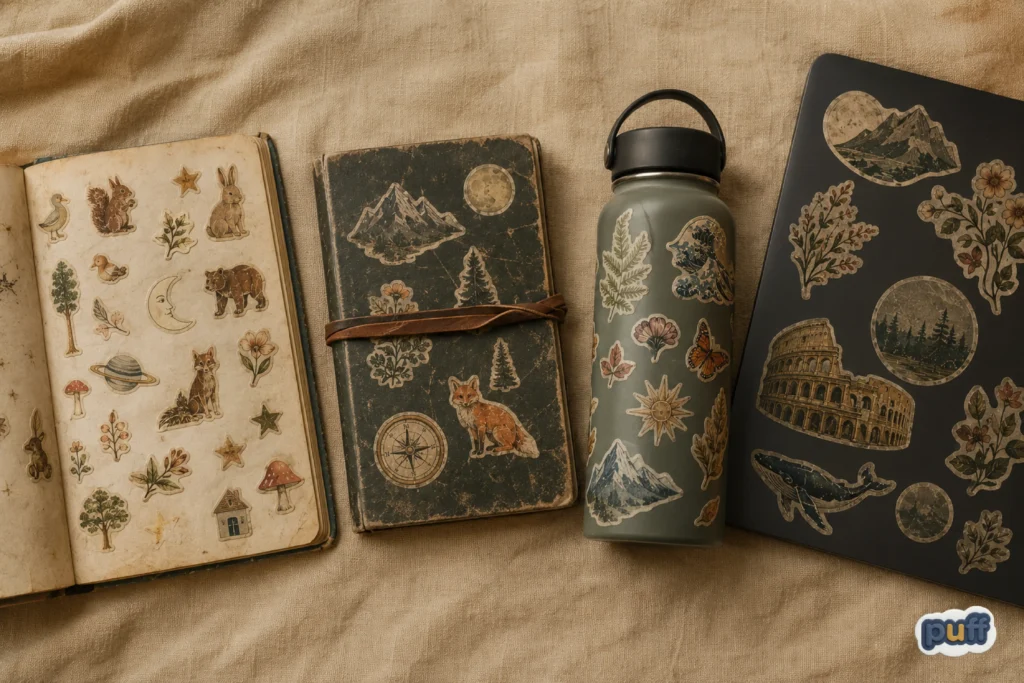
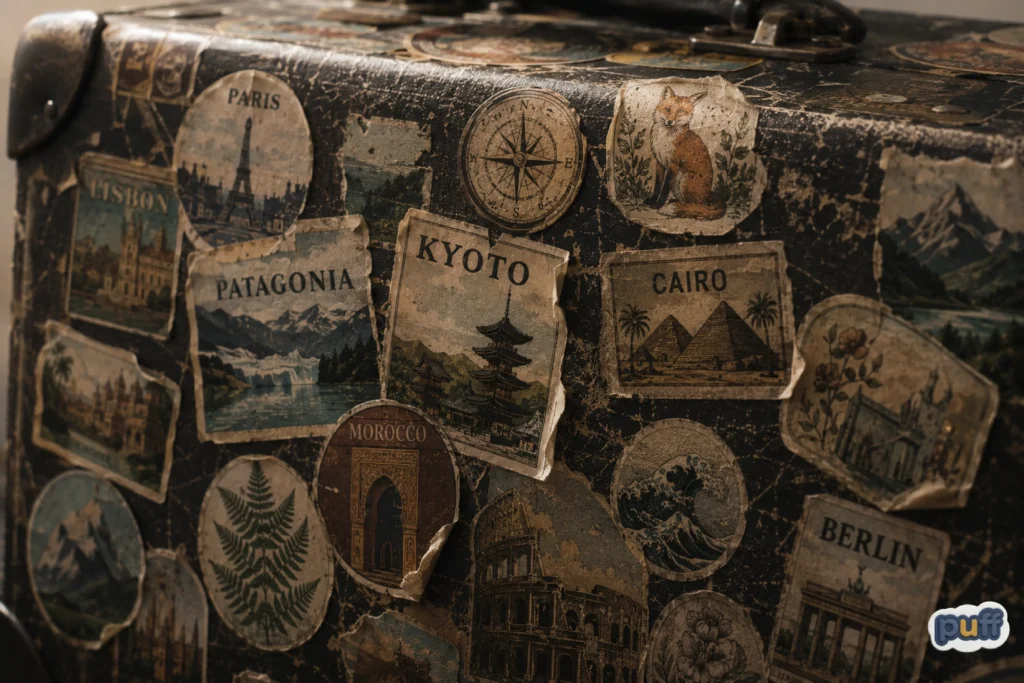
It’s tempting to think growing up means leaving sticker books behind. In practice, adulthood doesn’t end the habit, it just multiplies the surfaces available for it. A travel sticker survives three continents on the side of a suitcase. A particular design outlives several laptops and a couple of jobs. A water bottle slowly fills up with places visited, causes supported, and bands seen live. Travel journals, sketchbooks, instrument cases, camera bags, and bike frames all become the same kind of page, just shaped differently.
None of this is random decoration. Each addition is a small, carefully edited exhibition of identity, a portable museum with no curator but the owner. One person covers an entire notebook over a decade. Another applies a single sticker and keeps the rest in a drawer, because using them feels like ending something too soon. Neither is right or wrong. Both are doing the same thing: giving visible form to an invisible story.
That’s also why these objects become so hard to replace. The laptop or the suitcase itself is rarely rare. What can’t be recreated is the specific sequence of decisions stuck to its surface, a concert attended, a country explored, a small business supported. Strip every sticker off, and what disappears isn’t adhesive vinyl. It’s a visible record of attention, built one choice at a time. The object remains. The autobiography doesn’t.
The Difference Between Decoration and Recognition
At first glance, a sticker can look purely decorative, something added to make an object more colorful. Sometimes it is. But decoration alone doesn’t explain why some stickers stay with us for years while others vanish within weeks.
The difference often comes down to recognition. A sticker is kept not because it’s beautiful, but because it recognizes something its owner already feels: a mountain that recalls a first solo hike, a tiny coffee cup that recalls a standing Friday meet-up, an illustrated whale tied to a lifelong fascination with the sea. The sticker doesn’t create the meaning. It recognizes it, which is why two people can look at the same design and feel entirely different things. One sees nice artwork. The other sees a piece of their own life.
Psychologists Rogers, Kuiper, and Kirker were among the first to demonstrate what’s now called the self-reference effect: information connected to our own experience tends to be remembered more easily, and felt more deeply, than information that stays emotionally neutral. Sticker books take advantage of this without anyone planning it that way, every page gets more personal because every addition reflects something already recognized by the person arranging it.
Why Touch Still Matters
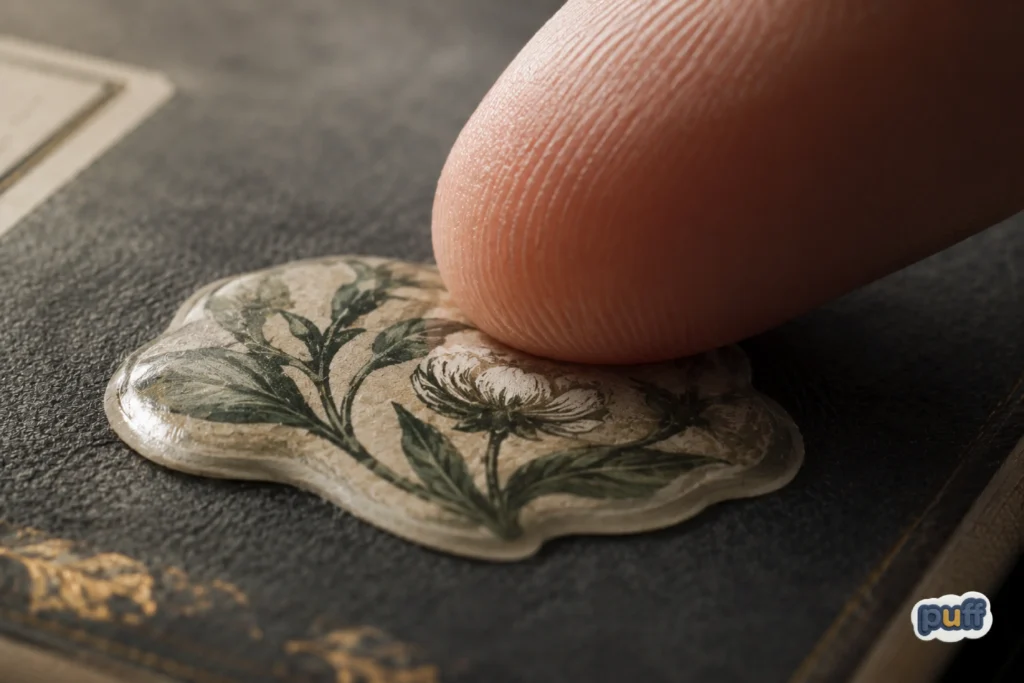
One reason physical collections survive is that memory has never belonged to vision alone, we remember through touch as much as through sight. Opening an old sticker book takes movement: pages turn, paper flexes, fingertips pause over raised surfaces and worn corners. Some stickers stay smooth. Others have softened after years of handling. Those small differences matter.
Psychologist Sian Beilock and other researchers working on embodied cognition have shown that physical interaction shapes how we think and remember, memory isn’t stored in the mind alone; it’s often strengthened by the body’s interaction with the world. That may explain the lasting appeal of dimensional stickers. A raised surface isn’t just seen, it’s encountered: the slight give of a puffy sticker, or the polished dome of an epoxy one, turns the experience from observation into participation. That tactile layer adds something a flat image can’t, a sticker that can be revisited with the hands, not only the eyes, and it’s exactly the layer a purely digital collection struggles to reproduce.
What We Really Preserve
It’s tempting to think collections exist to preserve objects, a stamp collection preserves stamps, a sticker book preserves stickers. Look closer, though, and the object starts to look less like the destination and more like the vehicle.
What survives inside a sticker book isn’t really paper backed with adhesive. It’s evidence: of what captured someone’s attention, where they traveled, which stories they wanted to revisit, who they were becoming at that particular moment. The stickers matter, but what they point toward matters more, which is probably why people keep adding stickers to journals and keepsake collections long after childhood ends. The behavior stays useful because identity never stops changing. Every few years we become slightly different people, and the archive changes with us, not to preserve the past exactly as it was, but to show how we arrived here.
A Collection Is Never Finished
One of the more interesting things about a sticker book is that it rarely feels complete. Even once every page is filled, another book eventually appears. Another journey begins.
That impulse says something. People aren’t really trying to complete a collection, they’re trying to continue a story. Completion belongs to objects; stories stay open. That’s why a traveler keeps adding destinations, an artist keeps discovering new illustrators, and a grown adult still pauses in front of a well-designed sticker because something familiar quietly returns.
Psychologist Dan McAdams’s work on narrative identity describes something similar: we’re constantly revising the story we tell about ourselves, adding new experience while reinterpreting the old. A personal collection mirrors that process closely. It isn’t a record of who we were. It’s a record of who we’ve been becoming.
It’s easy to dismiss sticker books as simple childhood entertainment, bright pages, a pleasant afternoon activity. But for many people they’re one of the first places they ever practiced curation. Long before we understand museums, we understand choosing. Long before we understand archives, we understand keeping. That practice almost always starts with cheap stickers rather than precious ones. A classroom reward sheet or a bag of party favors costs very little per sticker, which is exactly why they get handed out freely, and why nobody can predict which one a child decides to keep.
That instinct doesn’t end when the pages stop being bound together. It shows up in a carefully kept travel journal, a sketchbook layered with collected designs, a shelf of souvenirs, a laptop covered in years of travel, even in a set of custom puffy stickers, when each one marks a project, a place, or a milestone rather than pure decoration.
This is part of a wider series on why we collect the way we do: Why We Save Stickers We Never Use looks at why some people preserve a sticker instead of using it; Soft Depth vs Smooth Depth looks at how material changes the memory of touching something; and a future piece on When 3D Stickers Become Collectibles will look at what happens once personal meaning starts to outweigh rarity.
Perhaps the mistake was ever assuming sticker books belonged only to children. Children just made the behavior easier to notice. Adults keep building the same kind of archive, it just stops looking like a sticker book. Every journal, every well-traveled suitcase, every memory box and shelf of keepsakes belongs to the same quiet tradition: we have always needed small places where our lives can remain visible. Sticker books were simply one of the first places many of us learned how to build them.