
The Complete Guide to Custom Puffy Stickers
A complete guide to custom puffy stickers: material choice, ideal thickness, die cut versus kiss cut, waterproofing, and printing methods, explained clearly.
Artwork, proofing & production
The Complete Guide to Custom Puffy Stickers
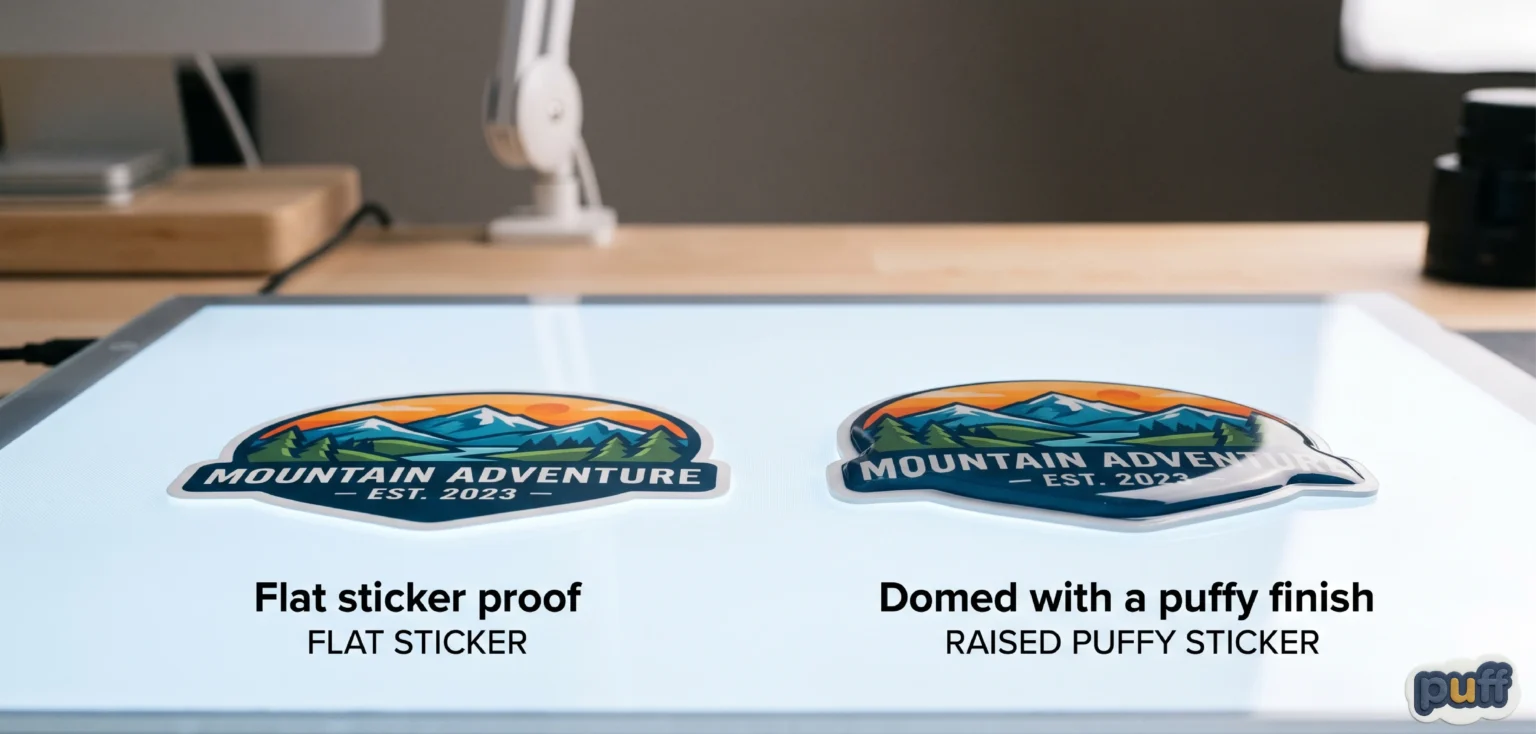
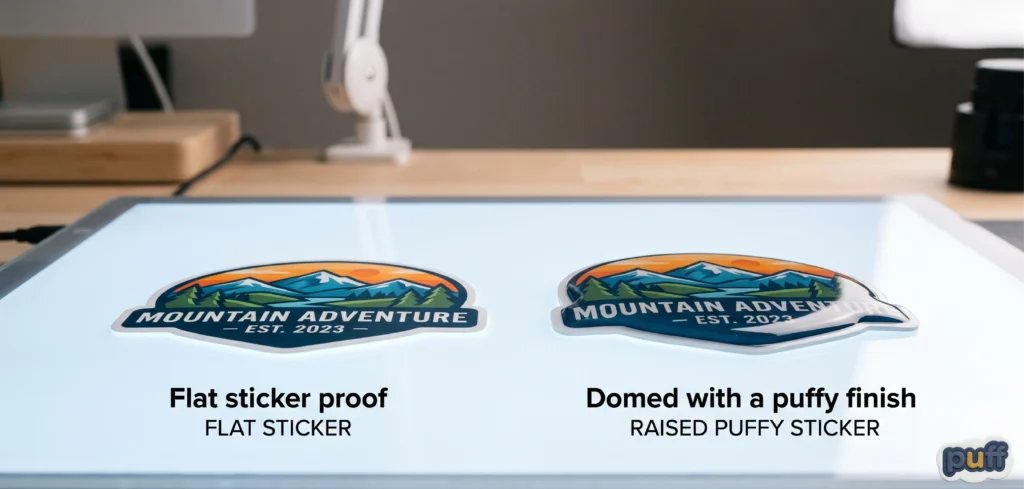
Two proofs sit side by side on a light table. Same illustration, same four colors, same die line. One lies flat against the paper the way ink always has. The other rises a few careful millimeters above its backing, and the moment someone tilts the sheet, a thin rim of light catches along its edge.
Nobody reaches for the flat one first.
That instinct is the entire reason a puffy sticker exists. Ordering one means making a string of decisions most people never think about until they are staring at a spec sheet: which material, which cut, which finish, how thick the dome should sit, whether the sticker needs to survive a water bottle or just a laptop lid that never leaves a desk.
None of those choices are really about manufacturing. Manufacturing is just the mechanism. Each decision is a bet on how an object is going to feel in somebody’s hand months from now, long after the order has shipped and the spec sheet has been forgotten.
Most guides to custom stickers read like a parts catalog, material here, finish there, price break at the bottom. This one treats the spec sheet the way it actually functions: a design brief for a small physical object, written before ever meeting the person who is going to hold it. That is the order this guide follows. Not features first and feelings later. The decisions in the order they actually get made, and what each one quietly determines about the finished object before it ever leaves the shop.
Every puffy sticker we supply is a five-layer stack: protective top film, printed vinyl or PET, foam or PU core, permanent acrylic adhesive and a silicone release liner. Change the film and core and you get the whole family, foam stickers, puffy stickers, epoxy stickers and dome decals.
What a Custom Puffy Sticker Actually is
Peel back the backing on a puffy sticker and the resistance is the first thing anyone notices. Flat vinyl comes away from its backing in one clean motion. A puffy sticker holds on a beat longer, because there is more of it letting go.
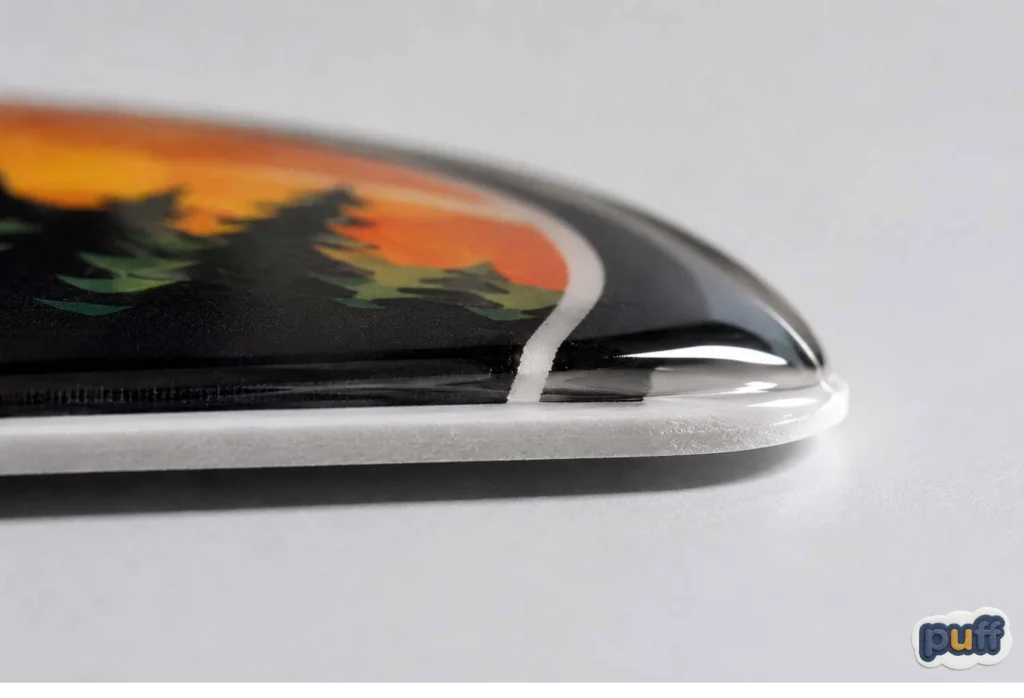
Underneath the printed film sits a thin layer of clear domed material, almost always a soft, flexible PVC, laminated directly over the artwork before the whole piece is cut into its final shape. That layer is what turns a flat illustration into something with an actual profile: a rounded edge, a faint shadow gathering along the curve, a surface that shifts in appearance as light hits it from a different angle instead of sitting still the way ink does.
A flat sticker is a two dimensional problem, solved once and finished. A puffy sticker adds a third dimension, and every remaining decision in this guide exists because of that one addition. Thickness, material, finish, even the way artwork gets prepared before printing, all of it is downstream of the simple fact that the surface is no longer flat. When Does a Custom Sticker Stop Feeling Flat? sits on that boundary, following the point at which a raised surface stops reading as a printed image and starts reading as an object.
That extra dimension is also why puffy stickers survive handling that flat vinyl does not. A raised edge absorbs the brunt of a fingernail catching it, a bag strap rubbing against it, a corner bumping a doorframe, in a way a flat edge cannot, because there is more material there to take the contact before the artwork underneath is affected. The dome is decorative and structural at once, something most people never notice until a flat sticker on the same bottle has already peeled and the puffy one beside it has not.
The same dome behaves slightly differently depending on what it sits on top of. Glass and metal give it a hard, unforgiving surface to grip, which favors a stronger adhesive but rewards it with the cleanest possible finish once applied. Fabric and unfinished wood flex and breathe under the dome, which is why stickers meant for those surfaces usually lean on a softer, more flexible backing rather than the firmest adhesive available. None of this changes what the sticker is. It changes how confidently it stays put once it gets there.
The Material Question: Soft PVC Against Epoxy
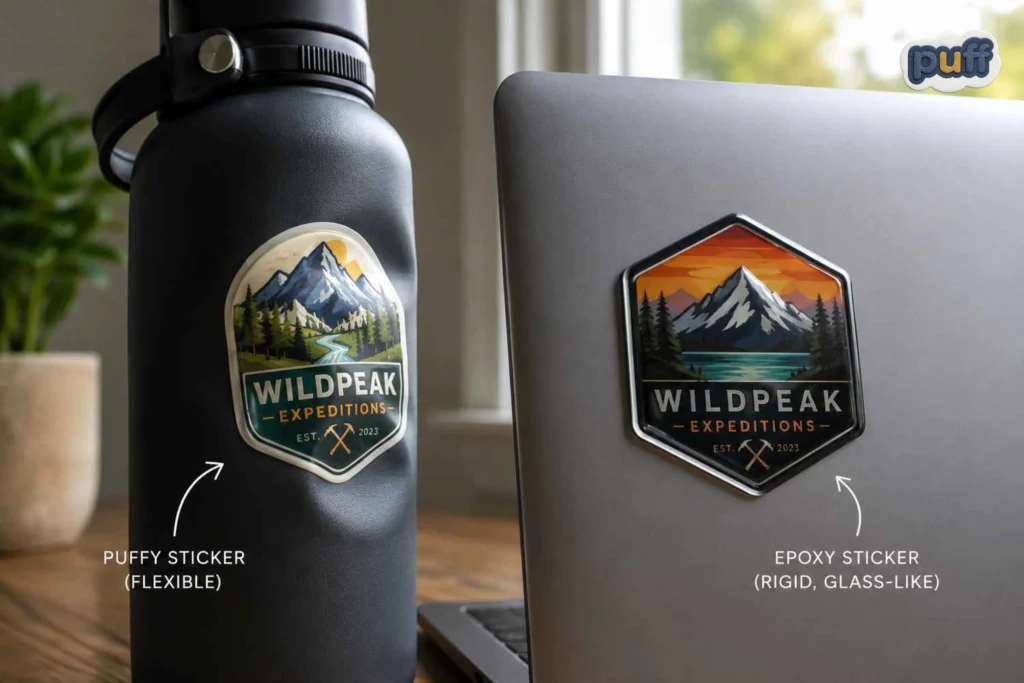
Bend a soft PVC sticker around the curve of a water bottle and it gives slightly, then holds. That flexibility is the whole point of the material. Soft PVC is a flexible plastic that domes cleanly under heat and pressure without cracking once it cures, and it keeps bending afterward, along with whatever surface it ends up on.
Epoxy resin stickers dome in a similar process but cure into something closer to glass, rigid rather than pliable, closer in feel to a small award pin than to a sticker in the traditional sense. That rigidity buys a harder gloss and a crisper edge than PVC can produce, along with a surface that resists scratching in a way soft PVC does not. It also means an epoxy dome does not want to bend, and a curved surface that flexes regularly will eventually crack a rigid dome at exactly the spot where it is asked to move.
Neither material wins in the abstract, because the real question was never which material is better. It is where the sticker is going to live for the next several years. A soft PVC sticker on a curved, flexible surface, a bottle, a bag, a phone case picked up and set down all day, will outlast a rigid dome asked to do the same job. An epoxy dome on something flat and stationary, a laptop lid, a storefront sign, a display piece that never bends, will hold a sharper shine and a harder surface than PVC delivers on the same spot.
Cost tends to track the same divide. Soft PVC scales more easily into larger runs and irregular shapes. Epoxy domes, being a more deliberate, often hand finished process, usually carry a premium that makes more sense for smaller runs or higher end branding pieces where the glass like finish is the entire point.
This guide only has room to draw the line between the two. Soft Depth vs Smooth Depth goes several layers deeper into how each material actually behaves under stress, light, and years of handling, for anyone specifying an order where the material choice matters as much as the artwork does.
Common Uses for Puffy Stickers
A puffy sticker rarely announces what job it is doing. It ends up on a laptop lid next to a dozen others from different trips and different years. It ends up on the outside of a shipping box a customer did not expect to keep, sitting on a desk months later long after the product inside has been used up. It ends up on a water bottle, a skateboard deck, a notebook cover, chosen the way people have always chosen stickers, as a small, low stakes way of marking something as theirs.
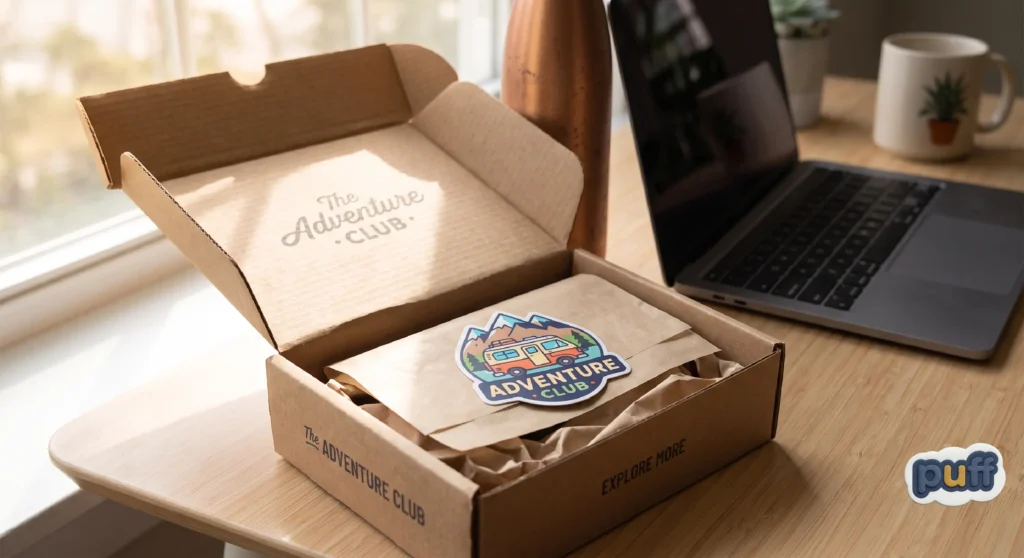
Businesses lean on that same instinct from the other direction. A puffy sticker included in a package reads less like an advertisement and more like a small gift, something a customer wants to keep rather than throw away with the rest of the packaging. Trade show giveaways, loyalty program inserts, subscription box add-ons, and product packaging all use the same object for the same underlying reason, because a sticker somebody actually keeps does more for a brand over months than a flyer they read once and discard. Seasonal runs are the same idea against a deadline, and Custom Puffy Stickers for Christmas Launches works through what that does to a schedule when the date cannot move.
Individual customers use them for something closer to identity than decoration. Custom Puffy Stickers Became the New Therapy traces why that instinct has become more pronounced recently, especially for people looking for a small, low effort way to personalize an object without making a larger commitment or a public statement.
The use case rarely changes how the sticker gets manufactured. It changes which of the decisions in the rest of this guide matter most for a given order, whether that is durability for something going in a backpack every day, or finish quality for something meant to represent a brand on a store shelf.
Preparing Artwork for Manufacturing
A print shop cannot dome a file the way a monitor renders it, and that gap catches more first time orders off guard than any other part of the process. Colors shift slightly once light passes down through a clear, curved coating instead of bouncing straight back off flat paper, so a color that looks correct on screen sometimes needs a slight adjustment to read the same way once it is domed.
Bleed has to extend past every edge that will eventually be cut, usually by a small, consistent margin the print shop specifies in advance. Skip that margin and the die line clips artwork that was never meant to be trimmed, leaving a thin sliver of unintended background color at the edge.
Thin lines disappear under a domed surface faster than most designers expect. A hairline border that reads perfectly crisp flat on a screen can soften or vanish entirely once light refracts through even a slight curve sitting on top of it. Bold shapes, thicker outlines, and simpler color separations tend to survive the trip from flat file to domed sticker far better than fine detail or delicate line work does.
None of this is a limitation so much as a translation problem. Flat artwork and domed artwork are not quite the same object once the lamination goes on, and the file has to account for that difference before it reaches a press, not after the first proof comes back looking slightly off. A short conversation with a print shop before finalizing artwork usually catches these issues faster than any amount of guessing at settings alone.
Vector files, built from scalable paths rather than a fixed grid of pixels, handle this translation the most cleanly, since a logo or illustration built as a vector can be resized and re-separated for print without losing a single edge. Raster artwork, a photograph or a design built directly in a pixel based program, still works, but usually needs a higher starting resolution than a screen ever requires, since a file that looks sharp at low resolution on a monitor can look soft or pixelated once it is enlarged and domed.
Die Cut or Kiss Cut
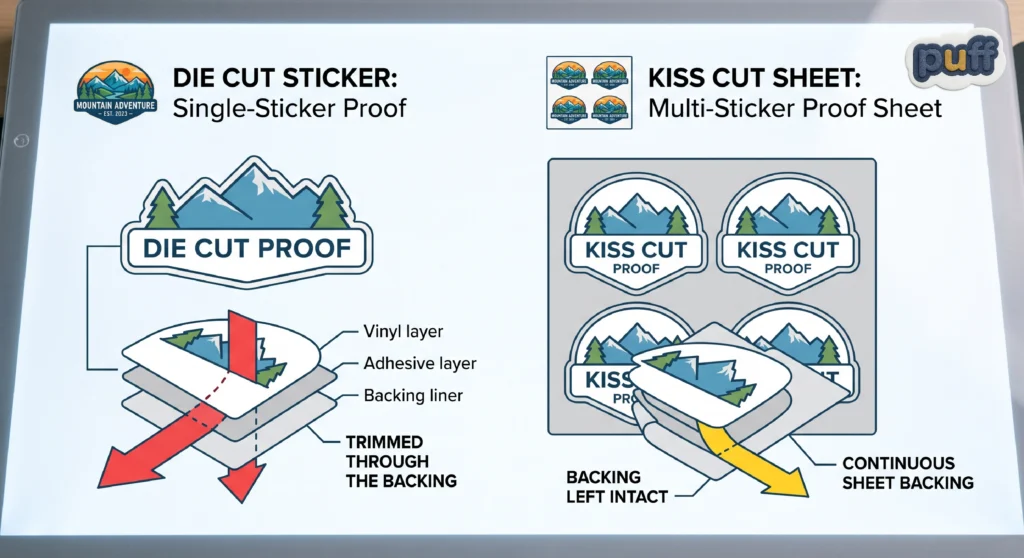
A die cut sticker is trimmed all the way through both the sticker material and its backing, so the finished shape ends exactly where the artwork ends, with nothing extra attached. A kiss cut sticker leaves the backing sheet intact around the design, cutting only through the sticker layer itself, so several designs can share one larger sheet without separating until someone chooses to peel one free.
The difference sounds procedural, and on a spec sheet it looks like one. In practice it changes how the object gets handled before it is ever used. A die cut sticker reads as a single, complete object the instant someone picks it up, an edge with nothing extra riding along with it, ready to be placed immediately. A kiss cut sheet reads as a set first, several options sitting together, meant to be looked over before anyone commits to peeling just one away from the rest.
The psychologist James Gibson described the way an object’s physical form signals how it is meant to be handled, a concept known as affordance, the idea that shape carries instructions before anyone consciously works them out. A die cut edge affords immediate placement. A kiss cut sheet affords browsing, comparing, choosing among options first. Neither format is more correct than the other. They are built for different moments in a customer’s decision, one for someone who already knows exactly what they want, the other for someone who wants to look at several things side by side before deciding.
For businesses running promotional giveaways, kiss cut sheets often work better precisely because they invite that browsing moment, turning a giveaway into a small selection process instead of a single handout. For individual designs meant to stand alone, die cut is almost always the more natural choice.
How Thick Should a Puffy Sticker Be
Puffy sticker domes generally sit somewhere between half a millimeter and two millimeters of relief above the backing, a range that sounds almost too narrow to matter until a fingertip actually crosses it. Thinner than that and the dome barely registers as raised at all. Thicker than that and the sticker becomes fragile at the edges, more likely to catch and peel during ordinary handling.
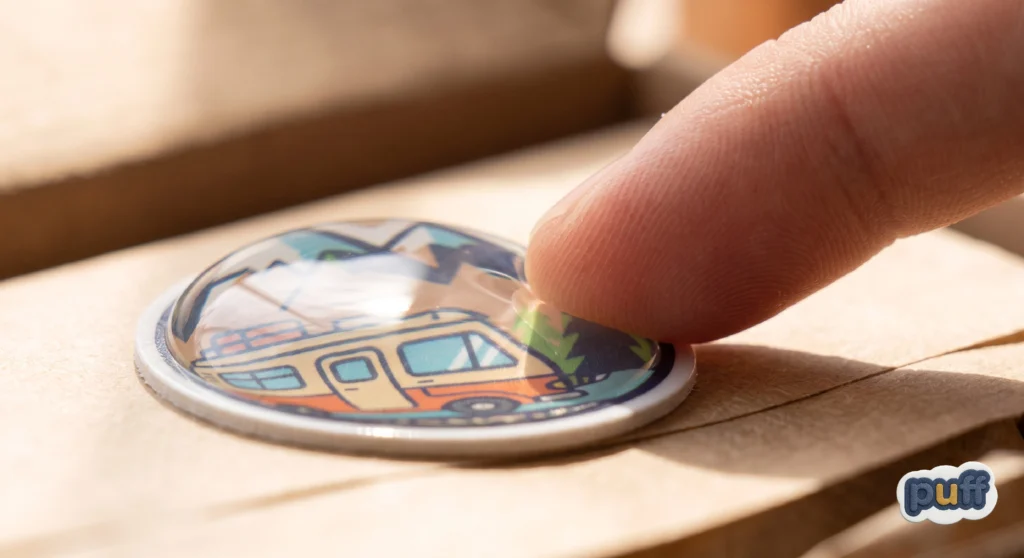
Human skin is more sensitive to that range than intuition suggests. Researchers studying tactile perception describe a measure called two point discrimination, the smallest distance between two points of pressure that skin can still tell apart as separate rather than one. Fingertips sit among the most sensitive skin on the body by this measure, able to distinguish points separated by only a few millimeters. A dome rising even a fraction of a millimeter above its surroundings registers to a fingertip almost at once, often before the eye has finished confirming what it is looking at.
That sensitivity is the reason a puffy sticker feels different from a flat one within the first second of contact, long before anyone has consciously decided to notice. It is also why thickness functions as something closer to a personality trait for the finished sticker than a manufacturing spec. A thinner dome reads as subtle, a soft suggestion of depth rather than a statement. A fuller dome reads as deliberate, closer to a small object in its own right than a decorated surface.
When 3D Stickers Become Collectibles traces what that same raised surface does to a person’s relationship with an object over years rather than seconds, once a sticker’s texture starts working on memory instead of just touch. Thickness is where that relationship starts. Everything the flagship essay describes happening slowly, over years of handling, begins with this one physical decision made before the sticker is even printed.
Waterproof Versus Water Resistant
A water bottle goes through the dishwasher for the third time this week, sticker still fully intact. That is the water resistant standard doing its job, built to survive a splash, a damp hand, an occasional trip through light rain without the artwork lifting or smearing.
Waterproof stickers are built for a harder standard: repeated submersion, regular washing, a permanent spot on a bottle refilled from a sink every single day for years rather than weeks.
The difference usually comes down to the adhesive and the lamination working together rather than either one alone. A waterproof adhesive backing paired with a poorly sealed dome still lets moisture creep in along an exposed edge over time, eventually lifting the print underneath even though the sticker was technically rated waterproof. The two specifications have to be chosen as a matched pair based on where the sticker is actually going to live, not selected separately out of habit.
For anything going on a mug, a water bottle, or an item washed regularly, waterproof is worth the modest cost difference over water resistant. For a laptop lid, a notebook cover, or anything that mostly stays dry and only occasionally meets a spilled drink, water resistant usually covers the real risk without paying for a durability rating the sticker will rarely need.
Either rating still has limits worth knowing before an order goes out. Dishwasher safe is not the same claim as waterproof, since sustained heat breaks down some adhesives faster than repeated water exposure alone does. A sticker rated for regular handwashing may still need to sit out of a hot dishwasher cycle to hold up for its full expected lifespan, a distinction worth raising with a print shop directly rather than assuming one rating automatically implies the other.
Common Printing Methods
A press runs a few hundred sheets through in full digital color before anything gets domed. That is how most custom puffy stickers begin, a process fast enough to handle photographic or gradient heavy artwork economically even at small quantities, with the domed lamination that gives the sticker its shape applied afterward as a separate step.
Screen printing shows up more often on simpler designs using fewer colors, where the ink itself needs to sit thicker on the page and hold up under heavier or more repeated wear than digital printing alone provides.
Neither method changes what the finished sticker actually feels like once the dome goes on top, because doming happens after printing is already complete, on different equipment entirely. That separation is part of why the same base artwork can move between finishes, glossy dome, matte dome, thicker or thinner relief, without ever needing to be redrawn or re-separated for a different press.
Choosing between the two methods usually comes down to color count and order size rather than any difference in the final tactile experience. Digital printing wins for full color, photographic, or gradient heavy designs at almost any quantity. Screen printing wins for simple, high contrast designs ordered in bulk, where the thicker ink lays down a more saturated, durable color across a very large run.
Frequently Asked Questions
A first time customer stares at a spec sheet, unsure where to start. These are the questions that come up before almost every other one.
How long does a custom puffy sticker order typically take? Most runs move from approved artwork to finished stickers in 18–20 business days, with the exact timeline depending on quantity, material, and whether the design needs adjustment before it goes to press.
Can one sheet include more than one design? Yes. Kiss cut sheets exist specifically for that, letting several separate designs share one backing without separate orders.
Do puffy stickers fade in direct sunlight over time? UV resistant coatings slow fading considerably and are worth specifying for anything spending real time outdoors, though no printed material is entirely immune to color shift under years of constant direct sun.
Can a puffy sticker be cut into a fully custom shape rather than a standard circle or rectangle? Yes, die cutting can follow the exact outline of the artwork itself, which is the more common choice for character or logo based designs.
Is there a minimum order size for a custom run? MOQ is 250 pieces. Custom puffy stickers are available at both small personal quantities and larger business volumes, with the per unit cost dropping meaningfully as quantity increases, worth factoring in before settling on a small trial run.
What is the easiest way to see current material and finish combinations before placing an order? Browse the custom puffy sticker options to compare current sizes, materials, and finishes side by side, the fastest way to see real choices before working through a custom spec sheet from scratch.
Can a sample be ordered before committing to a full run? Yes. A single physical sample is worth requesting anytime color accuracy or dome thickness matters more than a digital proof can confirm, especially for a first order or a design moving between finishes.
How should a puffy sticker be cleaned once it has been applied? A soft cloth and mild soap handle most everyday grime without affecting the dome or the print underneath. Harsh solvents and abrasive scrubbing are the real risk, since they can dull the clear coating faster than ordinary handling ever would.
Does a puffy sticker work on a curved or textured surface, or only flat ones? Soft PVC domes flex with a curved surface the way a water bottle or a helmet requires, while a heavily textured surface, canvas or unfinished wood, needs the sticker’s adhesive backing matched to that texture rather than relying on the dome alone to hold the bond.
The Point of All These Decisions
Every decision in this guide sounds technical in isolation, a material code, a cut type, a thickness measured in fractions of a millimeter. Traced back to where each one actually lands, in somebody’s hand, on a surface they touch every day, under light that changes depending on where they happen to be standing, none of it is really technical at all.
A flat sticker asks to be looked at once and then fades into the background of whatever it is stuck to. A puffy sticker asks to be handled again, tilted toward a window, run under a thumb without anyone quite deciding to do it, for as long as it stays attached to whatever it ended up on. That difference is not a manufacturing detail sitting at the bottom of a spec sheet. It is the entire reason to choose one format over the other in the first place.
The material, the cut, the thickness, the finish, none of it decides what the finished sticker will come to mean to whoever ends up holding it. Meaning gets built later, slowly, the way it always does with small objects people keep around longer than they planned to. What these decisions actually control is much narrower and much more immediate: what that person’s hand discovers the first time it crosses the edge.