
The Science of Barrier Packaging
A bag of coffee sealed in spring is opened on a grey autumn morning, and the smell rises up the way it did on the first day.
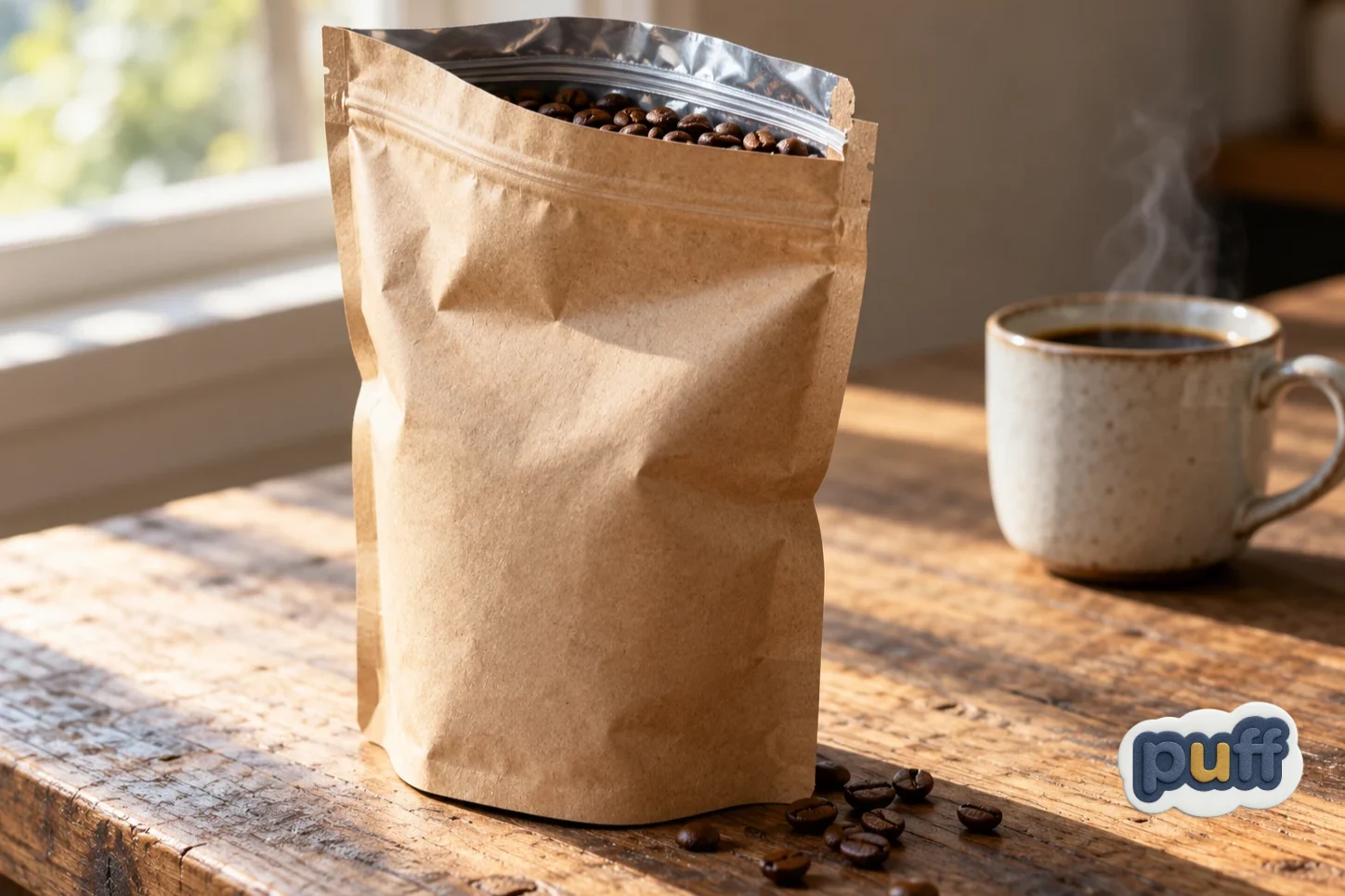
A bag of coffee sits at the back of a kitchen cupboard, behind the flour and a box of birthday candles. A small roaster sealed it in spring. Someone finds it on a grey morning in autumn, pulls the zipper, and the smell rises up the way it did on the first day: dark, sweet, a little smoky. Nothing about the kitchen stood still for those months. The seasons turned, the heating came on, the cupboard door opened a thousand times. Inside the bag, though, barrier packaging kept time moving at a different pace.
Now picture the opposite. A sleeve of crackers left unrolled on the counter overnight. By breakfast they bend instead of snap. Nothing spoiled in the dramatic sense. No mould, no smell. The air in the room walked in and settled into them, one water molecule at a time.
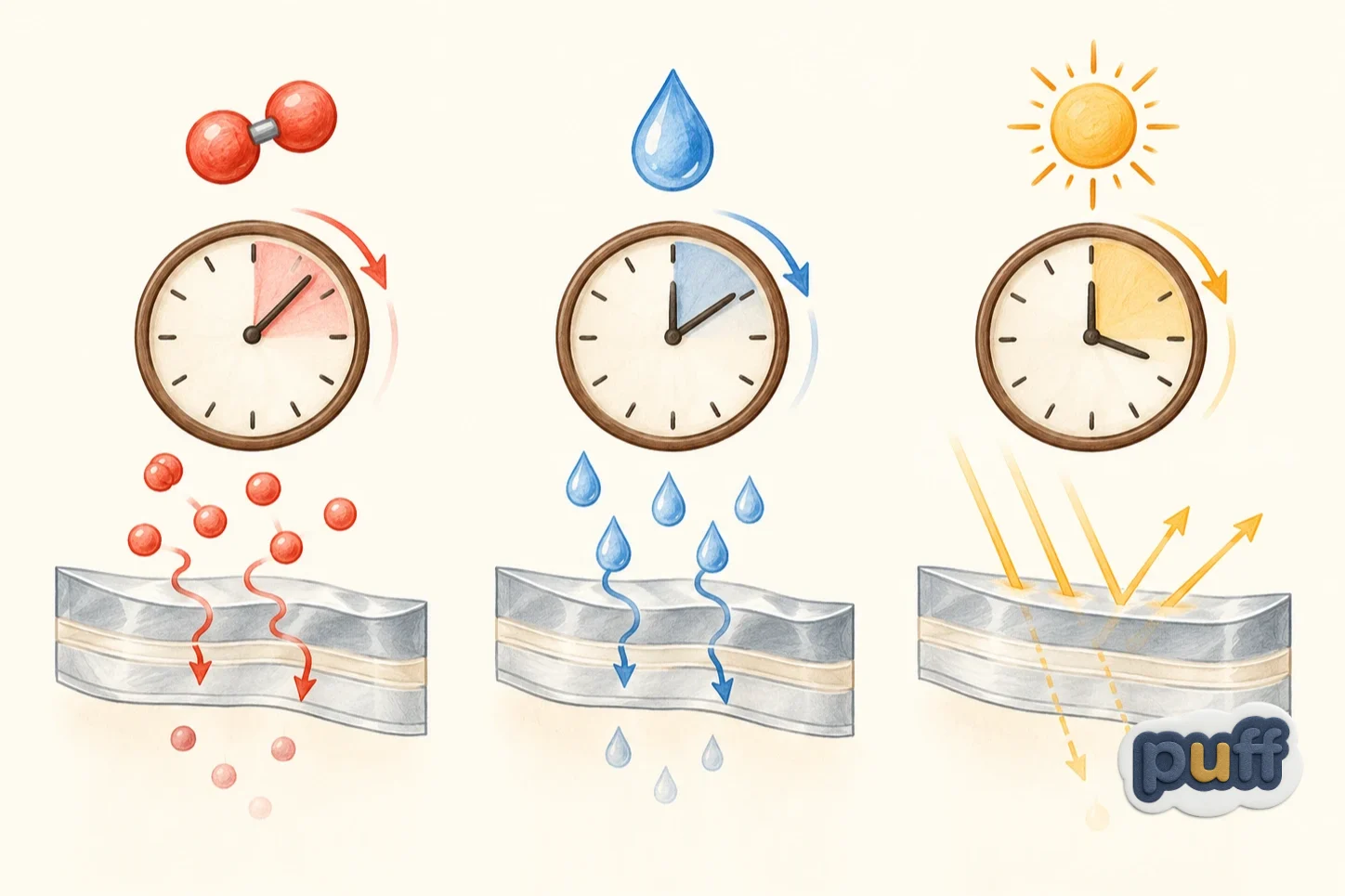
Both scenes describe the same quiet science. Every food carries its own set of clocks, and those clocks start ticking the moment the food meets the world. A package cannot stop them. What a good package can do is slow the right clock, by the right amount, for the right length of time. That is the whole craft of barrier packaging, and once you see it this way, a pouch on a shelf stops looking like a container and starts looking like an agreement about time.
Three Clocks in Every Pantry
Open any cupboard and you are looking at a room full of slow chemical events. The walnuts are drifting toward a bitter, papery taste. The dried basil is fading from green to khaki. The brown sugar is turning into a brick. Each of these changes runs on a different engine, and food scientists have spent careers measuring how fast each one runs.
Three engines matter most for packaged dry goods. The first is oxygen. Air is about one fifth oxygen, and oxygen loves to react with fats, aromas, and colour compounds. It is the reason nuts go rancid and why coffee loses its perfume long before it would ever make anyone sick. The second is moisture. Water vapour moves from wherever there is more of it to wherever there is less, so a dry cracker in a humid kitchen acts like a sponge waiting to happen. The third is light. Sunlight and even bright shop lighting carry enough energy to break apart vitamins, fade natural colours, and push oils toward that stale, cardboard flavour.
Here is the part that changes how you see a package: every food has one clock that runs faster than the others. For roasted coffee it is oxygen, along with the slow escape of the aromas that make coffee smell like coffee. For crackers, chips, and freeze dried fruit, it is moisture. For something like a cold pressed oil or a herbal tea in a clear window pouch, light can be the quiet thief. The clock that runs fastest decides when the food stops being at its best, and that is the clock the package needs to fight first.
The food scientist Ted Labuza spent much of his working life on this idea. He studied how fast the reactions inside food move, and how temperature, moisture, and the package itself speed them up or slow them down. His work helped turn shelf life from a guess into something you could predict with real numbers. The lesson underneath all of it is simple and a little humbling. Food is always changing. The only question is how fast.
An Old Fight With Time
Long before anyone said the word barrier, people were already fighting the same three clocks. They packed fish in salt to pull the water out. They dug cellars into hillsides because cool, dark earth slowed everything down. They poured a layer of fat over cooked meat in a crock, or sealed jam jars with a disc of wax, to keep the air away from the food beneath.
Every one of those habits is a barrier in disguise. Salt fights the moisture clock from the inside. A cellar slows all three clocks by keeping them cold and dark. A cap of fat or wax is a little lid against oxygen. Grandmothers who never studied chemistry understood, through generations of trial and spoiled batches, which clock mattered most for which food.
In the early 1800s, a French confectioner named Nicolas Appert found that food sealed in glass and heated could last for months. He did not know why it worked. Nobody had yet shown that tiny living things cause most spoilage. He only knew that a good seal and patient heat could hold a summer harvest into winter. The tin can followed, then the foil wrapper, then the thin films we know today.
What changed over those two centuries was the material, not the goal. A modern pouch is doing the same job as a cellar, a salt barrel, and a wax-sealed jar, folded into something you can slip into a tote bag. It carries a long human story in a very small space. When you tear the top off a bag of dried apricots, you are taking part in one of the oldest habits we have: setting food aside for a later day and trusting that it will still be good when that day comes.
That trust is a cultural thing as much as a technical one. Different places have different relationships with stored food. Some kitchens keep a deep pantry, stocked for months. Others shop for the day and keep almost nothing. Packaging shapes those habits too. A bag that keeps food well for a long time makes a deep pantry possible, and a deep pantry changes how often a family shops, what they buy in bulk, and how much they throw away.
How Barrier Packaging Works: A Wall That Lets a Little Through
Hold a sealed pouch up to your ear and give it a soft squeeze. It feels solid, finished, closed. In the language of everyday life, a sealed bag is either open or shut. In the language of materials science, nothing is ever fully shut.
Gases slip through solid plastic films by a process called permeation. A molecule of oxygen lands on the outer surface, dissolves into the film, wanders through the tangle of polymer chains, and comes out the other side. It sounds impossible, the way it sounds impossible that light can pass through a window. Yet it happens all the time, at a pace set by the material, its thickness, the temperature, and the difference in pressure on each side.
A helpful way to picture it is a crowd crossing a thick forest. A thin film is a narrow strip of trees, and people stroll through in a steady stream. A thicker film is a wider forest, so fewer make it across in a day. A film with a metal layer is a forest with a tall stone wall running through the middle, with only the odd crack to squeeze through. Warm weather sends more people walking. Cold weather keeps most of them home. The forest never becomes a perfect wall. It only changes how many get through, and how long it takes.
This is why engineers do not describe a barrier with a yes or a no. They describe it with a rate. The oxygen transmission rate of a film tells you how much oxygen passes through a square metre of it in a day, and its partner measure does the same for water vapour. A thin everyday sandwich bag lets a lot through. A film with a metal layer lets through very little. Aluminium foil, when it has no pinholes, comes close to zero. Close, though, is the honest word. Barrier is a dial, not a switch.
Once you think of it as a dial, a lot of packaging choices start to make sense. A bag does not need to be perfect. It needs to be slow enough that the food's fastest clock never runs out before someone finishes eating it.
The Trust We Place in a Bag We Can't See Through
A glass jar of lentils is easy to trust. You can see every lentil. You can watch for anything strange. A shiny or kraft lined pouch asks for a different kind of trust, because it hides the very thing you care about.
Think about how that feels at the shelf. You pick up a bag of loose leaf tea, and you cannot see the leaves. What you can see is the surface of the bag, the weight of it, the stiff fold at the gusset, and a small printed date. You can hear it too. In The Sound of Packaging, we looked at how the crisp rustle of a mylar bag tells your hands what they are holding before your eyes catch up. That sound is part of the trust. A soft, papery crinkle suggests one kind of bag. A brighter, tighter rustle suggests something sealed and serious.
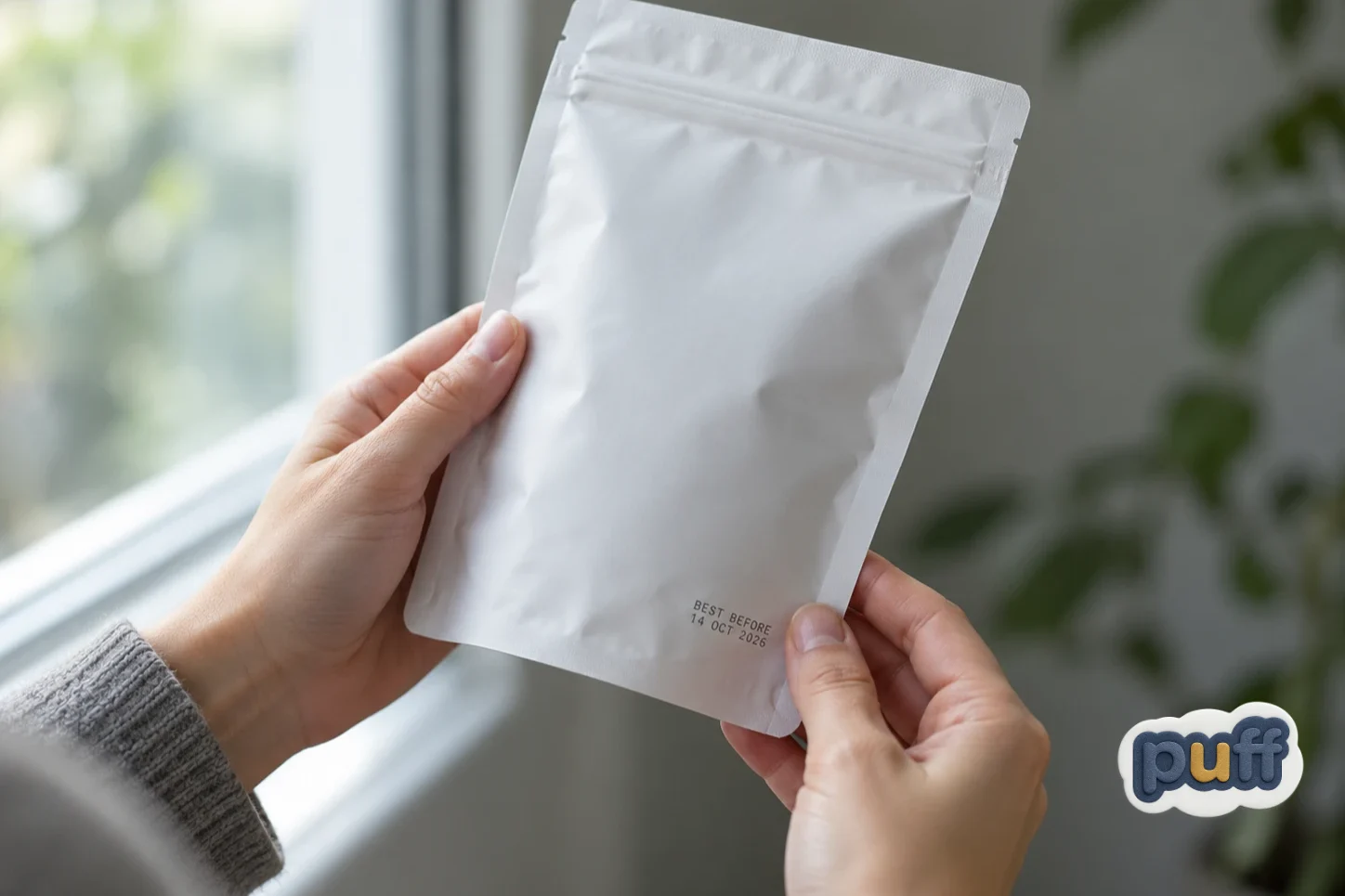
The printed date might be the most interesting part. A best before date is a promise that came out of a clock. Somewhere, someone measured how fast oxygen and moisture move through this particular film, how fast this particular food changes, and how warm the shop and the kitchen are likely to be. Then they turned all of that into one quiet line of ink. When you read that date, you are reading the result of the science without ever seeing the science.
There is something gentle about that. Most of the care that goes into a package happens where nobody will ever look. The person who opens the bag does not think about transmission rates or polymer chains. They think, this still smells lovely. That is the whole goal. A barrier does its best work when it makes itself invisible.
Where the Layers Come From
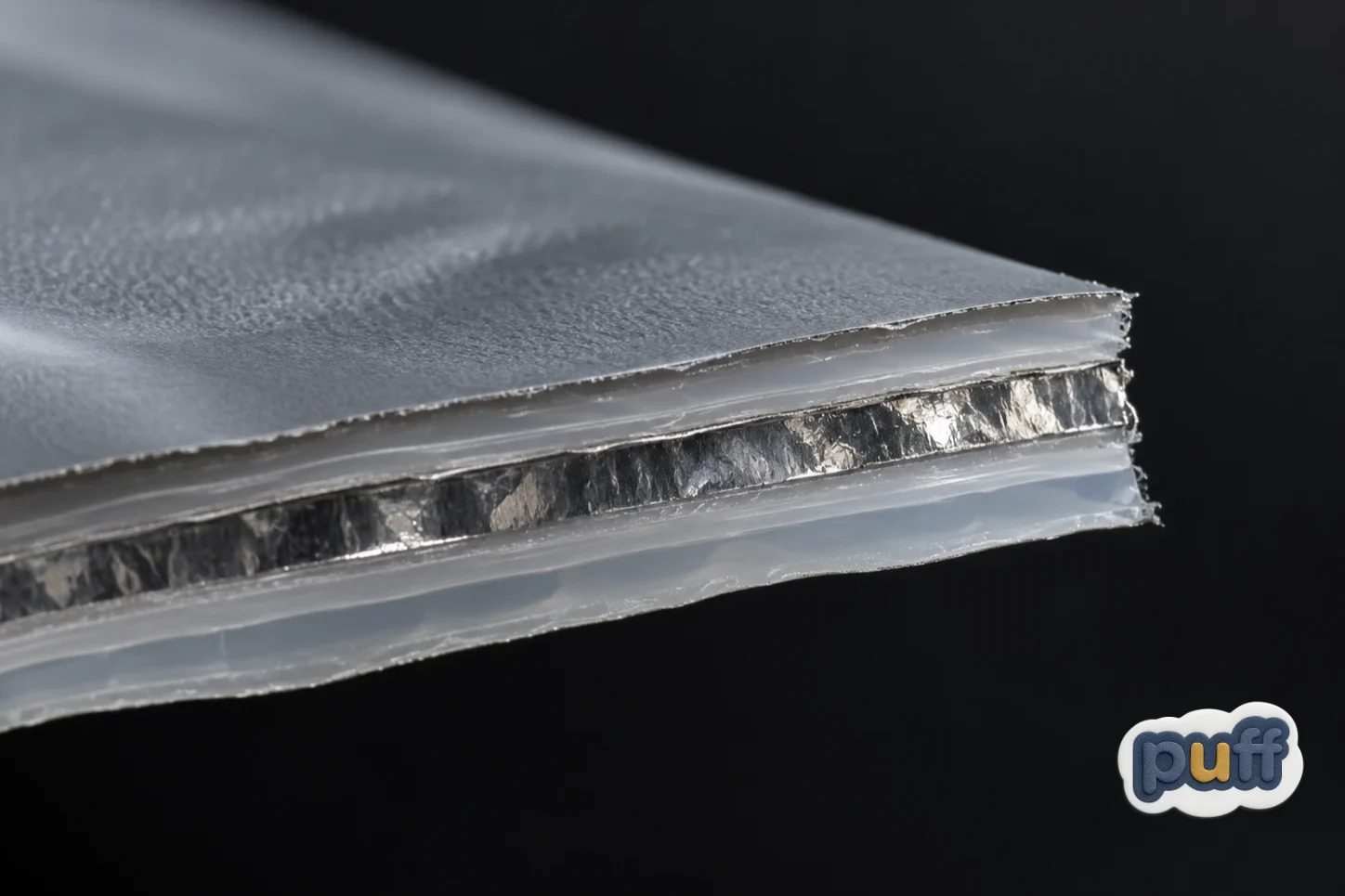
Look at the cut edge of a sturdy food pouch with a magnifying glass and you may see what looks like a single sheet. In many cases it is several sheets bonded into one, each chosen for a different job.
One layer gives the bag its strength and its printable face. One layer, often a thin metallised film or a coated barrier film, does most of the work against oxygen, moisture, and light. One layer on the inside melts under heat so the bag can be sealed shut. In the Complete Guide to Custom Mylar Bags, we followed polyester film from its early life in scientific and industrial work to its place on a pantry shelf. The short version here is that each layer is a specialist, and a laminated pouch is a small team of specialists pressed together so close you would never guess there was more than one.
This is where the science starts to run into a harder conversation.
The Honest Tension
Picture a recycling sorting line. Items move fast on a belt, past cameras, magnets, and jets of air. A plain bottle made of one plastic is easy. A pouch made of three or four bonded materials is hard, because the materials cannot be pulled apart again in any practical way. The very thing that made the pouch so good at slowing the clocks, its stack of specialist layers, is the thing that makes it hard to give a second life.
That is the tension at the heart of modern packaging, and it would be dishonest to pretend it away. Stronger barrier tends to mean more layers or more different materials. More different materials tends to mean a harder path through recycling. A bag made from a single material, which is far easier to recycle, often gives up some barrier strength to get there.
Then the story gets one more twist. When a package fails to protect its food, the food gets thrown away, and wasted food carries a heavy footprint of its own: the farming, the water, the transport, the roasting, all of it gone. As we explored in Why "Paper Is Better" Isn't a Complete Packaging Argument, a barrier's greatest environmental gift is often the food it saves, and that gift is easy to miss because you never see the spoiled food that did not happen.
So there are three things pulling against each other: how well the bag protects, how easy the bag is to recycle, and how long the food needs to last. You cannot push all three to the maximum at once. Anyone who tells you otherwise is selling you a feeling, not a package.
None of this is a reason for despair. Materials scientists keep finding ways to get more barrier out of a single kind of plastic, so a pouch can stay protective while staying one material from the outside in. The progress is real. Still, the most useful step for anyone choosing packaging today is a quieter one, and it starts with asking the right question.
The Look of Protection
For a long time, serious barrier packaging had one look. It was silver, shiny, and a little clinical, the kind of bag that came out of a camping shop or a military ration box. The shine said protected. It did not say warm, or homemade, or made with care.
Walk down a coffee aisle today and that has changed. You see matte black pouches with a soft, almost velvety touch. You see paper-faced bags in oatmeal and sand tones, printed with a single line drawing. You see pouches that stand up on their own and fold over at the top like a lunch sack. Many of them carry the same kind of barrier inside that the old silver bags did. The protection moved inward, out of sight, and the outside became free to look calm.
There is one design choice where looks and science still pull hard against each other: the little clear window. People love to see the food. A window turns a mystery bag into something you can judge with your own eyes, and that can build trust fast. Yet a window is also a gap in the light barrier, a small doorway for the third clock. For a bag of pasta or dried beans, that may not matter much. For roasted coffee, delicate tea, or anything with bright natural colour, it matters a great deal. The prettiest bag on the shelf is not always the one that keeps its food the longest, and a thoughtful maker weighs that trade on purpose instead of by habit.
The Right-Sized Barrier
A good tailor does not make every coat as heavy as possible. A coat for a mild spring evening and a coat for a winter in the mountains are both good coats. They are good because they fit the weather they will face.
Barrier works the same way. The bag that wastes the least is seldom the one with the strongest barrier or the one with the lightest barrier. It is the one matched to the food's fastest clock and the life that food will live. We can call this the right-sized barrier. Too little barrier and the food spoils, so the bag fails at its main job and creates waste. Too much barrier and you have spent extra material, and often lost an easier recycling path, to protect against a clock that was never going to run out.
A few plain questions get you most of the way there.
What changes first in this food? If it is a roasted coffee or a bag of nuts, oxygen deserves the most attention. If it is a crisp snack or a powdered drink mix, moisture is the main enemy. If it is something with bright natural colour or delicate oils, light matters more than you might expect.
How long will it sit before someone finishes it? A small batch of cookies sold at a weekend market and eaten within the week lives a very different life from a bag of dried mango that might travel across an ocean and wait on a shelf for months.
Where will it live? A warm, humid shop speeds up every clock. A cool, dry storeroom slows them down. Heat matters more than most people think, because chemical reactions run faster as things warm up.
How will people use it? A bag that gets opened once and emptied is one thing. A bag that gets opened every morning for a month needs a good reseal, because every time the zipper opens, fresh air rushes in and the oxygen clock jumps forward.
Picture two makers working a few streets apart. One bakes shortbread for a Saturday market. Her biscuits are buttery and dry, and they sell out by noon most weeks. Her fastest clock is moisture, with oxygen working slowly on the butter in the background, and her customers will finish a bag within days. A modest barrier with a good seal serves her well, and she can lean toward the simplest material, the one easiest to recycle, without putting her biscuits at risk.
The other maker roasts single origin coffee and ships it to people in other cities. His beans keep releasing gas for days after roasting, and their aroma starts to fade the moment oxygen reaches them. His bags might sit in a postal van, then on a doorstep in the sun, then on a shelf for weeks. His fastest clock runs hot, and he needs a strong oxygen and light barrier, plus a one-way valve and a reliable zipper, or his best work will reach people tasting flat.
Neither maker is more responsible than the other. Each one has matched the bag to the food and the journey. If they swapped packaging, both would be worse off: the baker would be using more barrier than her biscuits need, and the roaster would be sending his coffee out half protected. The right answer depends on the clock, and the clock depends on the food.
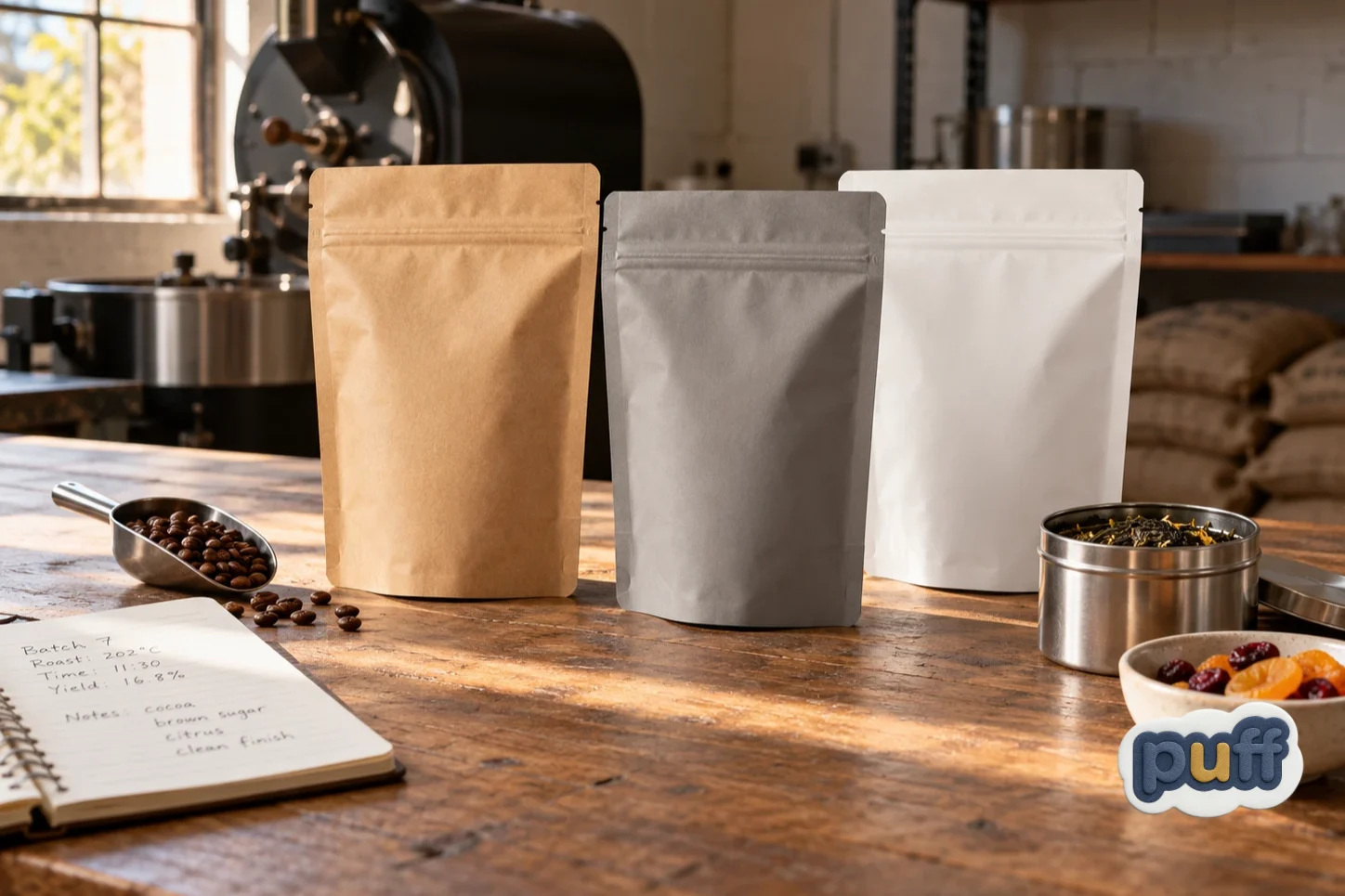
For a coffee roaster or a tea blender who wants a warm, natural look without giving up protection, a kraft mylar bag shows how these choices can come together. The paper face gives it a soft, earthy feel in the hand, while the barrier inside is designed to block oxygen, moisture, and light.
The Moment the Seal Breaks
There is a small sound when a heat seal tears open, a soft dry rip that marks the end of the bag's first life. Up to this point, the barrier has been working against the outside world. From this moment on, it is working with a person.
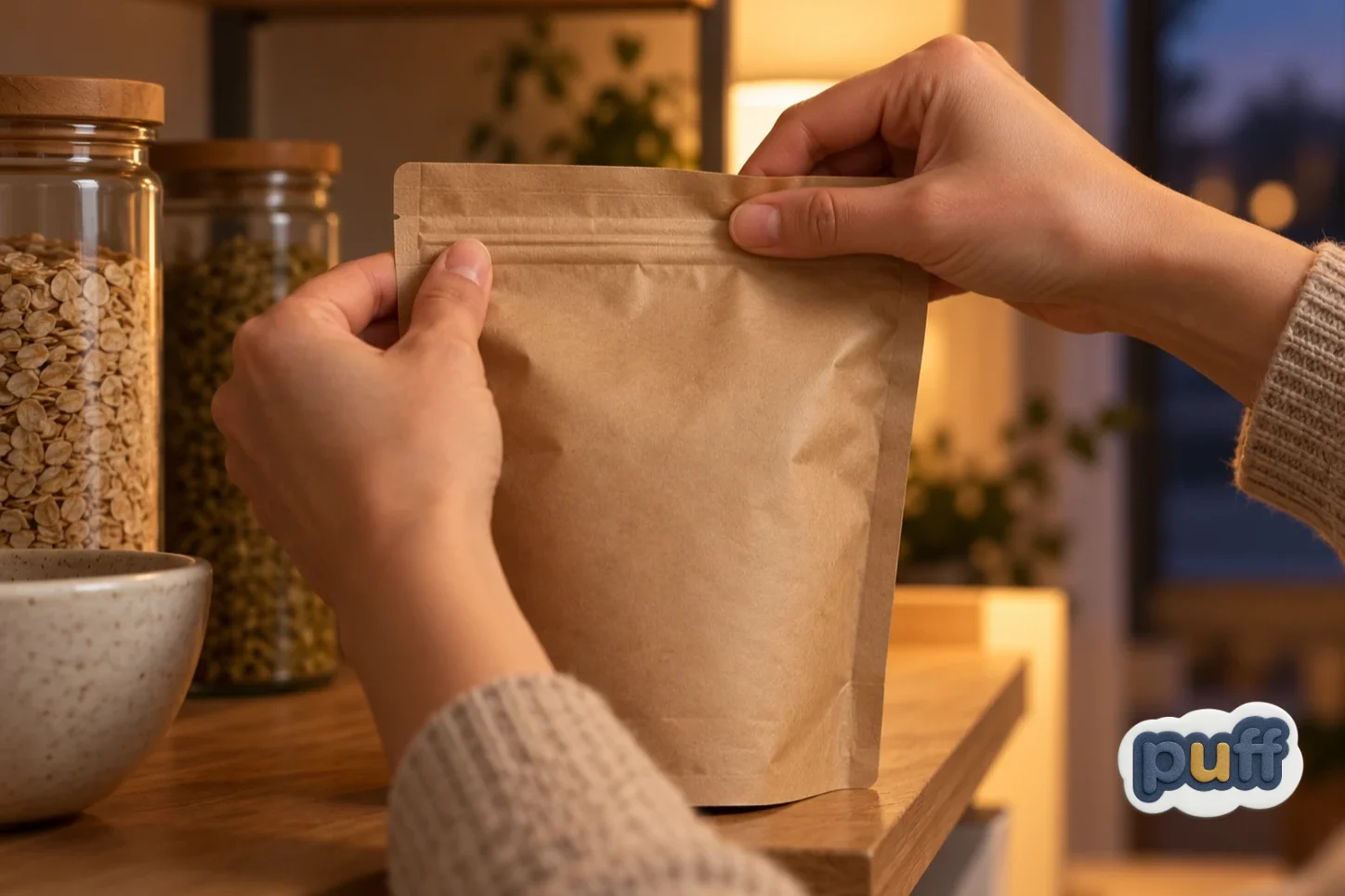
This second life gets far less attention than it deserves. A pouch with a strong barrier and a weak zipper loses most of its value after the first scoop. A pouch with a good reseal, folded down and pressed shut, keeps slowing the clocks in the kitchen the same way it did on the shelf. The difference shows up a few weeks later, in the smell of the coffee or the snap of the cracker.
It also shows up in how people feel about the brand. Nobody writes a review that says the oxygen transmission rate was well chosen. They say the beans tasted fresh until the last cup. They say the granola stayed crunchy. They remember, without quite knowing why, that this brand's food always seems to keep. For a small business, that quiet memory is worth more than almost any claim printed on the front of the bag. The barrier becomes part of the flavour, and the flavour becomes part of the name.
There is a kindness hidden in this. When a maker chooses the right barrier, they are thinking about a morning they will never see, in a kitchen they will never visit, for a person they will never meet. They are trying to make sure that the last scoop tastes almost as good as the first. Most care in the world looks like that: invisible, practical, and aimed at someone else's ordinary day.
A Kind of Patience
Go back to the coffee at the back of the cupboard. When it was roasted, a small set of clocks began to tick inside it. Oxygen wanted in. Aroma wanted out. Moisture and light waited at the edges. The bag could not stop any of them. What it did instead was ask each one to wait a little longer.
That is a better way to see packaging than the one most of us carry around. We tend to think of a bag as a wall, something that either keeps the world out or fails to. The truth is softer and more interesting. A barrier is a form of patience. It holds a moment in place for as long as that moment needs holding, and then it lets go.
Seen this way, the hard questions about packaging and waste stop being a fight between good materials and bad ones. They become questions of fit. How much patience does this food need? How much material does it take to give it that patience, and where does that material go when the patience is no longer needed? There is no single bag that answers all of that for every food. There are only thoughtful matches, made one product at a time.
The best barrier is the one nobody notices. The coffee smells like spring in the middle of autumn, the person holding the bag smiles without thinking about why, and somewhere far away a maker's careful choice has done its quiet work.