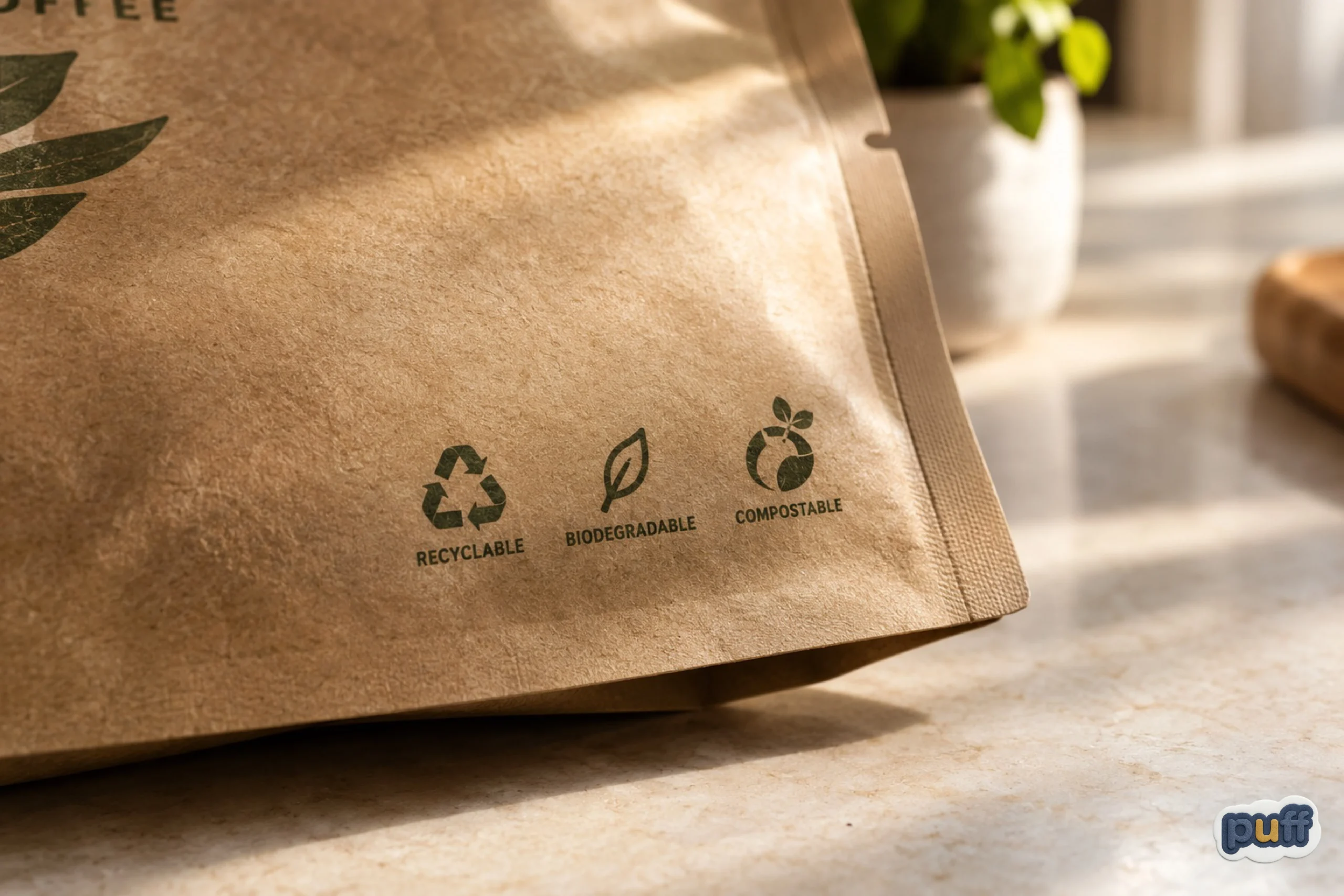
Stand over a kitchen bin with a bag in your hand and you will probably hesitate for a second. There is a small green leaf printed near the seam, a chasing-arrows triangle stamped on the back, and somewhere in the fine print, the word “biodegradable.” Three symbols, three claims, and usually just one bin close enough to reach. So you guess. Maybe the leaf wins and it goes in with the food scraps. Maybe the triangle wins and it goes in with the cans. Either way, you have just made a decision the packaging was supposed to make easy, and instead made harder.
This happens millions of times a day and it rarely gets treated as a problem, because all three words point in the same emotional direction. They all say, more or less, “you did the right thing.” Nobody stops to ask whether “right” means the same thing three different ways, because on the surface it feels like it should.
One Feeling, Three Separate Claims
Recyclable, compostable, and biodegradable used to be specialist words, the kind an engineer or a materials scientist would use precisely and nobody else would use at all. Somewhere along the way they became casual synonyms for “good for the planet,” used almost interchangeably in conversation and, often, deliberately blurred on packaging design. But underneath the shared good feeling, each word is describing a completely different physical process, with its own conditions, its own timeline, and its own way of failing.
Recyclable is a claim about infrastructure as much as material. It means the object can be collected, sorted, and reprocessed into something new, but only if a facility exists nearby that accepts that specific material, and only if the material actually gets sorted into the right stream. A recyclable bag in a city with no processor for that plastic type is, in practice, just a bag.
Compostable is a claim about a defined chemical transformation. It means the material will break down into usable soil, but only under specific conditions: sustained heat, moisture, and microbial activity that most home compost piles never reach. Most compostable packaging is certified for industrial composting facilities, not backyard bins, and the certification comes with a bounded window of time, often ninety to a hundred and eighty days, not “eventually.”
Biodegradable is the loosest claim of the three, and that looseness is the point worth noticing. It simply means the material will break down through natural biological processes at some point. No promised timeline. No promised facility. No promised end state. Almost anything is technically biodegradable if you wait long enough, including a lot of things nobody would call environmentally friendly. A material that takes four hundred years to break down is, strictly speaking, still biodegradable.
Packaging design tends to lean into this confusion rather than clear it up. The three symbols are often grouped tightly together near the seam or the base of a bag, close enough that the eye reads them as one cluster of approval rather than three separate statements to weigh individually. That layout choice is not necessarily dishonest, but it does the opposite of what good information design usually aims for. It compresses three different questions into a single glance.
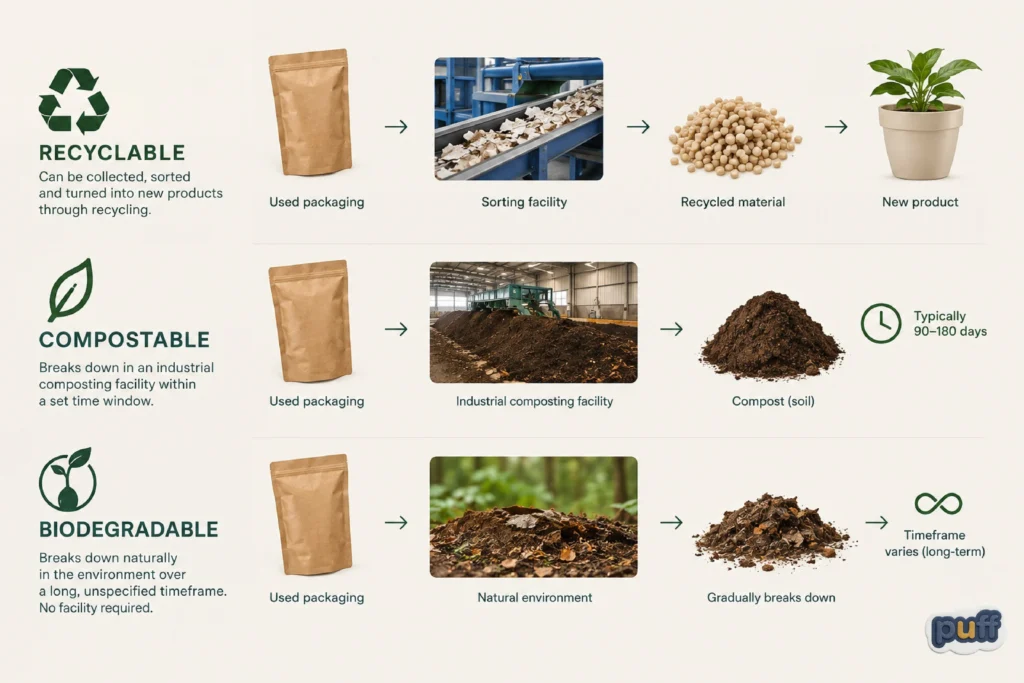
Same-looking pouch, three completely different end-of-life journeys.
Why We Round Up
There is a reason the vaguest of the three words often feels the most reassuring rather than the least. “Bio” sounds like nature doing the work quietly on its own, no facility, no sorting truck, no fine print. “Recyclable” sounds bureaucratic by comparison, dependent on a system you have to trust to function correctly. So people often relax more at the word that actually commits to the least, and grow more skeptical of the word that is, in a strange way, the most rigorously defined and independently verifiable of the three.
This is not a failure of intelligence. It is a shortcut every brain takes with moral language. Once a signal registers as broadly good, the mind tends to stop parsing the details and starts trusting the category. You see a leaf, you feel virtuous, you move on. The three words get treated like they are stacking the same kind of good on top of each other, each one adding a little more credibility to the others, when in reality they are three separate promises that do not necessarily support one another at all.
The shortcut has a real cost, and it is a quieter one than most packaging debates admit. Someone who feels reassured by any of the three symbols is less likely to pause and check what their own city’s program actually accepts, because the reassurance already did its job. The confusion is not just a labeling inconvenience. It changes behavior at the bin, and it does so in the opposite direction from what the symbols were meant to encourage.
When One Virtue Works Against Another
Here is the part that rarely makes it into a marketing brief. Engineering a material to satisfy one of these three claims can actively undermine another. A plastic film with additives designed to help it biodegrade faster in a landfill often has a weakened polymer structure, the exact thing a recycling facility needs intact to reprocess it into something new. Add one virtue, quietly subtract another.
The same tension shows up with compostable plastics like PLA. To a sorting machine, and often to a person standing at a bin, a compostable cup can look identical to a recyclable one. If enough compostable material ends up mixed into a recycling stream, it can contaminate the whole batch, forcing recyclers to send material to a landfill that would otherwise have become something new. The three claims are not simply additive. Stack them without understanding the tradeoffs, and you can end up canceling out the very outcome you were aiming for.
This is why testing matters more than the label does. Facilities like the New Materials Institute, led by Jason Locklin, exist specifically to put these claims through the same conditions a landfill, a compost facility, or a recycling plant actually provides, rather than taking a marketing department’s word for how a material will biodegrade once it leaves the shelf.
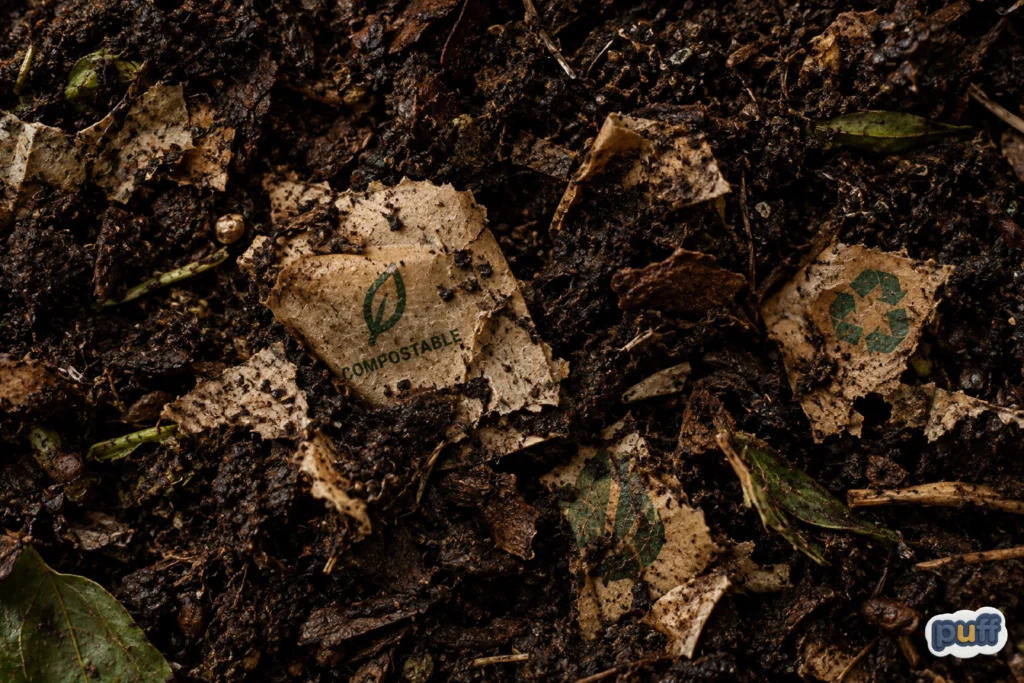
This is what “compostable” is supposed to look like, given the right conditions.
What the Label Should Actually Tell You
A useful habit, once you know the difference, is to stop asking “is this eco-friendly” and start asking a more specific question: what exactly is this claiming, and can that claim be checked. A real compostable certification names a standard, something like industrial composting under ASTM D6400 in the United States, and names whether that means a home compost pile or a commercial facility with controlled heat and turning schedules. A real recyclability claim should tell you the material type clearly enough that your local program can actually take it. A bare “biodegradable” with no further detail is, functionally, closer to a hope than a guarantee.
The distinction between home compostable and industrially compostable is worth the extra sentence it takes to check, because the two are not interchangeable either. A certification body like BPI tests specifically for industrial conditions, sustained heat well above what a backyard pile reaches, and a material certified that way will often sit in a home compost bin for years without meaningfully changing shape. That single word on the label, “industrial,” is doing more real work than the leaf icon next to it.
None of this makes any single one of the three claims dishonest on its own. It just means each one is answering a narrower question than the warm feeling around the word suggests, and a shopper who understands that narrower question makes a better decision than one who is simply responding to the color green.
The Business Case for Saying Less
For a brand choosing packaging, there is a quieter lesson buried in all of this. Stacking three sustainability symbols on a bag to look maximally responsible can backfire, especially with the growing number of people who now know enough to ask what each one actually means. A single honest, specific, verifiable claim tends to earn more trust than three overlapping ones that may not even be technically compatible with each other.
This is part of what makes a recyclable mono-PE liner worth naming specifically rather than folding into a vague “eco-friendly” label. A kraft mylar bag built with a genuinely recyclable structure, one that still blocks oxygen, moisture, and light the way any good barrier packaging should, is making one clear, checkable promise instead of three blurry ones. The material science behind why that barrier performance matters in the first place is worth its own read, covered in The Complete Guide to Custom Mylar Bags. And the broader problem of a package’s visible cues carrying more persuasive weight than its actual engineering, the same instinct at work here, gets its full treatment in Why “Paper Is Better” Isn’t a Complete Packaging Argument.

Before the eco label goes on, it pays to know exactly what the material can do.

The most recognized eco symbol, and also one of the most misunderstood.
Coming Back to the Bin
Go back to that moment at the kitchen bin, bag in hand. The three symbols printed near the seam were never actually a chorus singing the same note. They were three separate, signed statements, each one making a claim about a different process, a different facility, a different stretch of time. Recyclable is a promise about infrastructure. Compostable is a promise about chemistry, bounded by a clock. Biodegradable is barely a promise at all, more of an acknowledgment that everything eventually returns to the earth in its own time.
The real question was never “is this green.” It was always narrower and more answerable than that: what, specifically, is this claiming, and where does that claim actually hold true. Once you start asking it that way, the three little symbols on a bag stop looking like reassurance and start looking like what they always were, a short, honest set of instructions, waiting for someone to read them closely enough to follow.

The recycling symbol started it. Compostable packaging is where the conversation is heading now.