Some surfaces don’t just create depth.
They define what that depth feels like.
A raised surface can feel soft and responsive.
Or smooth and sealed.
At a glance, puffy and epoxy stickers seem similar.
Both rise above the surface. Both create dimension. Both break flatness.
But the experience they create is completely different.
One absorbs touch.
The other reflects light.
One feels expressive.
The other feels controlled.
And that difference begins long before we consciously think about it.
Raised, but not the same
Both puffy and epoxy stickers introduce dimension.
But the shape may rise in both cases while the material completely changes how that rise is interpreted.
Puffy stickers create depth through foam.
The surface has a slight give. It compresses under touch. The edges feel soft, rounded, and lightly cushioned.
Epoxy stickers create depth through resin.
The surface doesn’t compress. It doesn’t respond. It holds its shape beneath a smooth dome.
This changes the entire experience of depth.
The same raised form can feel either playful or precise depending on how the material behaves under touch and light.
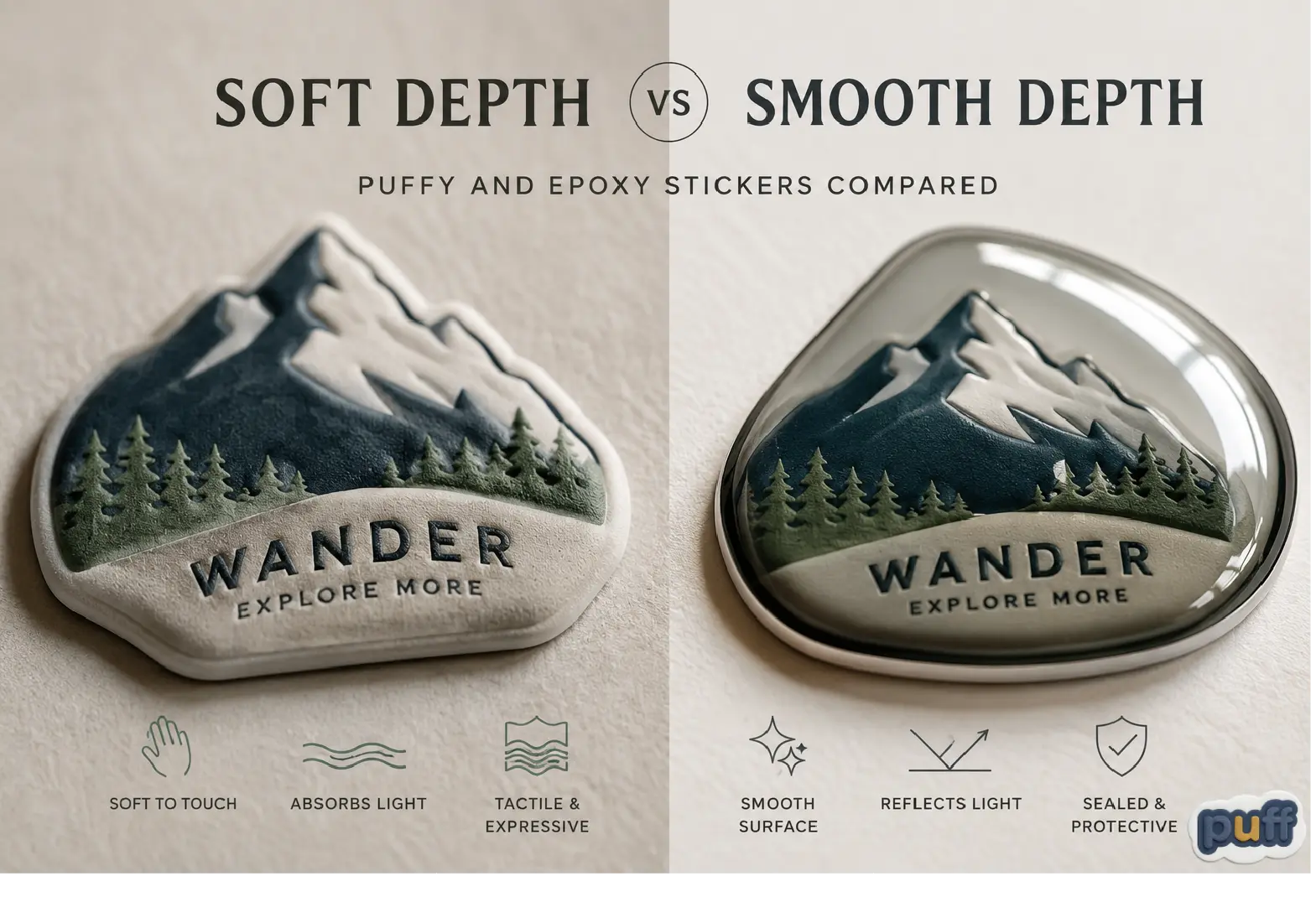
Soft depth vs smooth depth
Puffy stickers create what could be called soft depth.
The surface feels approachable. Slightly tactile. Almost forgiving.
There’s a sense that the material wants interaction.
Epoxy creates smooth depth.
The dome is polished, continuous, and visually sealed.
There are no interruptions. No softness. No visible texture absorbing the light.
It feels finished in a completely different way.
Not inviting – but complete.
That distinction matters because people don’t just react to shape.
They react to how surfaces behave.
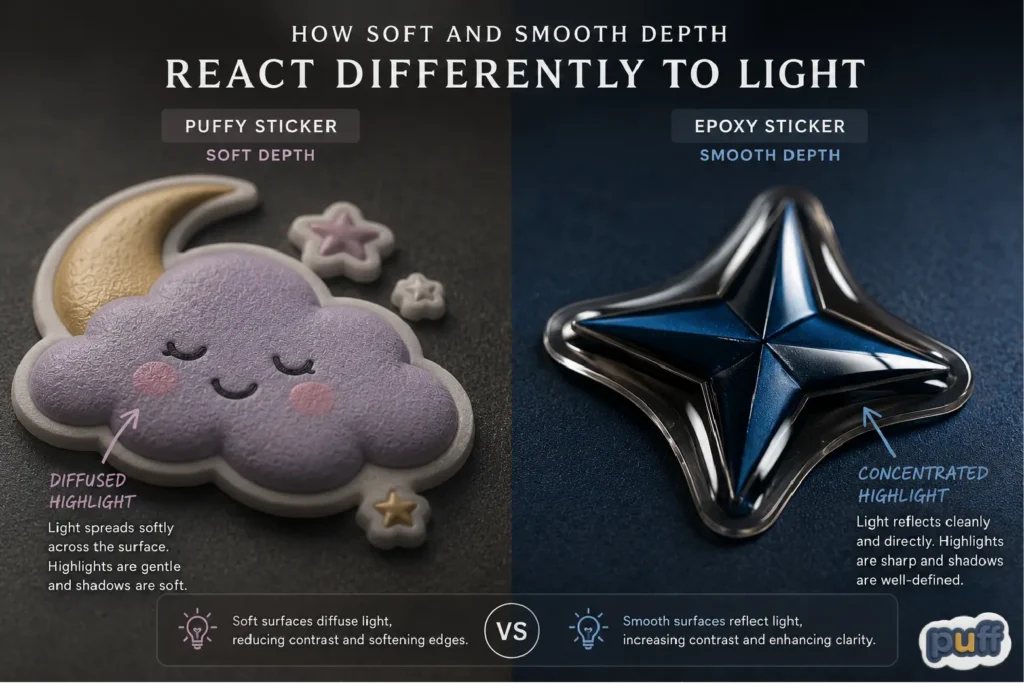
Boost your aesthetic branding by choosing how your labels react to light – diffused matte foam or concentrated glossy resin.
How soft and smooth depth react differently to light
Light behaves differently on both materials.
On a puffy sticker, light diffuses softly across the surface.
Edges appear gentler. Highlights spread gradually. Shadows feel less defined.
The material softens contrast.
Epoxy behaves almost the opposite way.
The resin dome reflects light cleanly and directly.
Highlights appear concentrated and controlled, almost like glass catching movement across its surface.
This controlled reflection creates a stronger sense of structure.
Where puffy feels tactile and relaxed, epoxy feels precise.
The interesting part is that these reactions happen visually before touch is even involved. The eye already begins predicting softness, smoothness, and rigidity based on how light moves across the surface.
Why polished surfaces feel more permanent
One of the biggest differences between soft and smooth depth isn’t just touch.
It’s permanence.
A soft surface feels flexible. Slightly temporary.
A polished resin dome feels fixed.
Even before touching it, the brain interprets that smooth sealed surface differently. The reflection feels stable. The shape appears preserved beneath the resin rather than exposed to the environment.
That visual stability creates a subtle sense of durability.
Not necessarily physical durability – but psychological durability.
The object feels like it will remain the way it is.
This is part of why epoxy stickers are often associated with product badges, tech branding, automotive decals, and polished packaging details. The resin dome creates the impression that the design has been protected beneath a surface rather than simply printed onto one.
The sticker stops feeling exposed.
It feels encapsulated.
And encapsulated objects often feel more valuable because they appear preserved.
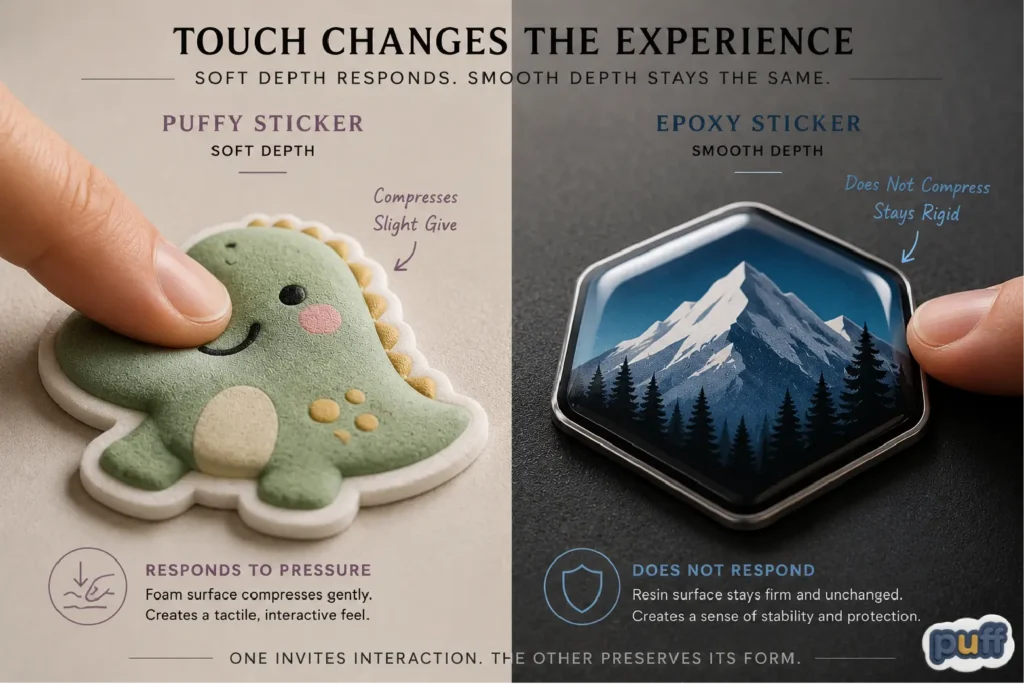
Puffy stickers offer a soft, interactive squeeze, while epoxy stickers maintain a firm, premium dome.
Why softness changes emotional response
Soft materials create a different emotional relationship.
A puffy sticker doesn’t just sit on a surface – it responds slightly to pressure. That response creates interaction, even if the movement is minimal.
People naturally associate softness with comfort, informality, and play. A material that gives slightly under touch feels less rigid and less distant.
That’s why puffy stickers often feel expressive in a way epoxy doesn’t.
They feel less engineered and more tactile.
Less sealed and more physical.
That stronger tactile connection may also explain why some dimensional stickers are never used at all. When a sticker feels particularly satisfying to touch, people sometimes choose to preserve it rather than apply it. The object becomes something to keep rather than consume. We explore this behaviour further in Why We Save Stickers We Never Use, where we examine why some people preserve their favourite stickers for years rather than ever applying them.
Even visually, softness changes interpretation.
Rounded foam edges diffuse highlights differently. Shadows soften. Surface transitions feel less exact.
The object becomes approachable before it’s even touched.
And perception doesn’t separate vision from touch as clearly as we think.
Before the hand reaches the surface, the eye has already formed assumptions about softness, flexibility, and interaction. Materials communicate these things silently.
Why smooth depth feels more controlled
Epoxy stickers feel controlled – not emotionally, but visually.
The resin dome behaves consistently under light. The reflection remains clean and concentrated. The surface appears almost tensioned, like liquid frozen in place.
That consistency matters more than people realize.
Humans naturally associate smoothness and symmetry with precision. When reflections behave predictably, the object feels manufactured carefully. Visual noise disappears beneath the dome.
Polyurethane Foam behaves differently.
Its surface interrupts light rather than organizing it. Small texture shifts, softer transitions, and subtle inconsistencies create variation. That variation feels natural, but it also feels less exact.
Neither response is better.
They simply create different interpretations.
One feels refined through control.
The other feels expressive through texture.
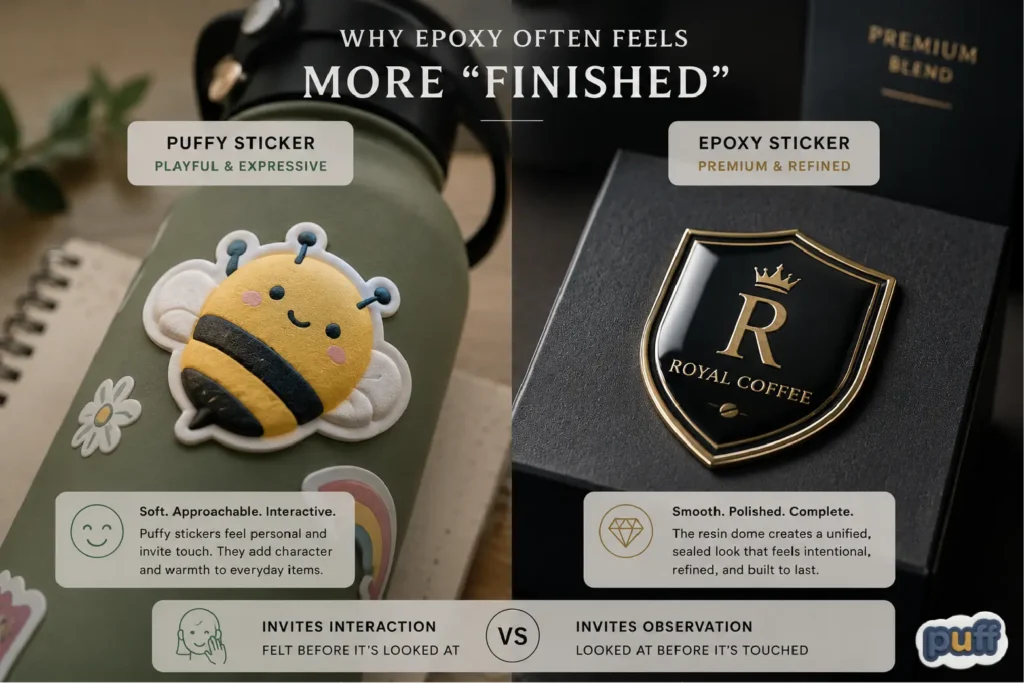
From playful stationery to premium brand labels, select the 3D finish that best represents your brand identity.
Why epoxy often feels more “finished”
There’s a reason resin domes are often described as premium.
The surface creates closure.
A puffy sticker still feels like layers sitting on top of each other. You remain aware of the foam, the print, and the softness beneath the surface.
Epoxy visually unifies everything.
The dome smooths transitions. Edges soften beneath the resin. The design appears embedded rather than applied.
That changes how the object is read psychologically.
Instead of feeling assembled, it feels completed.
And completion carries emotional weight.
People trust objects that appear resolved. A sealed surface feels intentional because it suggests the design has reached its final form.
Nothing feels exposed.
Nothing feels unfinished.
The difference between interaction and observation
Puffy stickers encourage interaction.
Epoxy stickers encourage observation.
That distinction sounds subtle, but it changes how the object exists in space.
Soft foam invites touch because touch changes the experience slightly. The material responds back. There’s participation.
Epoxy creates distance.
Not coldness – but separation. The surface remains unchanged no matter how it’s viewed or handled. The experience becomes more visual than tactile.
One material asks to be pressed.
The other asks to be looked at.
This is why epoxy often feels cleaner and more formal, while puffy feels more playful and emotional.
The difference isn’t only physical.
It’s behavioral.
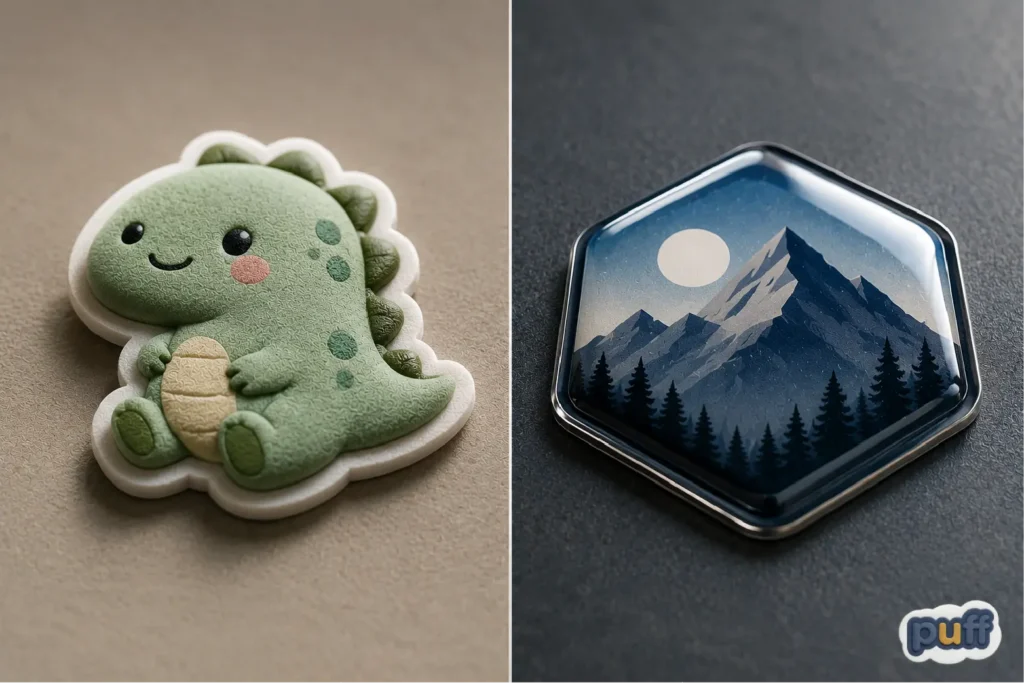
Elevated Aesthetics: Exploring the unique textures of matte custom foam and crystal-clear epoxy resin.
Why “raised” is not enough to describe material
People often group all dimensional stickers together.
Raised equals raised.
But depth alone doesn’t define experience.
A surface can rise softly or rigidly.
It can absorb light or reflect it sharply.
It can invite touch or resist it.
The emotional meaning of dimension changes depending on how that dimension behaves.
This is why material choice matters even when the design itself remains identical.
The surface changes interpretation before content has time to.
And once that interpretation forms, it becomes difficult to separate it from the object itself.
Not all depth feels the same
Puffy and epoxy stickers may both create dimension, but they create completely different experiences of depth.
One feels soft enough to respond.
The other feels smooth enough to preserve.
One creates interaction through touch.
The other creates precision through reflection.
And somewhere between those two surfaces, perception shifts.
Not dramatically.
Not consciously.
But enough to change how the entire object is remembered.