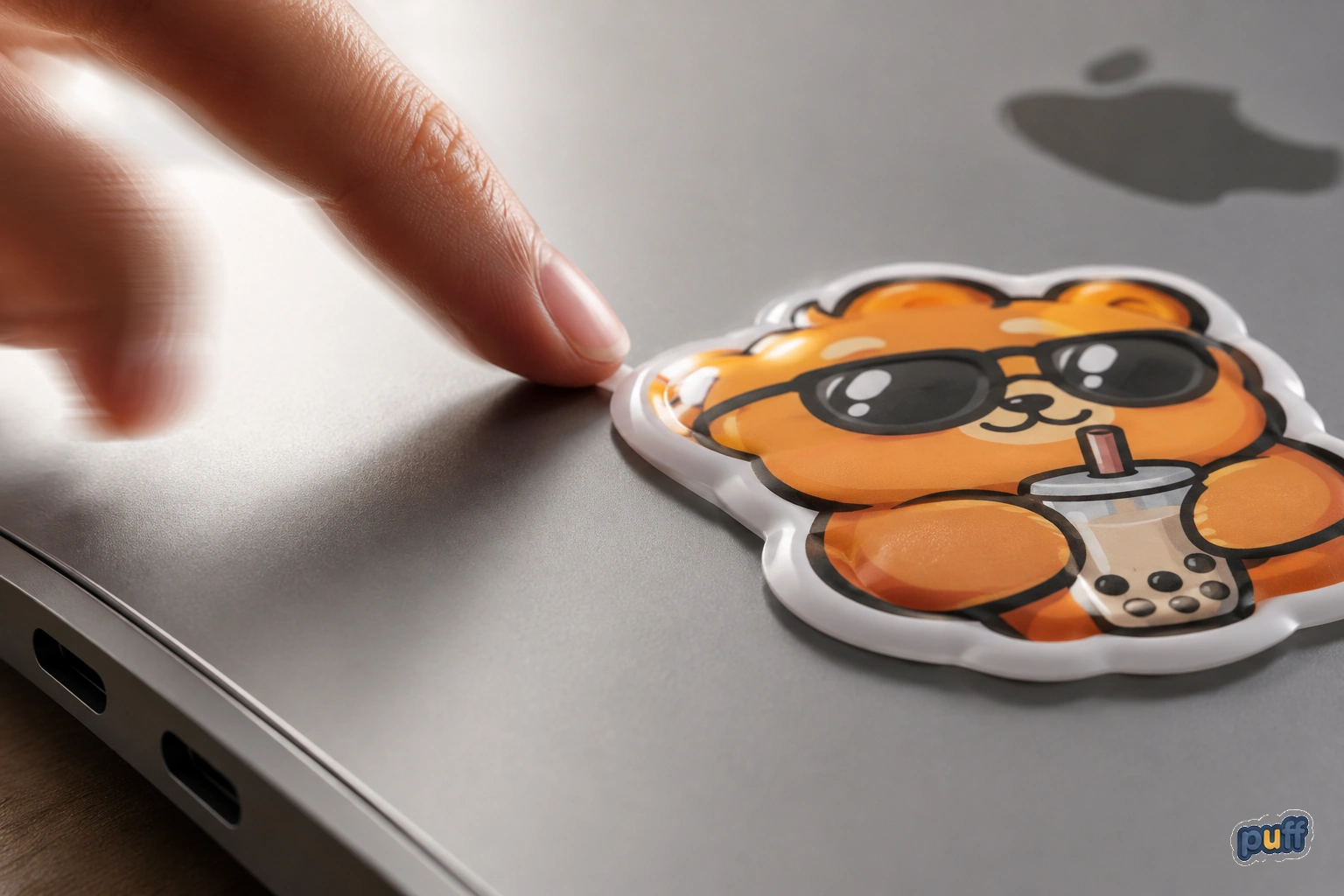
A package arrives on the desk, and before the return address has been fully read, a thumb has already found the raised sticker in the corner and started moving back and forth across it. Nobody decided to do this. The hand simply went.
That gap, the space between seeing something raised and reaching for it, is smaller than a blink. Vision catches the edge of a custom sticker, a small circuit somewhere behind the eyes fires, and skin makes contact before conscious thought has caught up enough to explain why. This is not curiosity in the usual sense. Curiosity implies a pause, a question, a decision to go find out. What happens here has none of that pause. It looks more like a reflex, the kind that moves the body first and asks permission afterward.
Most writing about tactile packaging treats touch as a preference, something people happen to enjoy once they notice it. That framing misses the stranger and more useful part. The reach itself, the automatic drift of a hand toward a raised edge, is not a preference at all. It behaves more like a wiring pattern, one that a raised custom sticker seems to trigger with unusual reliability, in strangers who have never seen the product before and have no reason to expect anything worth touching.
Long before language, touch was how anyone learned whether the world could be trusted. Infants explore new objects mouth first, then hand first, patting and pressing to build a working sense of what is solid, what gives, what is safe. That early habit never fully retires. Adults still run a faster, quieter version of it every time a hand meets an unfamiliar surface, checking without meaning to.
Understanding why takes a closer look at what a raised surface promises the eye, well before it ever reaches the hand.
The Hand Moves Before the Mind Decides
In the 1970s, the psychologist James Gibson proposed something that ran against how perception had been described for decades. People do not first see a neutral shape and then work out, step by step, what to do with it. They see possibilities directly. A chair looks sit-on-able. A door handle looks grip-able. Gibson called these built-in possibilities affordances, and the idea changed how psychologists think about the basic job of eyesight. Vision was never just a camera collecting flat images and handing them off for analysis later. It was always scanning for what a surface lets the body do next.
A flat printed label affords very little. The eye reads it, takes in the color and the words, and moves on, because there is nothing else for a hand to do with it. A raised sticker offers something else entirely. Its edge catches light differently than the flat surface surrounding it, and the shadow it throws tells the eye there is height here, something with an edge to press against. That shadow alone can be enough to prime the hand before a single conscious thought has formed. The instruction is written in light, not language, and the visual system hands it straight to the motor system without waiting for the mind to sign off.
Designers who work with light know this instinctively, even without naming it Gibson’s theory. A subtle bevel, a slightly raised edge, a soft highlight along a curved surface, these are small visual promises before they are anything else. A puffy or dome sticker is not simply printed with a different technique. It is printed with a different set of instructions for the eye, ones that end with a hand doing something.
This is why a raised sticker on a laptop lid gets touched by people who have never seen one before and have no memory or expectation attached to it. The reflex does not need history to work. It only needs a surface that visibly breaks the plane it sits on.
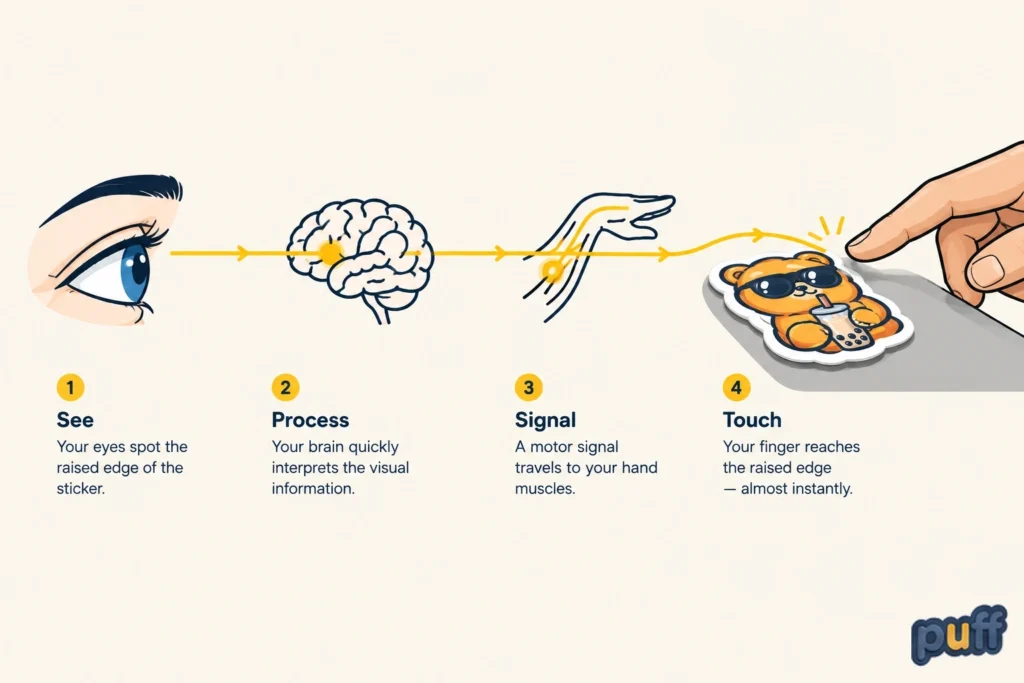
Illustrated infographic showing how the eye detects a raised puffy sticker, processes the information, and guides a hand to touch the sticker almost instantly.
Two Kinds of Touching
Not all touching does the same job. Researchers who study how hands gather information about objects, among them Roberta Klatzky, have shown that people reach for distinct, almost ritualized movements depending on what they are trying to learn. To judge texture, the hand moves side to side across a surface. To judge shape, fingers trace along an outline. To judge firmness, the hand presses straight down and waits to feel how much give there is. Each movement has a name in the research and a specific job, and the body reaches for the right one without ever being told which one to use.
A puffy or embossed sticker invites more of these movements in sequence than a flat one ever could. Fingers slide across it once to check the texture, press briefly to test how much it gives, then sometimes trace the raised edge to confirm exactly where the shape begins and ends. A flat sticker offers a single signal and the exploring stops there. A raised one offers something closer to a short exchange between the surface and the hand.
Picture two versions of the same logo sticker sitting side by side on a shelf, one flat, one raised into a small dome. Both show identical colors and artwork under the same light. Only one gets picked up, usually without the person noticing they have done it. The raised version supplies a target for the hand’s default checking behavior. The flat one gives the hand nothing to check, so it simply keeps moving past, the way an eye skips over wallpaper.
There is also a real difference between touching to learn something and touching simply because it feels good. The first kind ends the moment the question is answered. The second kind lingers well past the point of necessity, the way a thumb keeps circling a smooth stone in a pocket long after there is nothing left to discover about it. Puffy and embossed stickers tend to produce both, one right after the other. The hand checks first, out of that old information-gathering habit, and then stays a moment longer simply because the surface feels pleasant to hold.
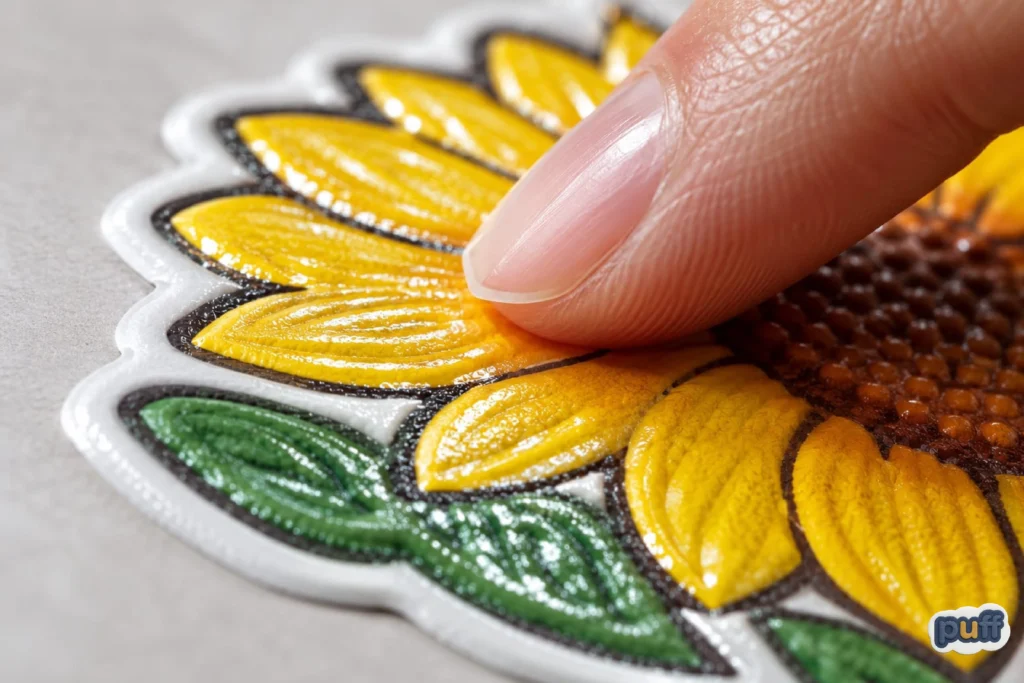
Extreme macro view of a sunflower puffy sticker showing embossed petals, glossy finish, and raised tactile details under fingertip contact.
Touch as a Shortcut to Trust
Screens have made looking cheap. Almost anything can now be seen from a dozen angles in a photograph before it ever exists in front of a real hand. That has quietly raised the value of the opposite experience. A raised surface, a texture that resists the flatness of a phone screen, carries a kind of proof a photograph cannot fully deliver. People tend to trust what their hands confirm more than what their eyes alone report, even when they would never put it in those words.
There is an old saying that seeing is believing, but older instincts disagree. Long before photographs existed, people confirmed a coin’s worth by biting it, tested fruit by pressing a thumb into the skin, judged fabric by rubbing it between two fingers. Sight offered information. Touch offered proof. That hierarchy has not gone away. It has only gotten quieter, buried under a century of packaging designed to be looked at rather than held.
This shows up in small, ordinary behavior nobody thinks twice about. Someone comparing two nearly identical products on a shelf will often pick both up, not to check the price but because picking things up is simply how a hand decides whether something feels solid and well made. A sticker with real dimension gives an object that confirmation instantly, without a single word of copy. It tells the hand this is really here before the mind has finished sorting out what it is even looking at.
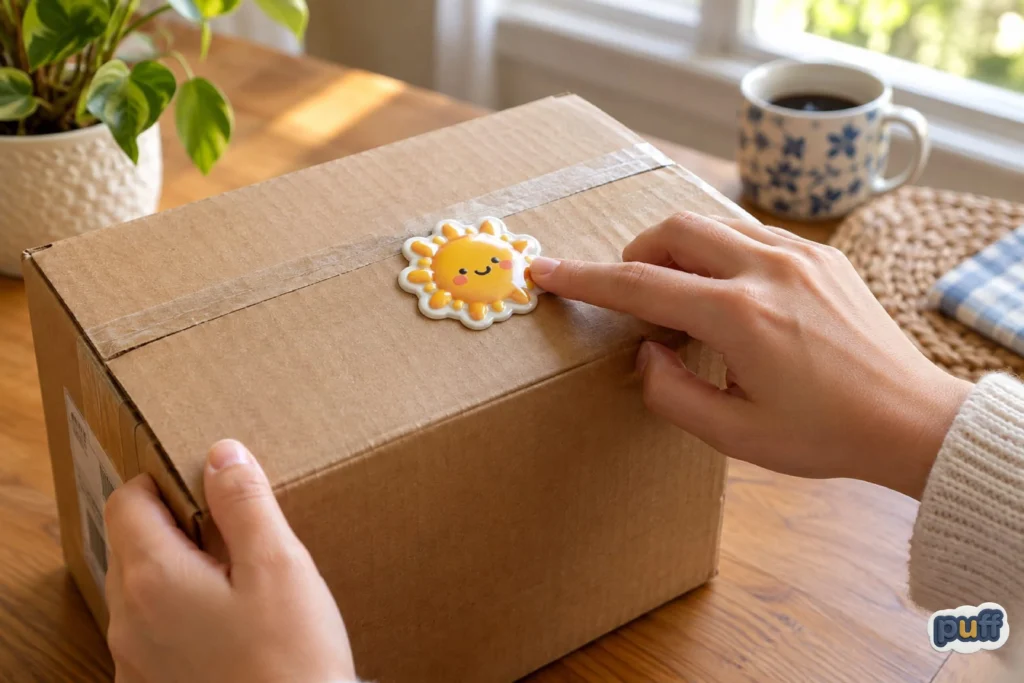
A cheerful sun-shaped puffy sticker decorates and seals a cardboard shipping box, adding a playful branded touch to the unboxing experience.
The Sticker That Answers Before You Ask
This is the quiet advantage of building the reflex into a product rather than leaving it to chance. A custom puffy sticker placed where a hand naturally lands, the corner of a box, the edge of a laptop, the side of a water bottle, does not need to ask for attention. The raised surface does the asking on its own, the moment light catches it. Anyone who has watched a stranger’s thumb drift toward a sticker without the person even looking down has watched this reflex play out in real time.
On a shipping box, the effect compounds. The average customer has opened enough anonymous cardboard mailers to stop looking closely at any of them. A raised sticker breaks that pattern instantly, the way an unexpected texture underfoot makes a person glance down mid stride. The hand notices the mismatch before the eyes finish reading the label, and that noticing is the whole point.
The earlier piece on why some custom stickers feel like objects looked at the sense of ownership that follows once something crosses over from image into object. This is the mechanism underneath that shift, the actual motion that gets it started. Before an object can feel like it belongs to someone, a hand has to reach for it first, and that reach happens faster than the feeling it eventually produces.
The same idea explains why flat and raised stickers set side by side pull attention so differently, even when the printed artwork underneath is identical. For a fraction of a second, the eye treats them the same. The hand never does.

Dimensional puffy stickers displayed on a laptop, insulated water bottle, and journal, illustrating versatile everyday branding and personalization applications.
None of this requires a brand or a customer to understand affordance theory or exploratory hand movements for it to work. The reflex fires whether or not anyone could explain it, which is exactly what makes it valuable and also easy to overlook. A raised custom sticker is doing real work in the half second before a person has formed any opinion about a product or a package. That is not a small thing to have happening in the corner of a label.
A Reflex, Not a Decision
What the reflex ultimately reveals is a small, easily missed truth about how people come to believe something is real. Not through the eyes first, however much modern life insists otherwise, but through the hand, which reaches before it is asked and reports back before the mind has finished looking. A raised surface does not wait for permission. Somewhere between the seeing and the understanding, the hand has already found it.
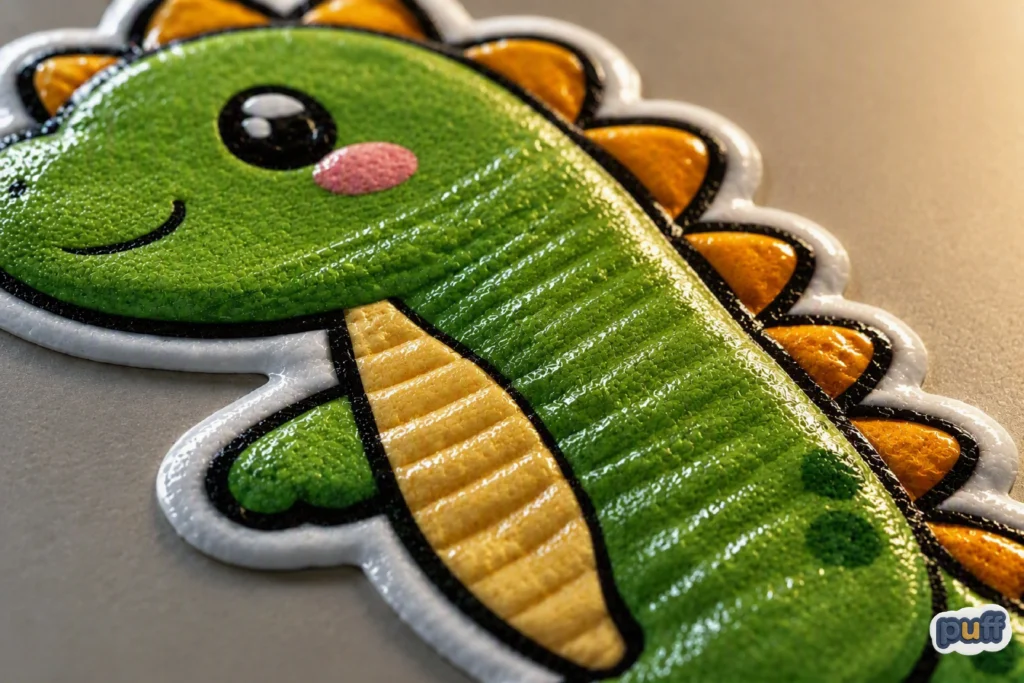
Extreme close-up of a dinosaur-shaped puffy sticker revealing glossy raised contours, textured surfaces, and vibrant dimensional printing.