Before the Color Appears
At first glance, it looks like color.
But the moment you try to hold it still, it disappears.
You tilt the surface slightly, and everything shifts. Blues slide into greens. Greens fracture into pinks. Something metallic turns almost liquid, then disappears before you can hold onto it.
You try to stabilize it.
To pause it in a single state.
To see it clearly, the way you see everything else.
But it doesn’t cooperate.
The color doesn’t stay long enough to belong anywhere.
It appears only when something changes – angle, light, position.
It exists briefly.
Then it’s gone.
There’s something strange about that.
We’re used to surfaces behaving consistently. Giving us something stable to recognize, something we can return to and find unchanged.
This doesn’t.
It behaves less like an object, more like an event.
A Surface That Won’t Settle
Most materials are predictable.
A color is chosen.
A finish is applied.
A surface behaves the same way every time you look at it.
You learn it once, and that’s enough.
Holographic surfaces don’t allow that.
They don’t settle into a single identity.
They don’t offer one version to understand.
Instead, they shift continuously – quietly, subtly, but persistently.
A slight tilt alters everything.
A small change in light reshapes the entire surface.
What you’re looking at never fully becomes fixed.
And because it never stabilizes, it never becomes familiar in the usual way.
Color as Something That Happens
In holographic stickers, color isn’t applied – it emerges from the interaction of light with structured surfaces, where reflection and diffraction create shifting outcomes rather than stable ones.
We tend to think of color as something that exists on a surface.
Something applied.
Something stored.
Something repeatable.
You can point to it. Name it. Reproduce it.
Holographic color doesn’t behave like that.
It isn’t applied to the material.
It’s produced by it.
Light hits the surface and is redirected in complex ways – bent, split, reflected across microscopic structures.
What you see is not a property.
It’s a result.
A temporary outcome of light interacting with the surface at a specific moment.
Change the angle, and the outcome changes.
Change the light, and it changes again.
The color isn’t fixed.
It’s conditional.
And that changes how you relate to it.
You’re not observing something stable.
You’re witnessing something that’s happening.
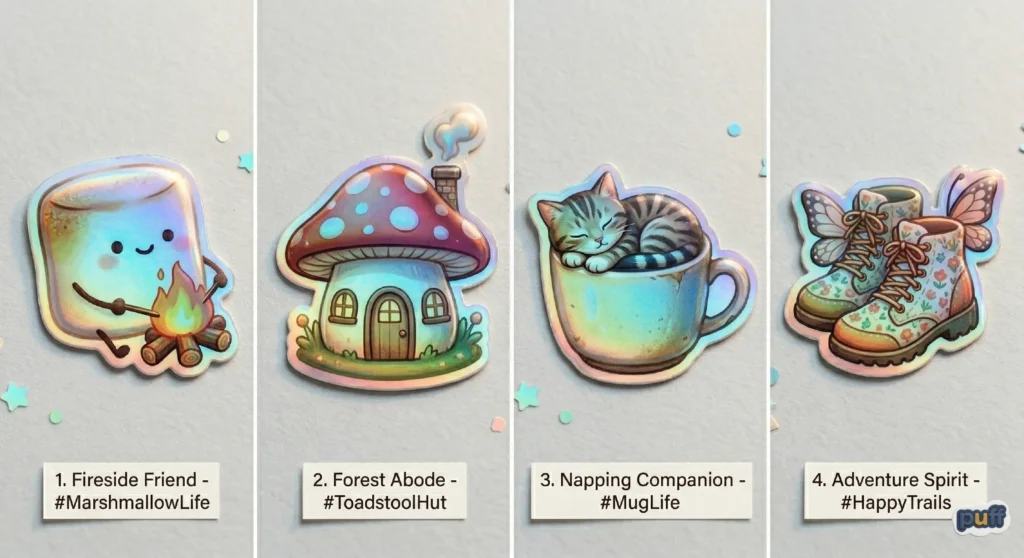
From toasted marshmallow friends to napping teacup kittens, our Little Comforts series brings the warmth. The holographic prism effect adds a dreamlike glow to these ultra-thick, raised stickers. Perfect for your “me-time” journal.
The Surface Isn’t Doing One Thing
Most surfaces have a clear role.
They display.
They present information in a controlled, stable way.
Holographic surfaces do not commit to a single function.
They reflect.
They scatter.
They fragment.
They recombine.
And they do all of this simultaneously.
There isn’t one image to look at.
There are multiple, layered outcomes depending on how you engage with it.
The surface doesn’t show you something.
It generates something.
The Illusion of Depth
What feels like depth isn’t actually there – it’s something the brain constructs from changing light patterns, interpreting variation as distance even when the surface remains flat.
At some point, the surface stops feeling flat.
Not because it changes physically.
But because it behaves as if it has depth.
Light moves across it in layers.
Colors seem to exist at different distances.
Shifts in angle suggest something happening beneath the surface.
The brain tries to interpret this.
It assumes structure.
It assumes layers.
It assumes depth.
But there is none.
It’s completely flat.
And yet, it refuses to feel that way.
That contradiction – flat but not perceived as flat – creates a tension.
Something that shouldn’t be there, but is.
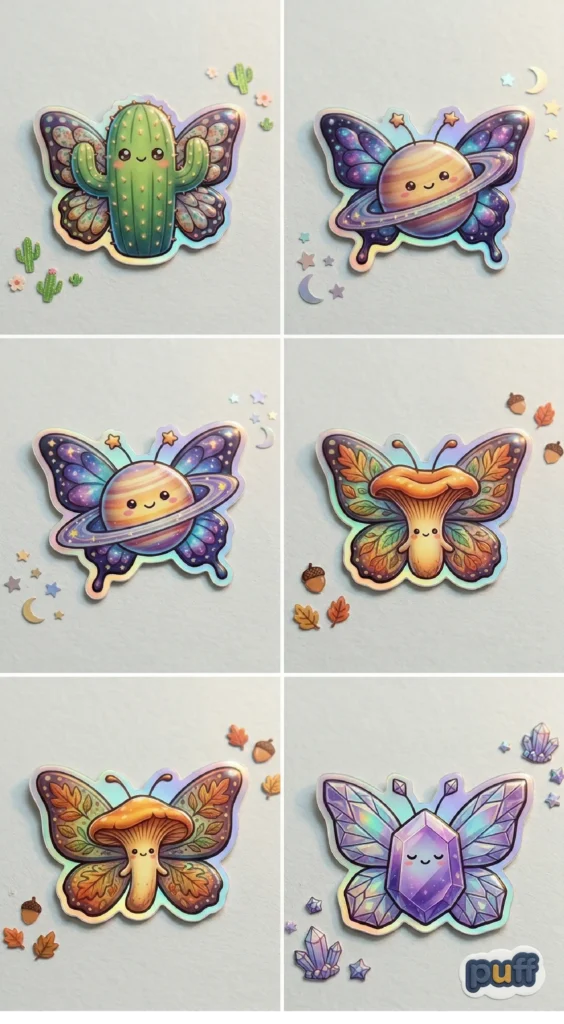
Where nature meets the nebula. Whether it’s a cactus-winged beauty or a crystal-bodied flyer, these hybrid butterflies bring a surreal, 3D pop to your gear. High-shine, high-texture, and 100% unique to Puff.
Why It Holds Attention
Most surfaces are easy to process.
You look once, understand what you’re seeing, and move on.
Holographic surfaces interrupt that pattern.
You look, and something changes.
You adjust, and it changes again.
There is no final state to settle into.
The brain keeps trying to simplify what it sees.
To reduce it to something stable.
But it can’t.
And that unresolved state holds attention.
You don’t keep looking because it’s clear.
You keep looking because it isn’t.
Movement Becomes Part of the Experience
Interaction doesn’t stay visual for long – it becomes physical, shaped by surfaces that invite contact and change the way we relate to design through raised, tactile feedback.
With most objects, you don’t need to move.
You can stand still and understand what you’re looking at.
Holographic surfaces require participation.
To see them fully, you have to interact.
Tilt it.
Turn it.
Shift your position relative to it.
Without movement, you only see a fragment.
The rest remains hidden.
The design doesn’t exist in a single frame.
It unfolds.
Over time. Through motion. Through interaction.
A Material That Doesn’t Repeat
Even if the material is identical, the experience never repeats exactly.
Because the conditions never repeat.
Light shifts throughout the day.
Angles change with every movement.
Context changes constantly.
And with that, the surface changes too.
You can’t memorize it.
You can’t reduce it to a single image.
You don’t remember what it looked like.
You remember how it behaved.
That becomes the identity.
Between Control and Uncertainty
Design is usually about control.
Precision.
Consistency.
Predictability.
Holographic sticker materials introduce something else – Uncertainty.
You can design the base structure.
But you can’t fully control the final experience.
Because it depends on variables outside your control:
Light.
Movement.
Position.
This creates a different kind of design outcome.
Part intentional.
Part reactive.
Part fixed.
Part fluid.
Something that is not entirely authored.
Something that is partially discovered.
Unlike most surfaces, this isn’t something you fully control. You can design the base, but the final outcome depends on light, position, and movement – things that exist outside the design itself.
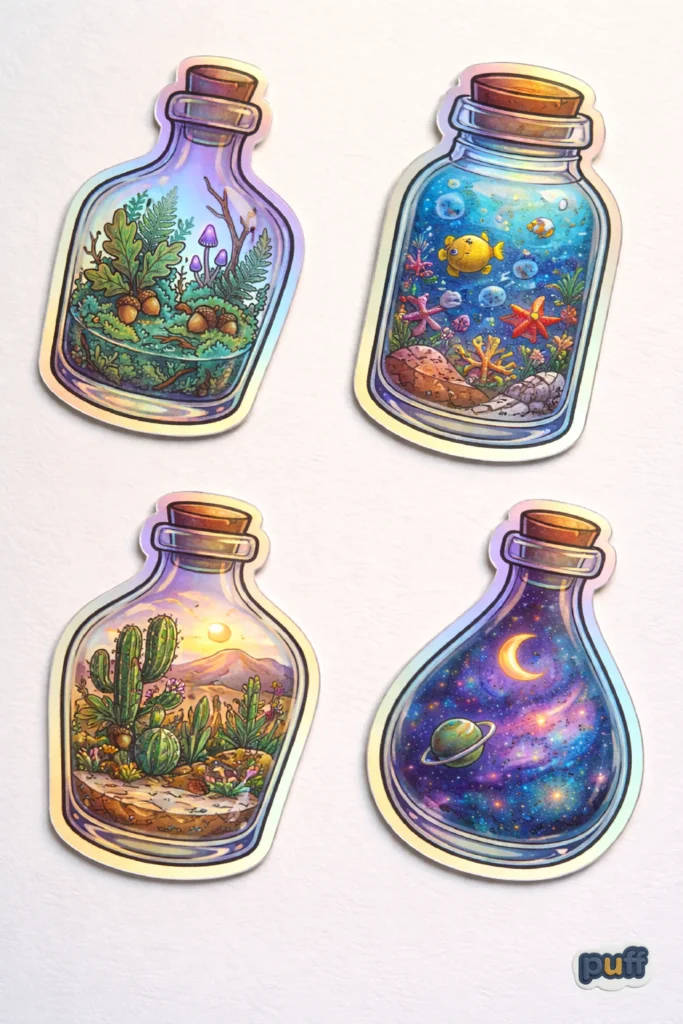
Choose your ecosystem: a mossy forest floor, a deep-sea reef, a desert sunset, or a slice of the nebula. Each bottle features a premium 3D “puff” and an oil-slick holographic finish that shifts as you move. Which world are you taking home?
Why It Feels Alive
There’s a reason holographic surfaces feel almost alive.
Not because they are.
But because they respond.
You move – they change.
You adjust – they react.
There’s a feedback loop.
Even though nothing is actively responding, it feels like something is.
Because the surface never stays passive.
It continuously reacts to interaction.
And that reaction creates the illusion of activity.
Recognition Without Stability
With most materials, recognition comes from consistency.
You see something once, and you know what it is.
Holographic surfaces reverse that.
You recognize them not because they stay the same – but because they don’t.
The constant shift becomes the defining feature.
The instability becomes the pattern.
You don’t recognize a fixed version.
You recognize the behavior.
Some materials are recognized in a similar way – not by staying consistent, but by the way they reveal themselves through interaction, especially in how they respond through sound and movement.
Light Is the Actual Medium
Without light, none of this exists.
The surface becomes flat.
Muted.
Unremarkable.
Everything you perceive depends on illumination.
Light isn’t separate from the material.
It is part of it.
Without light, there is no color.
Without light, there is no effect.
Without light, the surface becomes something else entirely.
What Cannot Be Captured
Holographic materials don’t translate well into images.
Photos flatten them.
They capture a single state that was never meant to be singular.
What you experience in real life is continuous.
Always shifting.
Always changing.
Always dependent on interaction.
A photograph shows one moment.
The material exists across many.
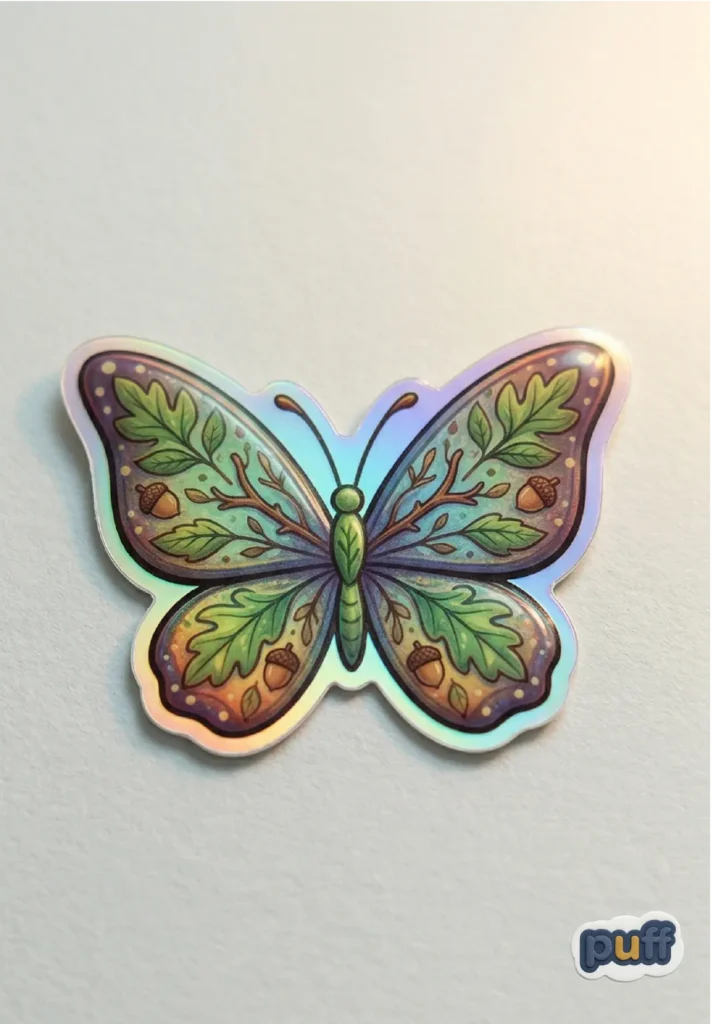
The intricate detail of an oak leaf meets the elegance of a butterfly in our signature 3D holographic vinyl. Notice the way the light catches the “acorn” accents? A true collector’s piece for the forest-obsessed.
You Have to Engage With It
You can’t fully understand it by looking from a distance.
You have to interact.
Move it.
Tilt it.
Let the light change across it.
Only then does it begin to reveal itself.
Not all at once.
In fragments.
Each slightly different.
Each dependent on the moment.
It Doesn’t Belong to One Version
Most surfaces exist in one state.
What you see now is what you’ll see again.
Holographic surfaces don’t belong to one version.
They exist across variations.
Each interaction creates a new outcome.
There is no final image.
No stable form.
Only shifting possibilities.
You Don’t Just Observe – You Participate
This changes the role of the viewer.
You’re not passive.
You’re part of the experience.
Your movement matters.
Your position matters.
Your interaction changes what exists.
The surface isn’t complete without that interaction.
It depends on it.
And Then It Disappears
You tilt it slightly.
And what you saw a moment ago is gone.
Replaced by something else.
You can try to return to it.
But it won’t be the same.
Because it never was fixed.
The color wasn’t stored.
It was created.
In that moment.
And like all moments –
it passed.
You’re not seeing color.
You’re seeing a moment that only exists because you’re there.